Get Full Government Meeting Transcripts, Videos, & Alerts Forever!
Get email alerts on the Fire Budget topic
No spam. Unsubscribe anytime.
Fire chief outlines FY2027 staffing, ambulance revenue and health-screening proposals
Summary
Fire Chief Bridal Driscoll told the council the department handled about 7,338 responses last year and is proposing overtime and personnel investments in FY2027, including four added firefighters tied to expanded Rollinsford ambulance response and funding for occupational health screening (NFPA-style physicals and cancer screening).
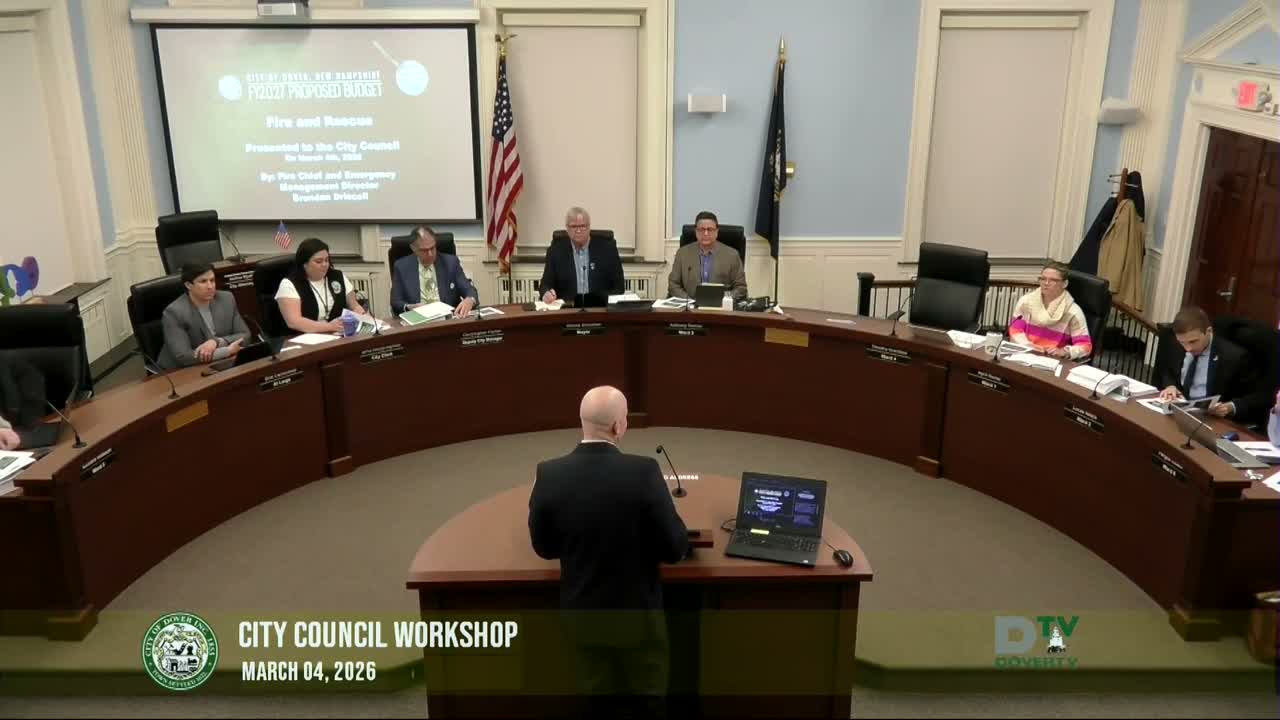
Fire Chief Bridal Driscoll presented the Dover Fire & Rescue FY2027 budget at the March 4 workshop, detailing operations, call volume and proposed personnel and equipment spending.
Driscoll said the department operates from three stations with 17 on-shift personnel per day, and reported 7,338 total responses last year — roughly 20 calls per day — including 4,910 emergency medical service calls and 107 fire calls. She said the service has seen a leveling of incident volume after a COVID-linked dip and now projects the same general range in coming years.
The chief said Dover assumed ambulance-response duties for neighboring Rollinsford late last year and added four personnel (one per shift) to support that contract; she estimated the salaries and benefits for those four firefighters at about $400,000. Projected ambulance revenue for the next fiscal year was presented at roughly $2,249,000, with an additional $200,000 expected from Rollinsford response.
Driscoll highlighted occupational health upgrades in the proposed budget, including NFPA-style physical exams and cancer screening protocols to identify job-related health risks early. She noted the department is replacing PFAS-containing uniforms with PFAS-free gear and pursuing post-fire decontamination practices.
Councilors asked about acceptable response times, future station siting as new development increases call volume in the southern part of town, overtime drivers and whether higher overtime indicates understaffing. Driscoll said an operational target is about four minutes from tone to arrival and that overtime patterns are driven partly by availability and by keeping shift coverage when members volunteer or are needed for specialized roles.
Councilors also pressed for more granular financial tracking of ambulance revenue vs. the cost of added staffing; Driscoll said ambulance billing and call-volume trends show increases but acknowledged budget-year phasing can complicate year-over-year comparisons.
The presentation did not result in a formal vote; budget decisions will be made through the standard review process and public hearings.