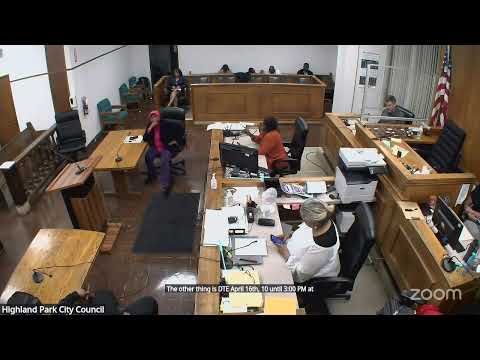
Highland Park council approves up to $3 million bond for sewer repairs amid push for wider maintenance plan
Loading...
Summary
The Highland Park City Council approved a resolution authorizing up to $3 million in capital improvement bonds to fund initial sewer repairs focused on District 1. Council members pressed staff for maps, maintenance plans and clearer timelines for Districts 2 and 3 while staff said state rating rules determine initial eligibility.
Highland Park’s City Council voted to authorize up to $3 million in capital improvement bonds to begin sewer repairs, approving a bond-resolution that staff said would be sold to the Michigan Finance Authority and financed through the State Revolving Fund program.
The council’s authorization covers sewer work the city describes as about 1.5 miles of combined sewer replacement, roughly 3 miles of cured-in-place lining and replacement of 47 manhole and catch-basin covers. Ron Liscum of Miller Canfield told the council the financing would be at a historically low rate — about 1% — over a 30‑year amortization and that the state disperses reimbursement proceeds as project costs are incurred.
The vote followed extended questioning about why the initial scope identified locations concentrated in District 1. One council member said the resolution’s language that the council “deems it necessary” should be softened and urged that work be spread more evenly across neighborhoods, citing repeated basement flooding at 312 Pilgrim as an example of need. A water/wastewater official replied that the state scoring of pipe structural integrity — not popularity or density — determines which segments qualify first for SRF funding and that District 1 currently shows the worst ratings.
Staff told the council that the $3 million would be a phased start and that preventive maintenance could be pursued in other districts while structural work proceeds. The official proposed bringing back a map and a maintenance scope to the council for a separate workshop, and estimated preventive maintenance at roughly $300,000–$500,000 a year to clean and TV portions of the system on a rotation.
Finance and rate impacts were discussed: staff stated the draft budget as presented assumes the debt service and that no immediate rate increase is included in the current draft. Liscum said approximately $540,000 of the $3 million is principal forgiveness through the SRF program, reducing net principal to about $2.4 million; staff estimated interest over 30 years at roughly $391,000.
The council approved the bond resolution and the clerk announced the motion carried. Next steps staff outlined: finalize project maps and scope, pursue bids for contracted maintenance work as needed, hold a workshop to present costs and map-based options to council, then follow the public hearing and final approval steps required under the city’s budget process.