Get Full Government Meeting Transcripts, Videos, & Alerts Forever!
Get email alerts on the Capital Improvements topic
No spam. Unsubscribe anytime.
Dover outlines six-year capital plan; staff warn adoption could raise tax rate by 90¢
Summary
Deputy City Manager Christopher Parker presented the proposed six-year Capital Improvements Program to the Dover City Council and Planning Board on Oct. 15, 2025, highlighting a projected 90¢ tax-rate increase if fully adopted and calling out major projects including a $33 million Broadway reconstruction and emergency recreation-court repairs. Planning-board review and council hearings are scheduled before anticipated votes in November and December.
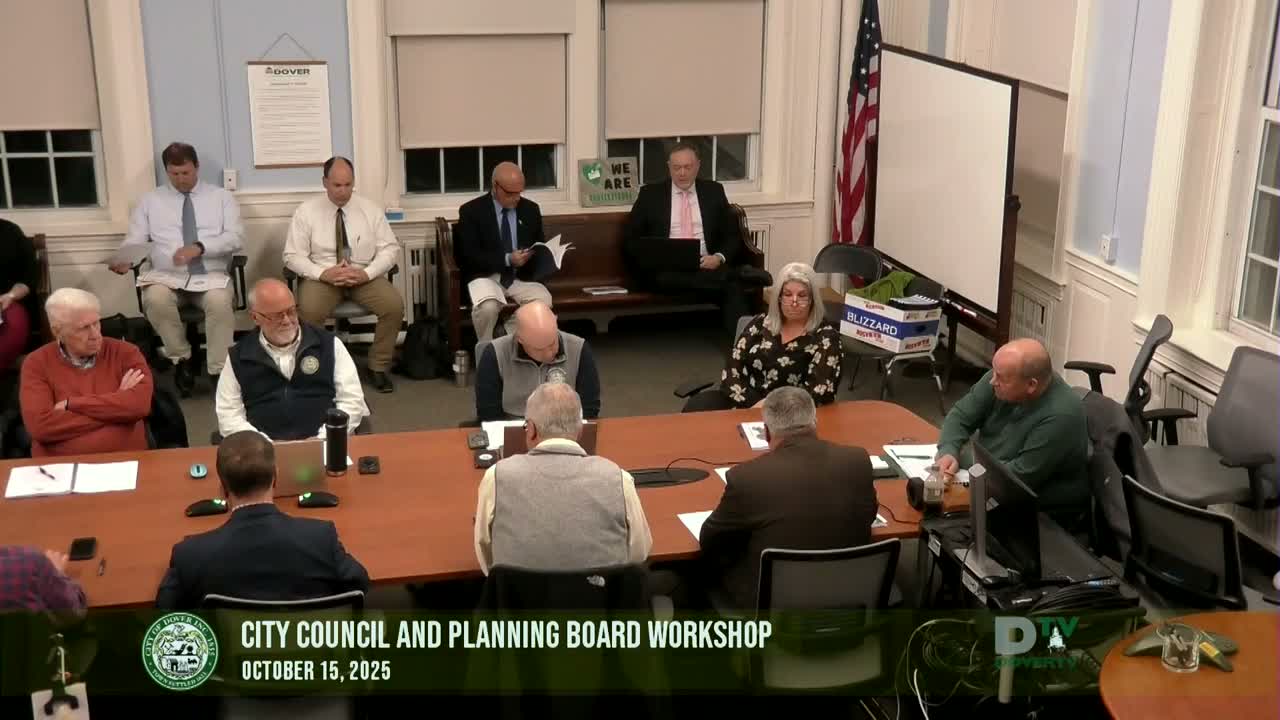
The Dover City Council and Planning Board received a detailed briefing on the proposed six-year Capital Improvements Program on Oct. 15, 2025. Deputy City Manager Christopher Parker, presenting for the capital improvements committee, said the plan maps major infrastructure investments and funding sources for fiscal years 2027–2032.
Parker said the CIP is intended to capture capital needs (projects costing at least $25,000 with an expected lifespan of three years or more) and explained funding tools ranging from operating-budget allocations and capital reserves to debt financing for projects $250,000 or larger. "If you adopted it, there would be a 90¢ increase in the tax rate," Parker said when summarizing the fiscal-impact analysis.
Why it matters: The CIP will guide the city’s capital spending and feed into next year’s operating-budget decisions; adopting the full program affects debt levels and taxpayer costs. Parker said the fiscal-impact table shows the combined city-and-school adoption would result in that tax-rate increase unless other changes are made.
Staff highlighted several large and time-sensitive projects. On streetwork, Parker called particular attention to a multi-year Broadway reconstruction, saying, "This is $33,000,000 we are investing in this 1 neighborhood," and described the project’s scale across streets, drainage, water and sewer systems. He also noted the Dover Point Road/Point Place roundabout has returned to the project list after prior removal for cost reasons, and that recreation-court reconstruction is being treated as an emergency project split over two years to allow efficient completion: "This project, which will be split over 2 years, so that, they can be done in an efficient manner, is a emergency style project."
Council members pressed staff on several items. A council member asked whether Shaw’s Lane parking — listed as a schedule change and shown in year six — could be advanced because of safety concerns at school drop-off; staff said construction estimates exceed $1,000,000 and said they plan to coordinate with the school department on design and timing. On downtown pedestrian work, staff recounted that earlier estimates around $12 million rose above $30 million after reengagement with the city’s design engineer; in short-term bidding, Parker said the city had budgeted $175,000 but received bids of nearly $500,000 for three intersections, and the city plans to proceed where affordable.
On environmental and utility items, a council member raised the absence of a PFAS treatment plant at the landfill and asked where PFAS treatment is occurring; the City Manager said the city has submitted design plans to the EPA but is awaiting the agency’s response.
Staff also reviewed financial detail pages, authorized-but-unissued debt tables, and reserve-account projections; Parker said the CIP book includes project sheets with scope and costing and that removed projects (for example, the Conchico incubator) appear in a separate section. He said the plan’s three resolutions — the overall project list, the non-debt-funded portion, and authorization to bond — will appear on the council agenda next week and that the Planning Board will start its public hearing and deliberations before the council acts. Parker noted the document will be available at the library, online, and at the clerk’s and planning offices and urged councilors to request staff as needed for follow-up meetings or workshops.
What’s next: The Planning Board will review and hold its public hearing in November; council hearings and a final council vote are expected during the November–December cycle, with staff indicating the council could vote on the program at its last December meeting. No formal council action or vote occurred during the Oct. 15 presentation.
Reporting note: Quotes and attributions are taken from the meeting transcript and are attributed to the speakers who made them.