Get AI Briefings, Transcripts & Alerts on Local & National Government Meetings — Forever.
Ann Arbor board hears $20.4 million recovery plan; trustees schedule special meeting amid public outcry
Loading...
Summary
Interim Superintendent Jazz Parks presented a comprehensive $20.4 million budget‑recovery package that would reduce about 141.5 staff positions, eliminate elementary world language outside IB schools and reconfigure specials to include Project Lead the Way; trustees scheduled a special meeting to consider final action after extensive public comment from teachers, paraeducators and parents.
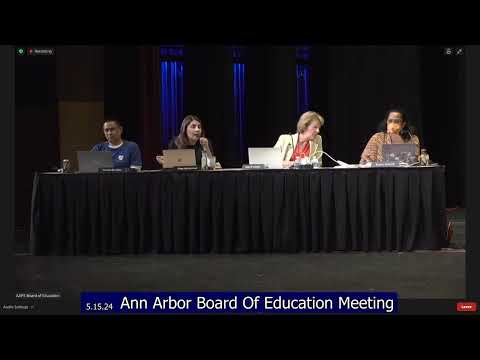
The Ann Arbor Public Schools Board on May 15 heard a comprehensive budget plan from interim Superintendent Jazz Parks that recommends about $20.4 million in reductions to address a projected shortfall for fiscal 2024‑25.
Parks told trustees the district faces three structural pressures — declining enrollment, higher operating costs and more staff — and presented a package that attempts to limit harm to core student programs while producing planned savings. "We have tried to keep reductions as far away from the student experience as possible," Parks said, summarizing the guiding principles behind the recommendations.
Key elements of the plan include moving Project Lead the Way (PLTW) into the elementary specials rotation so students keep five electives while trimming some FTE (estimated efficiency: about $1.2 million); eliminating elementary world language outside of International Baccalaureate (IB) elementary schools (estimated savings: about $400,000); reducing some co‑teacher allocations in high‑school band and orchestra programs (about $222,000); consolidating IB coordinator roles at the elementary level (about $525,000); closing or reducing some middle‑school pool programming where lifeguard staffing and health‑department issues exist (estimated savings: $520,000 plus repair costs); and vendor/software reductions of about $3.9 million. The district also proposed eliminating a low‑enrollment A2 virtual elementary program (8 students) and sunsetting or reworking other smaller offerings.
On staffing, Parks and finance staff presented an estimate of 141.5 total position reductions (about 6% of staffing) representing roughly $14.7 million in salary/benefit savings, supplemented by vendor and one‑time savings to reach the $20.4 million figure. Finance staff described scenarios showing the district’s current fund balance at roughly $6.3 million (about 2% of revenues). Under baseline assumptions without reductions, the district could run a deficit next year; the recommended reductions move the fund balance toward the 5% level required by Michigan’s early‑warning framework over a multi‑year horizon.
District finance director (presenter identified in meeting as Mr. Demetrio) walked trustees through the modeling and assumptions, noting differences between Treasury’s modeling (which uses audited historical years) and the district’s more current projections. "These decisions for 24‑25 need to be made now," he said, adding that the recommended package would improve the fund balance trajectory but still leave a gap to the board’s policy target that the district will need to close in the next year.
Human resources staff outlined a voluntary severance letter of agreement negotiated with union leaders that provides tiered payments for eligible staff with at least 10 years’ service, with deadlines for notices (staff must notify HR by June 1 for participation and resign/retire effective between June 14 and Aug. 16). HR also described the layoff and recall process, which relies on evaluation effectiveness, discipline records, seniority and certification; impacted staff notifications and union exchanges are scheduled under the timelines presented.
Board discussion centered on two questions: whether to vote on the plan at the meeting or allow time for deeper review and public digestion, and whether program changes such as eliminating elementary world language should be restored. Several trustees urged an immediate vote to give staff clarity; others asked for more school‑level impact data before committing. The board ultimately voted to schedule a special meeting on Monday to continue consideration.
The board took several related votes at the meeting on consent items and to schedule a June public hearing on the 2024‑25 general‑fund budget. Trustees also approved a tutoring contract (Delta Math RTI via K‑12 Connect) after questioning about pedagogical fit and vendor vetting.
What comes next: HR and administration will continue to refine lists for potential reductions and implement the voluntary separation timeline if adopted; the board will reconvene at the special meeting to decide whether to adopt the package or modify it. Parks recommended the board vote on a plan so staff receive timely notification, but trustees left open the possibility of adjustments before final approval.
The board scheduled a special meeting to consider the plan further and to receive any updated analysis, with public comment included. The administration said it would continue to seek revenue options such as property sales and legislative advocacy while implementing the voluntary severance program in partnership with bargaining units.