Lifetime Citizen Portal Access — AI Briefings, Alerts & Unlimited Follows
Joint committee hears testimony on H.5279 to fund roads, bridges and MBTA rail upgrades
Loading...
Summary
The Joint Committee on Bonding heard administration and municipal testimony on H.5279, which would authorize multi‑year Chapter 90 funding, MBTA rail modernization, and new programs (PRISM, FAIR, LAMP). Witnesses described program details and financing; members asked about local bridge needs, criteria and bond structure.
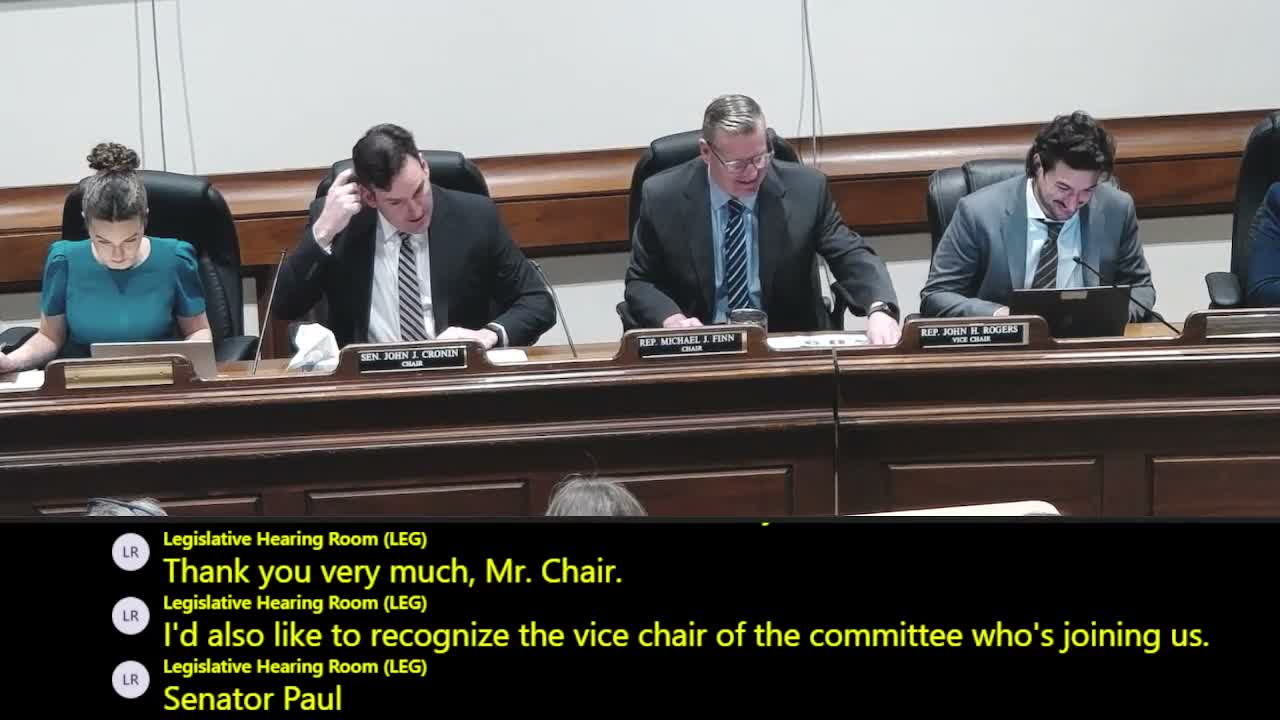
The Joint Committee on Bonding, Capital Expenditures and State Assets heard testimony on House Bill H.5279, a proposed bonding package to finance long‑term improvements to municipal roads and bridges, MBTA rail reliability, and related transportation programs. Chair State Senator John Cronin and co‑chair Michael Finn convened the public hearing and heard agency and municipal representatives outline program specifics and financing mechanics.
Massachusetts Department of Transportation Undersecretary Samantha Silverberg told the committee the administration supports a multi‑year approach and tied H.5279 to the Healey‑Driscoll administration's broader transportation investment plan. "These resources will be directed to cities and towns to borrow through Chapter 90," Silverberg said, and she asked the committee to consider a four‑year authorization to allow municipalities to plan capital projects more efficiently. Silverberg said the bill as filed "proposes more than $5,000,000,000 in bond authorizations" and described a suite of investments spanning roads, sidewalks, safety features and transit.
Cassandra Gaskin, chief of municipal aid and partnerships in MassDOT's highway division, provided line‑item detail for programs funded under the Chapter 90 authorization. She said the bill would sustain Chapter 90 at $300 million annually, with $200 million distributed through the traditional formula (road miles, employment and population) and $100 million allocated by local road mileage to better serve rural communities. Gaskin also described reauthorizations and new or accelerated programs the bill would enable: a $65 million municipal pavement program reauthorization, $12 million for the shared streets and spaces program, $500 million for the Life cycle Asset Management Program (LAMP) to accelerate statewide road and bridge improvements, and a new FAIR program to fund municipally owned bridges that are closed or load‑posted.
Jennifer Sullivan of the Executive Office for Administration and Finance outlined the financing approach, saying the administration plans to leverage Commonwealth Transportation Fund (CTF) capacity and, where appropriate, issue special obligation and sustainability bonds. Sullivan noted CTF bonds currently carry AAA ratings and said that permissive language in the bill would allow the treasurer and finance teams to select the most efficient debt instrument when the state goes to market.
Committee members pressed witnesses on several operational and local‑impact questions. Representative Paulino asked how many bridges statewide need repair and whether the bill addresses local priorities; MassDOT said it would provide an inventory to the member's office and pointed to LAMP and FAIR as targeted tools for state and municipally owned bridges. Members asked whether the $2.3 billion federal‑aid authorization reflects the state share; Sullivan explained the bill lists total project costs (including anticipated federal reimbursement) while bonding authorizations are sized to the state's expected match (roughly 20%).
Members also asked how the $200 million earmarked to support housing‑related transportation needs would be prioritized. Silverberg and Sullivan said the program is intentionally flexible—eligible uses could include roadway improvements, sidewalks, traffic signalization, bike or transit enhancements—and is not restricted to MBTA communities, so smaller or rural towns could also access funds that unlock housing. On procurement, MassDOT said recently delayed Red and Orange Line vehicles from CRRC are en route to Springfield and that future vehicle procurements would consider multiple U.S. builders.
Local government advocates urged prompt action. Dave Kaufman, senior executive and legislative director of the Massachusetts Municipal Association, and Violet Gehr, the association's legislative analyst, emphasized that timing matters for construction season and that the $100 million lane‑miles allocation helps rural municipalities. "Authorizing this $300,000,000 now allows municipalities to move forward with maintenance that saves taxpayers money in the long run," Gehr said.
The hearing concluded after questions and there was no committee vote on H.5279 at the session's end. Chair Cronin moved to adjourn and the committee recessed after recording testimony and public remarks.
What happens next: The hearing record will be available to the committee as it considers amendments and whether to report H.5279 out of committee; no formal vote or committee recommendation was taken at the adjournment.