Get Full Government Meeting Transcripts, Videos, & Alerts Forever!
Get email alerts on the Zoning Text Amendments topic
No spam. Unsubscribe anytime.
Committee approves three zoning text amendments to expand housing and biohealth eligibility
Summary
The committee unanimously approved ZTA 26‑02 (regional shopping centers), ZTA 26‑03 (biohealth priority campuses) and ZTA 26‑04 (mixed‑income housing eligibility) with technical and planning‑recommended amendments to lower thresholds and broaden eligible project types, each passing 3‑0.
The Planning, Housing and Parks Committee voted unanimously March 9 to advance three zoning text amendments intended to increase development flexibility for housing and biohealth projects.
ZTA 26‑02 (Regional Shopping Centers): Presented by Miss McCartney Green, the amendment removes a 30% cap on household living uses in RSC overlay zones and applies that flexibility to additional household types, including single‑family, multiunit and townhomes, provided a regional shopping center retains at least 600,000 square feet of gross leasable area. Staff and council clarified a technical correction so the threshold refers to gross leasable floor area rather than gross floor area. The committee approved the ZTA as amended (vote 3‑0).
ZTA 26‑03 (Biohealth priority campus): Staff described lowering the new‑construction threshold from 150,000 to 100,000 square feet, lowering the existing/grouped building threshold from 50,000 to 25,000 square feet, and adding eligibility for adaptive reuse of 100,000 square feet. Planning recommended approval and the climate assessment flagged only minor building‑related emissions impacts; the committee approved the amendment as amended (vote 3‑0).
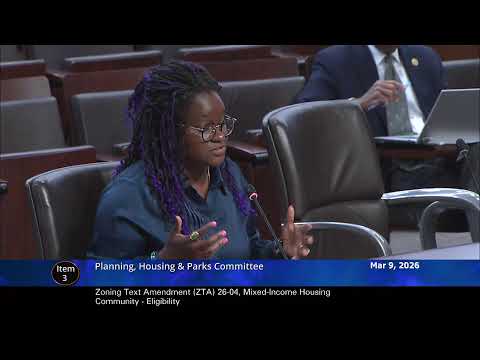
ZTA 26‑04 (Mixed income housing community eligibility): This amendment eliminates the 150,000 square‑foot minimum and instead raises the minimum dwelling units from 30 to 50, while expanding eligibility to include projects using 4% low‑income housing tax credits in addition to 9% credits. Planning estimated the change could allow 2–3 additional projects to qualify annually. The committee approved the amendment as amended (vote 3‑0).
Why it matters: Committee members framed the package as a way to speed permitting and expand the pool of projects that can access expedited review, adaptive reuse, and incentives, with potential cost savings illustrated by a past project that estimated nearly $8 million in savings from expedited review. Sponsors said the changes aim to keep Montgomery County competitive for biohealth and affordable housing investments.
Votes at a glance: Each zoning text amendment passed unanimously in committee with recorded voice consensus of 3‑0.
Next steps: The measures proceed to the full council for further consideration according to the council’s legislative schedule.