Lifetime Citizen Portal Access — AI Briefings, Alerts & Unlimited Follows
Committee presses to defend Wheaton funding, approves standalone CIP item for Johnson’s Local Park
Loading...
Summary
At a March 9 Planning, Housing and Parks Committee meeting, parks officials warned cuts would imperil a state $5.5 million grant for Wheaton Regional Park and tax credits tied to a solar initiative; the committee agreed to create a standalone CIP PDF for Johnson’s Local Park and asked staff for tiered operational‑impact analyses.
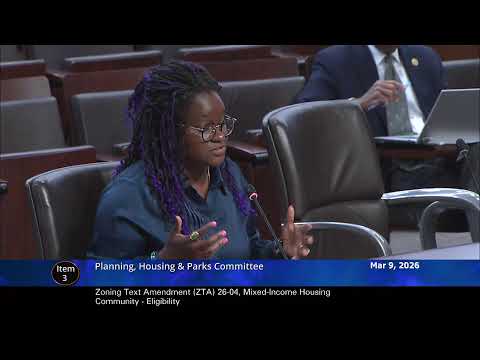
Chair Friesen convened the Planning, Housing and Parks Committee on March 9 to review the Parks Department’s capital requests and the county executive’s affordability proposal, pressing staff for operational impacts if funding is not fully restored.
Mitty Figueredo, the parks director, told the committee the department requested increased general obligation (GO) bond support for Wheaton Regional Park, $4 million a year to replace lost Program Open Space funding, $1 million for a restroom at the Wheaton Action Sports Park, $2.4 million in geo bond funding for a five‑year solar initiative, $3 million in current revenue for the Pilar maintenance program, and $1.8 million for natural surface trails repairs. Figueredo warned that without the Wheaton GO bond funding the Wheaton Action Sports Park could not proceed and that $5.5 million in state capital grant funding already secured would be put at risk. Figueredo also said the first two years of the solar request (400,000 per year in FY27 and FY28) leverage federal tax credits that are sunsetting and would be lost without prompt funding.
Why it matters: Council members — led by Council President Fana Gonzalez — urged protecting Wheaton Regional Park as a long‑standing regional commitment. Gonzalez said, “Do not touch Wheaton Regional Park,” and emphasized its regional importance to the Washington, D.C. area. Multiple members said they historically defend the parks CIP and asked staff not to accept early cuts without context.
What the committee asked for: Members asked parks staff to produce a tiered operational impact analysis that breaks down what would be lost at different funding‑restoration levels. Chair Friesen framed the requested product as a decision tool: if the council cannot fully restore funding, staff should specify which projects or credits would be preserved and which would be cut (for example, whether prioritizing program open space for Wheaton could preserve state grant leverage even if the solar initiative is delayed). Parks staff agreed to provide the analysis and to distinguish scalable items (such as some trail work) from discrete projects that cannot be partially funded.
Johnson’s Local Park: The committee agreed to create a standalone CIP project (PDF) for Johnson’s Local Park and to explore multiple funding sources. Parks staff said the project has expanded beyond a typical park refresher and likely needs an additional $2.5 million to reach the broader scope now envisioned; producing a ~30% facility plan would yield a more precise cost estimate. Staff noted geo bond eligibility is typically limited to countywide/regional parks and that local‑park funding often comes from other sources, so the committee directed staff to review eligibility and alternative funding (M‑NCPPC bonds, state aid, current revenue).
Other technical updates: The committee noted an MOU that transfers operational responsibility for several parkway corridors (Sligo Creek Parkway, Beach Drive, Little Falls Parkway) to the parks department; that change shifts duties, not new funding.
Next steps: Parks staff will produce the requested operational‑impact breakdown, including the tax‑credit implications for the $800,000 in solar funding across the first two years (staff estimated the tax credit value at roughly 30% of that two‑year amount, about $240,000). The council will revisit funding choices as the county’s current‑revenue picture clarifies (staff said current‑revenue decisions remain pending as of March 15).