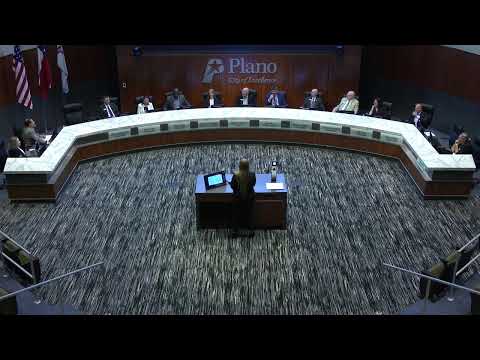
Commission denies developer’s mid‑rise planned development; staff had warned of sewer and access gaps
Loading...
Summary
After staff recommended denial, the commission denied two related planned development requests (items 2a and 2b) for mid‑rise residential buildings in the Legacy/Spring Creek corridor, citing inconsistencies with the comprehensive plan, missing sewer capacity analysis, unresolved access agreements, and an incomplete PD submittal; votes recorded 6–1 with one abstention.
The Plano Planning and Zoning Commission voted Tuesday to deny two related requests from Trumont Group (items 2a and 2b) that would have allowed mid‑rise residential development in a Commercial Employment district near Spring Creek Parkway and the Dallas North Tollway.
Molly Coria, the city’s lead planner, told commissioners staff recommended denial because the request runs counter to the comprehensive plan’s employment‑center designation, lacked required design elements for a mixed‑use environment, and did not include a wastewater capacity study. Coria said staff had asked for a sewer capacity study and noted there “may not be adequate sewer capacity to serve the proposed development.”
Griffin Neal of Trumont Group presented the applicant’s case and asked the commission to table the requests so outstanding technical issues could be resolved; Neal said the ownership was willing to deed‑restrict part of the 13‑acre concept site to employment uses and stressed the project’s proximity to DART and adjacent mixed‑use developments.
Commissioners questioned phasing (whether a high‑rise or office component should be developed first), whether access agreements with neighboring parcels could be secured, and whether revamping the site piecemeal could create unintended outcomes. Multiple commissioners said the submittal was incomplete. Commissioner Bronski moved to deny item 2a following staff recommendation; the motion carried 6–1 with one abstention. The commission then denied item 2b by the same margin.
In debate, Commissioner Brunoff urged denial without prejudice, saying the applicant should return with a more complete and coordinated plan rather than expect the commission to fill in core design elements. Staff and several commissioners emphasized that, even if some technical fixes were possible, the request did not meet many of the city’s mixed‑use and street‑network expectations for the area.
The denials mean the applicant must either substantially revise and refile or seek alternative approaches; staff recommended that, if the applicant wishes to return, it should provide a wastewater capacity study, a concrete access strategy and a more complete open‑space and street‑network plan to address mixed‑use design standards.