Get Full Government Meeting Transcripts, Videos, & Alerts Forever!
Get email alerts on the Ev Legislation topic
No spam. Unsubscribe anytime.
Lawmakers expand direct sales and fund used‑EV rebates; council flags budget and CCA changes
Summary
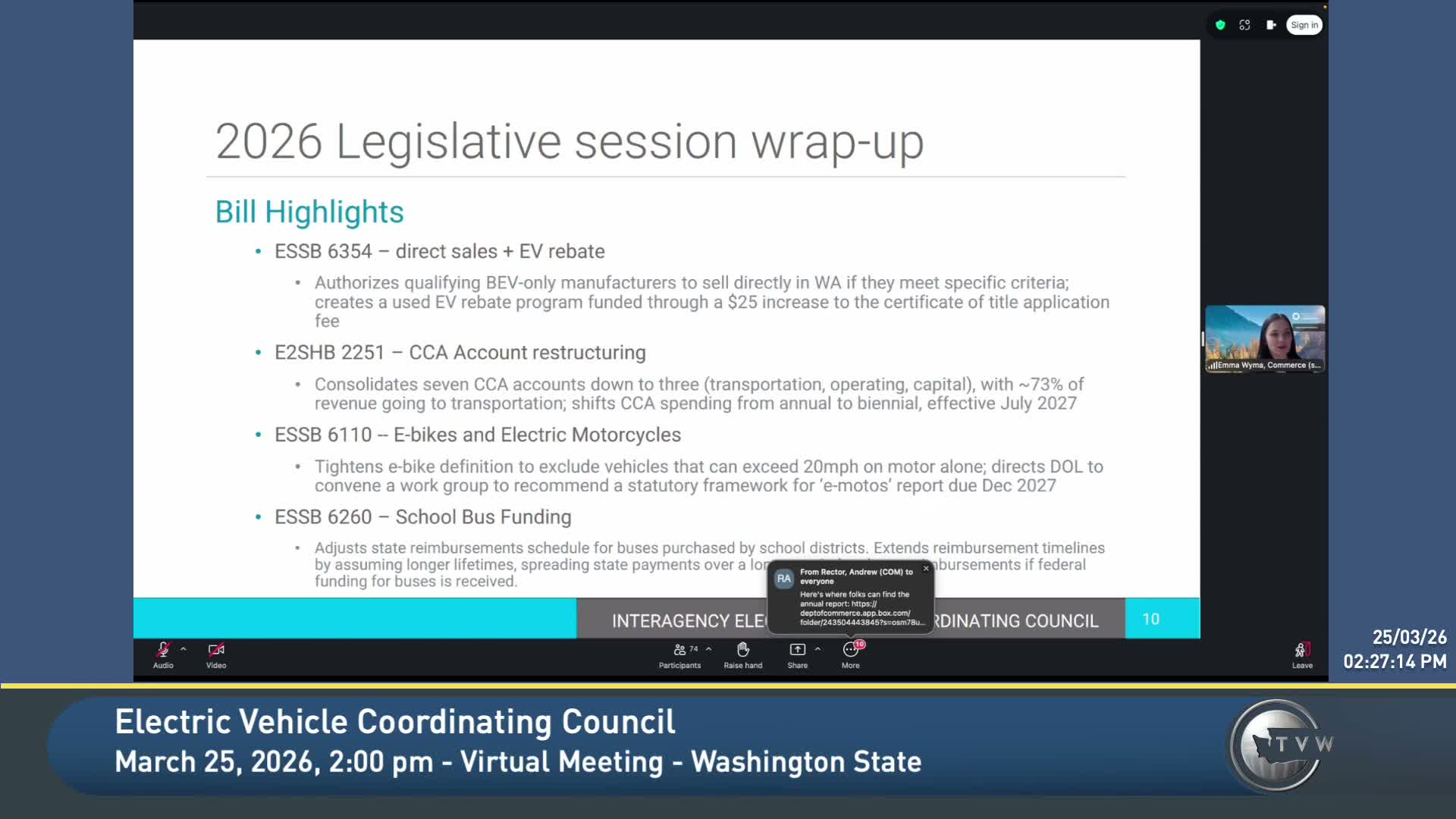
Commerce staff told the EV Council that Senate Bill 6354 now lets additional EV‑only manufacturers sell directly to Washington drivers, and the session created a used‑EV rebate funded by a $25 title fee increase; council staff noted broader budget constraints and Climate Commitment Act account restructuring.
Commerce policy staff summarized the most consequential outcomes from the recently concluded legislative session for EV programs and budgets.
Emma, an energy policy specialist at Commerce, said Senate Bill 6354, signed by the governor the day before the council meeting, "will expand direct sales access for EV‑only manufacturers." Under the new law, Rivian and Lucid meet the criteria and will be allowed to sell directly to Washington drivers, rather than through franchised auto dealers.
Emma also described the new used‑EV rebate: "This is only gonna be for used electric vehicles, and that's funded through its own mechanism by a $25 increase to certificate of title application fees," she said. Commerce staff said a $5 million appropriation will support an instant rebate program to restart, but the implementation timeline is still to be determined.
Council staff highlighted broader budget context: the session was a short (non‑budget) year operating under a state deficit, and many proposals for new EV funding lacked appetite. Emma noted a bill that consolidated Climate Commitment Act accounts (from seven to three) and shifted some spending from annual to biennial rhythms, and that legislation will take effect next year.
Council members asked about implications for school districts and bus funding. Ecology staff (Josh) said roughly $14 million is available for zero‑emission school buses (applications open Feb. 12–Apr. 23) and that payment schedules in an enacted bill spread depreciation payments over a longer life of the vehicle; he cautioned agencies are still working out interpretation and implementation.
Commerce staff also flagged a $13 million additional appropriation for the Washington Electric Vehicle Charging Program (Wave CP) from CCA capital funds and said that, given long project backlogs, Commerce is likely to proceed down existing applicant lists by score order while determining award mechanics.
The session outcome is primarily implementation‑oriented: staff will return with timelines and program rules as they are developed and as the governor signs appropriation bills into law.
The council will discuss implementation details at upcoming meetings.