Get Full Government Meeting Transcripts, Videos, & Alerts Forever!
Get email alerts on the Municipal Governance topic
No spam. Unsubscribe anytime.
Council tables ordinance to require extra council approval for professional service contracts
Summary
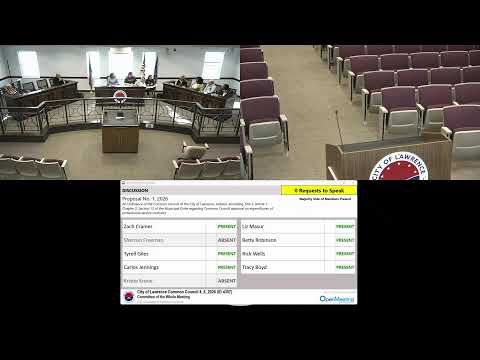
The Lawrence City committee of the whole debated Proposal 1 20 26 — an ordinance to require common council approval of certain professional service contract expenditures — and voted 6–1 to table the measure after members and counsel raised questions about scope, enforceability and a $5,000 threshold.
The Lawrence City committee of the whole voted 6–1 to table Proposal 1 20 26, an ordinance that would amend Title 1, Article 1, Chapter 2, Section 12 of the municipal code to require the common council to approve expenditures of professional service contracts before payment.
Members spent most of the discussion probing who sponsored the proposal, what precise changes it would make compared with last year's draft, and whether the council had the legal or practical tools to enforce the new requirement. Councilor Wells asked, "Why are we doing this? ... what is the need to be doing this when proposal 2 apparently didn't work?" and pressed for clarity about intent and consequences if the ordinance was not followed.
A committee member said the administration and corporation counsel, Miss Finley, had concerns about the draft language and specifically "they're specifically worried about that $5,000. They think it should be more than that." The committee member said counsel would try to provide a list of existing contracts between $5,000 and $50,000 so the council could assess the likely workload and impact.
The finance chair, speaking from experience with prior oversight efforts, cautioned the measure might create confusion without changing outcomes. "It's kind of a poke, not a shift," the finance chair said, arguing that past use of similar provisions had often resulted in bills being paid shortly afterward and limited practical effect. He also described an example in which a local landscaper was left unpaid after work approved by the Board of Public Works, saying the council later paid the bill — a factual anecdote offered to illustrate the ordinance's intended purpose of protecting small vendors.
Councilors also debated the separation of authority with the Board of Public Works and whether proposed language would require Board-approved contracts to come before the council prior to payment. Multiple members said that specific wording had not been included in the prior draft and that courts had not yet tested similar ordinances in other Indiana municipalities.
After discussion, Councilor James moved to table the proposal and a second was given. The council then held a roll-call vote and the chair stated the motion to table passed 6–1. No final changes to Proposal 1 20 26 were adopted at the meeting; members asked for further legal review and for a contract list from corporation counsel to guide next steps.
The committee adjourned following the vote.