Get Full Government Meeting Transcripts, Videos, & Alerts Forever!
Get email alerts on the Agriculture topic
No spam. Unsubscribe anytime.
Committee reviews work plan, requests more analysis of agricultural income test and economic supports
Summary
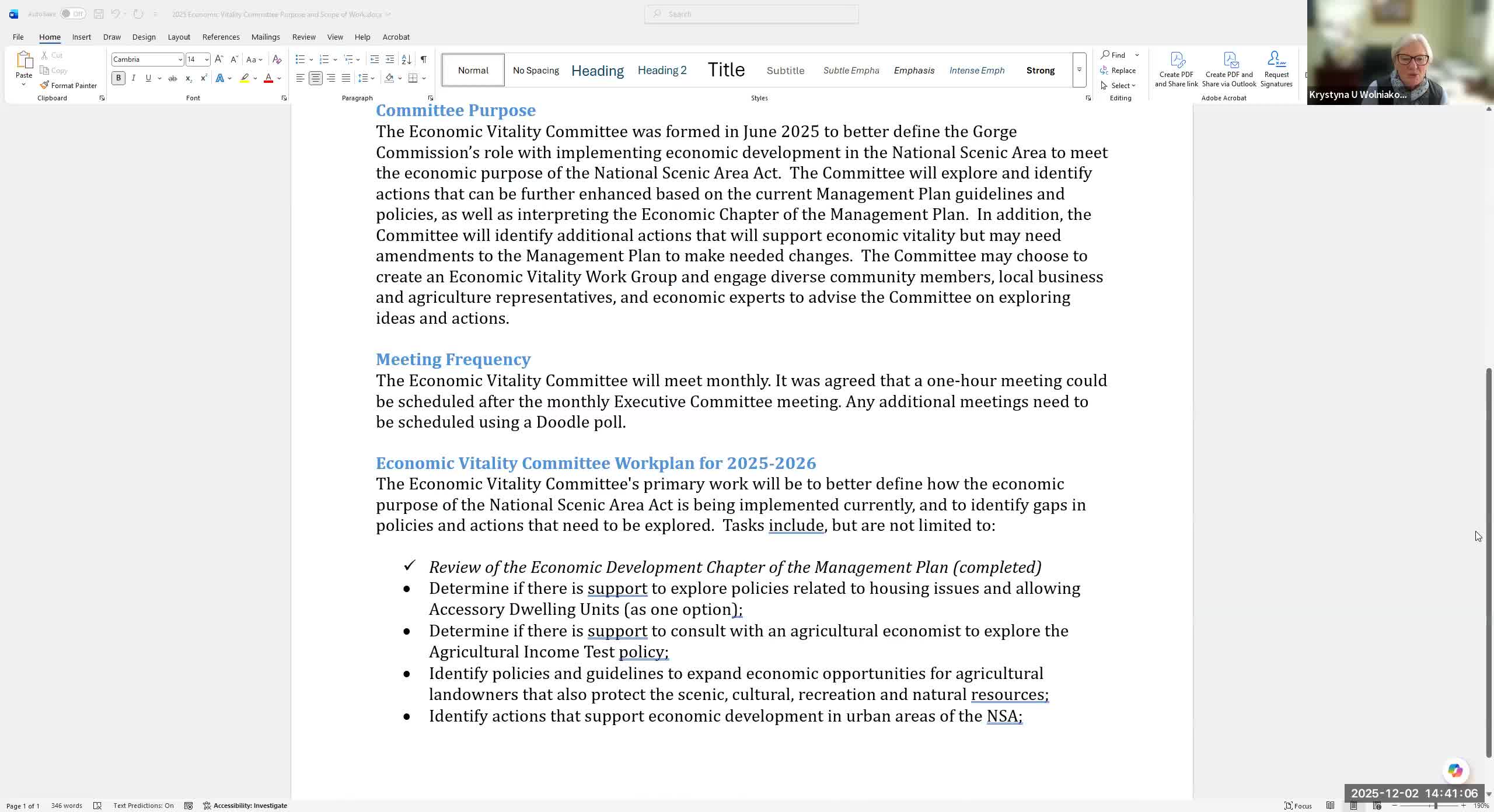
The committee reviewed its work plan items—inventorying large-scale agricultural parcels, evaluating the agricultural income test with external experts, and exploring non-regulatory economic supports for urban areas—and asked staff to return with more data and recommendations at the next meeting.
Committee staff reviewed the Economic Vitality Committee’s work plan and described preparatory steps already taken on agriculture-related items.
Christina told commissioners that GIS staff are compiling counts of large-scale agricultural tax lots and structures across the six counties in the Scenic Area and that the commission has consulted Oregon State University Extension to identify gross-income benchmarks for different crops by county. The proposed agricultural income test in the management plan is modeled on Oregon’s test, and staff said they are considering whether that income threshold is realistic and trackable.
Commissioners discussed whether to hire or consult an agricultural economist to validate the income test and how to prioritize that work relative to ADU analysis. Staff also described planned outreach and a PowerPoint presentation on what the commission changed in the last management plan review to support agriculture.
The committee agreed to keep the work plan as-is, incorporate staff follow-up on the agricultural income test, and revisit prioritization once the ADU analysis is available. Christina noted staff are balancing other tasks including a pending rulemaking, disaster-recovery work, and preparation for the Dec. 16 commission meeting.
No formal policy changes were adopted; the committee set scheduling expectations and asked staff to prepare legal standards and an estimated scope of work for items the committee may prioritize.