Get Full Government Meeting Transcripts, Videos, & Alerts Forever!
Get email alerts on the Adus topic
No spam. Unsubscribe anytime.
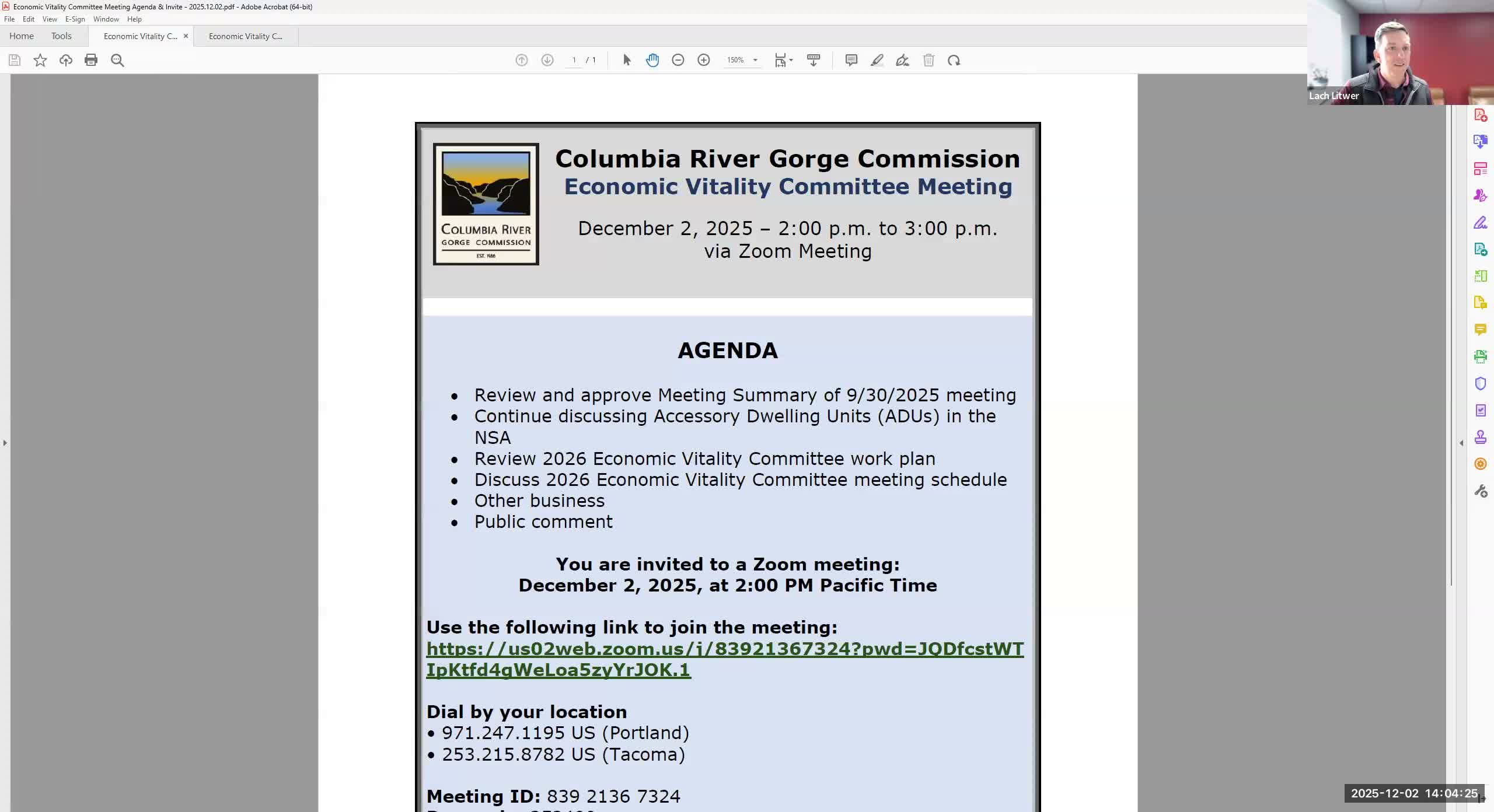
Economic Vitality Committee asks staff to analyze whether ADUs belong in the National Scenic Area
Summary
The Columbia River Gorge Commission Economic Vitality Committee asked staff to analyze whether allowing accessory dwelling units (ADUs) in specific land-use designations warrants a midterm plan amendment or should be deferred to the next full plan review; staff cautioned the legal standard and limited capacity will shape next steps.
The Columbia River Gorge Commission’s Economic Vitality Committee directed staff to analyze whether allowing accessory dwelling units (ADUs) in parts of the National Scenic Area (NSA) meets the legal threshold for a plan amendment and whether the Commission could act productively if that threshold is met.
Chair (an Oregon governor appointee) opened the discussion by saying “there is a housing crisis underway in our community,” and framed the committee’s task as deciding whether the change since the last plan review justifies expedited action or can wait for the next management plan update.
Bryce, a planning staff member, summarized current practice: the Scenic Area has generally operated on a ‘‘one parcel, one house’’ principle since the 1986 act, with a few site-specific exceptions (historic buildings, family farm housing, ag labor housing, life estates and, in a very small rural-center zone, duplexes). He described how accessory structures that include water and sewage—sometimes called "backdoor" ADUs—can function like dwellings but escape clear regulation, creating compliance challenges for staff.
Jeff, another staff member, told commissioners the Commission’s plan-amendment rule (discussed in the meeting as “chapter 3 50, division 50” / “OAR chapter 3 50, division 50”) sets criteria for what constitutes a significant change, including physical impacts to landforms, new inventory or data, and legal, social, or economic changes. He urged commissioners to review the rule text and warned that a credible staff opinion about meeting that standard requires substantive analysis.
Commissioner Alex Johnson, speaking from an agricultural perspective, said input costs for farmers have risen markedly in recent years—estimating increases "between about 40% and 200%"—and suggested ADUs might offer a supplemental revenue source for agricultural operations.
Public comment included Gil Kelly urging the committee to consider limits on short-term rentals if ADUs are allowed, arguing that without restrictions ADUs could be captured by the tourist rental market rather than addressing affordability. Alexandra Howard, identified as deputy director for land use planning at Multnomah County, thanked the committee for inclusion and said the county intends to stay engaged in the process.
Christina and staff said they can prepare additional work but noted competing demands—ongoing rulemaking, a disaster-recovery plan amendment, and an upcoming Dec. 16 commission meeting—and the holiday season may limit immediate availability. Commissioners agreed the committee should return to the topic in January with staff-provided analysis of the legal standards and a recommendation about whether to elevate the issue to the full commission.
The committee also approved the meeting summary from the Sept. 30 meeting by consensus during the session.