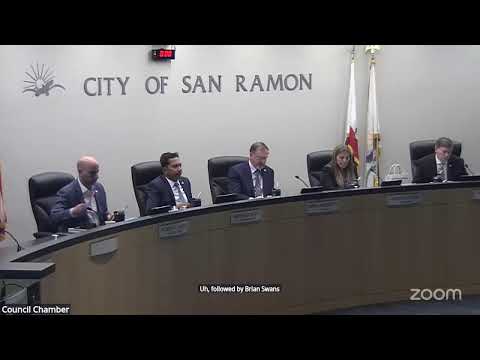
San Ramon council denies appeal, approves 20-year Orchards master plan
Loading...
Summary
After a public hearing focused on CEQA streamlining, vehicle miles traveled and tree preservation, the San Ramon City Council voted 5-0 on April 7 to deny an appeal of the Planning Commissionapproval and adopt Resolution No. 2026-040 approving the Orchards Development Project at 6001 Bollinger Canyon Road.
San Ramon City Council on April 7 denied an appeal of the Planning Commissionapproval of the Orchards Development Project and approved Resolution No. 2026-040, clearing the way for a 20-year master plan to redevelop the 92-acre former Chevron Park at 6001 Bollinger Canyon Road.
The council voted 5-0 after hearing staff presentations, testimony from the appellant and the applicant, and more than a half-dozen public comments. The appeal, filed by Brian Swanson, challenged the cityreliance on CEQA Guidelines section 15183 (streamlining for projects consistent with a prior certified EIR) and raised eight specific grounds, with the hearing centering on whether the record contained substantial evidence on vehicle miles traveled (VMT), greenhouse gas analysis, tribal consultation and the effect of post-2023 regulatory changes.
"This appeal is not about whether growth, housing, or downtown transformation is desirable," appellant Brian Swanson told the council. "The question is whether the [15183] checklist and appendices adequately answer the four required [15183] questions for the approvals granted." Swanson argued the record did not show how waivers and a long, phased 20-year approval would avoid peculiar or cumulative environmental effects.
Staff and the city's environmental consultant, First Carbon Solutions, said the General Plan 2040 EIR (certified December 12, 2023) served as the prior EIR and that the city prepared a consistency checklist using both program-level and project-level analyses where appropriate. Mary Bean of First Carbon Solutions told the council that the cityapplied the 15183 streamlining provisions, reviewed the project from aesthetics through wildfire, and "determined that no further CEQA review is required" because there were no project-specific impacts peculiar to the site.
Planning Division Manager Cindy Yee described the project applications: a major subdivision, two development plans (a 20-year master plan and a neighborhood-district entitlement), architecture review, tree removal and an environmental consistency checklist. She told the council the overall Orchards program proposes 2,510 units across three districts, and that the project would provide 16.2% deed-restricted affordable housing, exceeding the city's 15% inclusionary requirement. The neighborhood district alone is proposed to include 368 for-sale homes and an affordable site of 100 units to be developed with Eden Housing; of those 100, staff said 99 would be rental units affordable to very low- and low-income households.
Sunset Development's lead presenter, Stephanie Hill, framed the project as an infill mixed-use conversion of an office campus into a walkable community with retail, parks, a perimeter greenway and preserved heritage oak trees. She described a phasing approach that requires each future phase and building to return for project-specific environmental, architectural and entitlement review.
Multiple council members asked Swanson to point to specific record excerpts that would demonstrate the four 15183 questions were unanswered; Swanson replied he had prepared detailed materials, focusing especially on VMT and greenhouse gas issues, and faulted the staff packet for directing council to the full, lengthy administrative record rather than providing more item-by-item analysis. Council members and staff repeatedly noted that technical reports, including peer review of traffic and VMT analyses, were included in the record.
Public speakers raised related concerns about traffic on Bollinger Canyon Road and the surrounding corridor, the adequacy of park acreage relative to new population, and the removal of trees on the site. Residents asked the council to address each of the eight appeal points explicitly in the public record.
During deliberations, council members said they appreciated the appellant's work but found the staff report, technical appendices and consultants' analyses met the legal standards for 15183 reliance. Mayor Armstrong summarized the council's role as an evaluation of whether the city had followed the applicable law and process. The council adopted the staff resolution denying the appeal and approving the Orchards development, with the motion passing 5-0.
The approved action directs project conditions of approval and preserves the city's requirement that each future development plan return for project-specific review; staff noted that subsequent phases will require their own environmental review as applicable and that mitigation measures in the general plan EIR are incorporated by reference. The council did not adopt any continuance or additional requirements beyond the conditions in Resolution No. 2026-040.
Next procedural steps: the council's action finalizes the approval on April 7, 2026, subject to the conditions in the adopted resolution; future phases of the Orchards master plan (development plans, architecture review and further entitlements) will return to staff, the architectural review board and planning commission as required by the master plan conditions.
(Reporting note: quotes in this story are attributed to speakers who appear in the city meeting record: Brian Swanson (appellant); Mary Bean, First Carbon Solutions (environmental consultant); Cindy Yee (planning division manager); Stephanie Hill (Sunset Development); and members of the San Ramon City Council. )