Get Full Government Meeting Transcripts, Videos, & Alerts Forever!
Get email alerts on the Rezoning Prelimplat topic
No spam. Unsubscribe anytime.
Residents press board on flooding, safety and street connectivity in Wakefield Park rezoning
Summary
The board heard a contested rezoning and preliminary plat for Wakefield Park (79 acres, 27 lots). Staff recommended approval with a waiver from the dry‑sewer policy and a plat exception for street spacing; neighbors raised stormwater, floodplain and through‑street concerns and requested a gated emergency access or permanent cul‑de‑sacs. The board discussion was ongoing at adjournment.
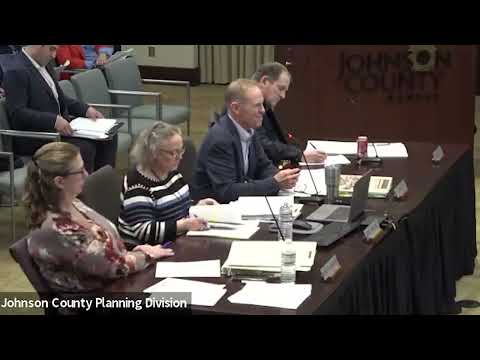
The East Consolidated Zoning Board held extended discussion and public comment on a rezoning and preliminary plat that would turn 79 acres at 4800 West 199th Street into a 27‑lot subdivision called Wakefield Park.
Diane Whitcomb of Johnson County planning staff summarized the proposal: the applicant (Phelps Engineering acting for landowner McBee Farms) seeks to rezone the property from RUR (rural) to PRN‑2 (planned residential neighborhood 2) and record a preliminary plat showing 27 lots ranging from about 2 to 2.9 acres, three private tracts for open space/stormwater, new public streets, and a monument entrance. Whitcomb said staff reviewed infrastructure and recommended a waiver from the county dry‑sewer requirement because Johnson County Wastewater considers it unlikely sewers will be extended to the site within 15 years; staff also recommended a plat exception for street spacing and recommended approval subject to stipulations in the staff report.
Residents raised multiple concerns in public comment. Matt Webb, whose family lives immediately north of the property, said stormwater has already encroached on nearby yards and asked that the stormwater plan be reviewed thoroughly and that a boundary fence be considered. Several Sweet Briar residents urged the board not to extend a through‑street into their existing cul‑de‑sac; they asked either to leave the road stub as a permanent dead end, provide a gated emergency connection, or install a fire gate or cable that would allow emergency access but keep regular through traffic out. One commenter proposed conservation alternatives (Kansas Land Trust or Johnson County Parks) instead of rezoning.
Developer representatives (Harold Phelps of Phelps Engineering and Tim Tucker, who prepared the stormwater report) said the applicant made design changes after a neighborhood meeting, added inlets and extended storm sewers to intercept runoff, and that the preliminary drainage study has been reviewed and accepted by public works. Phelps said impervious cover in the final plan would be lower than earlier flood‑study assumptions (he estimated the project would preserve over 40% green space) and that the proposed street stub responds to a 1979 plat that showed a temporary turnaround and right‑of‑way to the property line.
Board members asked detailed questions about stormwater, wastewater (septic vs. dry sewer), lot sizes, utility easements, and second access for fire and emergency vehicles. Planning and public works staff confirmed the traffic study and preliminary drainage study had been reviewed and accepted by county departments and that, under building and fire code, a single access point is allowed for subdivisions with fewer than 30 lots. Planning staff said the subdivision regulations nevertheless favor street connectivity and recommended the connection for design and long‑term planning reasons; staff noted the BOCC may grant exceptions.
Several board members expressed that emergency access is a serious safety concern even if the fire code does not currently require a second access for a development of this size. Staff cautioned that installing a gate on a public local street raises operational and legal issues for maintenance, service providers and rights of way, and legal counsel noted state law limits erecting gates across public highways except in narrow circumstances. Discussion continued at length and the transcript ends before a final recommendation on this item was recorded.
Next steps recorded in the hearing: staff will incorporate any recommended stipulations, and the item will be scheduled for consideration by the Board of County Commissioners; no BOCC hearing date was given in the transcript for this specific application.