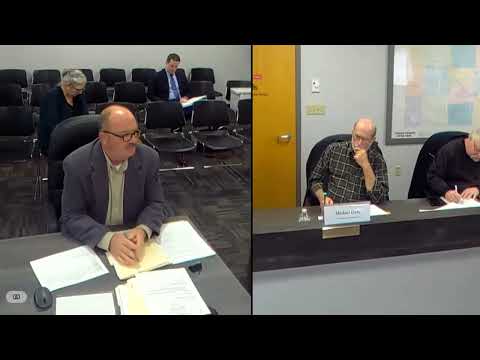
Grant County board upholds planning director's denial of proposed Matthews cell tower
Loading...
Summary
The Grant County Board of Zoning Appeals on April 6, 2026 upheld the area planning director's administrative denial of White Rock Holdings' application for a nearly 200-foot telecommunications tower in Matthews, citing county setback rules and insufficient room on the split‑zoned parcel.
The Grant County Board of Zoning Appeals voted on April 6 to uphold Executive Director Ty Glancy’s administrative denial of White Rock Holdings’ application for a telecommunications tower in the town of Matthews.
White Rock’s attorney, Kyle Resiteritz of Dentons, told the board the application included an engineer’s certification that any collapse would be contained within an on‑site compound and argued that Indiana law limits local fall‑zone requirements. "The fall zone objection is preempted by state law," Resiteritz said, and urged the board to deem the application complete so the planning office could proceed with review. He also cited a sworn Verizon affidavit describing a coverage gap that the proposed site would fill.
Ty Glancy and county staff countered that the question before the board was whether the application, as submitted for that parcel, complied with the Grant County area‑wide zoning ordinance. Glancy summarized the office's rationale: because the parcel is split between general business and residential zoning and the ordinance ties tower setbacks to height, a roughly 195‑foot tower requires setbacks (about 205 feet from property lines and roughly 390 feet from residential property lines) that cannot be met within the general business portion of the site. "This parcel does not meet those requirements," Glancy told the board, describing the decision as driven by physical space and ordinance dimensions rather than policy preference.
Board members pressed both sides on technical details. Resiteritz and his engineers said the proposed compound would be about 80 by 80 feet and that the tower’s fall‑zone analysis shows the structure would collapse into itself within the fenced compound. Members asked for precise measures for section lengths and structural elements and raised hypothetical failure modes not addressed by the submitted analysis; the applicant said additional engineering and site‑search documentation could be provided. Distances discussed in the hearing varied by metric: an early estimate of about 390 feet to the nearest property line was mentioned, while the applicant later characterized a worst‑case compound proximity to a residence at roughly 85 feet depending on the measurement used.
After extended deliberation that referenced both the county ordinance and Indiana Code 8‑1‑32.3‑17, the board moved to support the executive director’s findings. The motion carried on a roll call vote, and the board announced it had upheld the administrative denial. Board members noted that the applicant could seek judicial review in circuit or superior court or return with supplemental engineering evidence and additional materials documenting alternative site availability.
The decision leaves in place the planning office’s denial of the current application; it does not prohibit the applicant from submitting revised plans or pursuing other procedural remedies. The board closed the public hearing on the matter and moved on to remaining agenda items.