Get Full Government Meeting Transcripts, Videos, & Alerts Forever!
Get email alerts on the Police Efficiency topic
No spam. Unsubscribe anytime.
Waterbury police present 61-point efficiency study, highlight dispatch delays at Northwest Communications
Summary
Police Chief Fernando Spagnuolo and consultants from Barry Dunn outlined a 61-recommendation efficiency study for the Waterbury Police Department that flagged long front-end dispatch delays at privatized Northwest Communications and urged audits, a liaison and staffing changes.
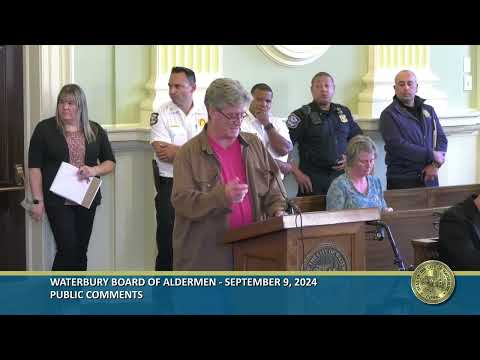
Police Chief Fernando Spagnuolo and consultants from Barry Dunn presented an operational assessment to the Waterbury Board of Aldermen on Sept. 9 that identified 61 recommendations for the department and raised concerns about delays between when residents call 911 and when officers are dispatched.
The report, awarded in 2022 under a contract of roughly $187,000, included a detailed review of the police department’s operations and a related assessment of Northwest Communications, the private dispatch center that handles the city’s calls. Michelle Weinsell, senior manager for Barry Dunn, told the board the project had two phases: an operational assessment and an action-planning phase to help the department implement recommendations.
“There were a total of 61 recommendations,” Weinsell said, noting that several midpoint recommendations were issued during the study and incorporated into the final document. The consultants said the most urgent concern was the “front end” lag — the time between when a call is received at dispatch and when it is assigned to a patrol unit — which they linked in part to Northwest’s operational practices.
Chief Spagnuolo said the data show that while the department’s dispatched-to-arrival response times generally meet national standards, the time callers wait for dispatch can be significantly longer for some categories of calls. He summarized the review’s findings for 2021: for a subset of the highest-priority calls the average time from the caller to dispatch was about “4 minutes,” while other categories showed average caller‑to‑dispatch delays of roughly 28.2 minutes for certain weapons/domestic calls and about 100 minutes for many lower‑priority calls. He cautioned that raw numbers can be skewed when calls are reclassified in process.
The presentation and ensuing aldermanic questioning focused on three areas: improving communication and oversight of Northwest, clarifying call-prioritization practices, and addressing staffing shortfalls. The department has already taken several steps it described as responsive to the report: it assigned a lieutenant to act as a liaison with Northwest, created a telephone‑response unit to handle peak volumes, and is conducting audits and ride‑alongs with dispatch staff.
Alderman Alsace sharply criticized past Northwest performance and urged bringing dispatch back under city control. “They falsified reports. They got caught. What happened? Nothing,” Alsace said, pressing for a faster remedy. The chief responded that building an in‑house dispatch center would be expensive and multi‑year, and that the department is pursuing interim oversight and accountability measures with the current contractor.
Spagnuolo also described personnel progress: the department reported 286 sworn officers on the roster and said it is working to reach its budgeted complement of 300 through recruitment and lateral transfers. Officials said they have applied for a COPS grant to add 15 officers and will keep pursuing both sworn hires and expanded civilian roles — including community service officers and other non‑sworn positions — as part of the implementation plan.
The consultants and the police chief asked the board to treat the report as both a diagnostic tool and a roadmap. Weinsell said the action‑planning phase includes prioritized implementation steps and that Barry Dunn would remain available to assist the department through the end of the calendar year. “We produced the report in the summer of ’23,” she said, and added that the firm is continuing work with the department on implementation.
Next steps announced to the board included continued audits of Northwest’s categorization and prioritization practices, regular eight‑hour command‑level reporting on call holds, contractual reviews for technology that allows citizens to self‑file low‑level reports, and a December progress update from the consultants. Aldermen said they will monitor performance metrics as the city pursues staffing and procedural fixes.
The chief invited further commissioner questions and described the report as a mix of best‑practice findings and actionable items that the department has already begun to address. The presentation closed with officials promising to return with more granular data and implementation milestones in coming months.