Get Full Government Meeting Transcripts, Videos, & Alerts Forever!
Get email alerts on the Flooding topic
No spam. Unsubscribe anytime.
Stockton researchers say tidal and "nuisance" flooding still common at Beach Haven pump sites
Summary
Stockton University's Coastal Research Center presented a 2024 monitoring study showing BH5 and BH7 as the most flood-prone storm grate stations; researchers reported 274 days and roughly 6,500 hours of sensor data and said pump stations helped reduce nuisance flooding at some locations.
Kim McKenna, interim executive director at Stockton University's Coastal Research Center, told the Beach Haven Borough Council on Sept. 8 that a 2024 field program detected repeated high-water spikes at several storm-drain locations and frequent "nuisance" flooding driven by tides and wind-driven surge.
McKenna said her team deployed pressure sensors at 12 monitored storm grate locations (labeled BH1–BH12), and compared sensor readings with local tide, precipitation and wind records. "We did three 90-day deployments," she said, and "there were 274 days of data collection, over 6,500 hours of data collected." She said the sensors and the tide gauge data were converted to NAVD88 elevations for engineering comparison.
The researchers defined a flood event as water standing at least 0.1 foot (about 1.2 inches) above the grate for at least 30 minutes. McKenna said BH5 (Center Street & Southwest Street) and BH7 (NW 3rd & Station Plaza) recorded the largest number of flood events and the greatest number of hours above grate elevation; BH8 and BH12 saw fewer events, in part because their top‑of‑grate elevations were higher.
McKenna highlighted examples where tides alone produced water-level spikes without rainfall, calling these "nuisance" or sunny‑day floods. "If you look, you have to have the other set of data to make that determination," she said, noting a nuisance spike on Nov. 28, 2024. The team found the highest water level at a monitored station reached 3.89 feet NAVD88 and lasted about a half hour.
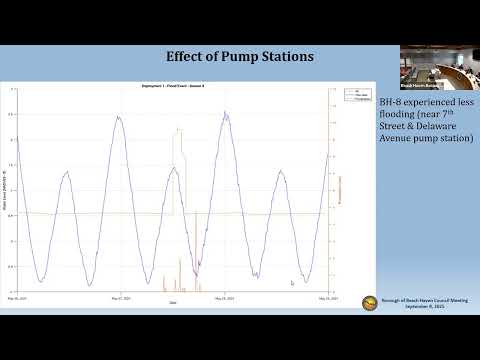
The presentation also examined the role of newly installed pump stations. McKenna said locations near pumps (including BH8) showed lower sustained water levels during some events, and added: "So that's where I think that the pumps really helped, at least with small storms or with the nuisance flooding." She offered the dataset for council review and said copies and figures are available from borough staff.
Council members thanked the researchers and asked operational questions. When asked whether the sensors remain installed, McKenna said the devices were removed in December after data download and QA/QC. The researchers said the work compared 2018–19 data with 2024 to assess changes after pump installation.
The council did not take immediate action on the report but acknowledged the findings as they consider flood mitigation and communications planning ahead of next summer.