Get AI Briefings, Transcripts & Alerts on Local & National Government Meetings — Forever.
Oregon City planning commission receives Land Use 101 briefing on ex‑parte rules, 120‑day deadlines
Summary
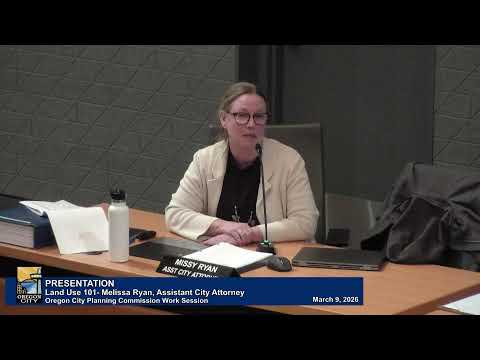
Assistant City Attorney Missy Ryan led a Land Use 101 work session for Oregon City planning commissioners covering zoning authority, quasi‑judicial decision types, ex‑parte disclosures, the raise‑or‑waive rule, the 120‑day decision deadline and risks of LUBA appeals. Commissioners recessed for a 10‑minute break after the training.
Assistant City Attorney Missy Ryan led a Land Use 101 work session for the Oregon City Planning Commission, reviewing the legal framework that governs zoning and the procedural rules commissioners must follow in quasi‑judicial decisions.
Ryan opened by tracing the authority to zone to the states and constitutional limits, saying the Tenth Amendment and the state's police power underpin local zoning while the Fifth and First Amendments impose takings and speech limits respectively. She reviewed the Land Conservation and Development Commission (LCDC) and the Department of Land Conservation and Development (DLCD) as the state agencies that implement the statewide planning goals, and cited Senate Bill 100 (1973) as the statute that required comprehensive plans and urban growth boundaries.
The training focused on the two main decision tracks commissioners encounter: legislative long‑range planning (code or plan amendments) and quasi‑judicial decisions tied to a particular property. On quasi‑judicial matters Ryan stressed the importance of procedural safeguards: "By state law, we have to give notice 20 days notice in advance of a hearing, and we have to issue this staff report no less than 7 days before the hearing," she said, and advised that evidence presented at hearings must be submitted into the record to become part of the file.
Ryan reviewed four quasi‑judicial decision types used locally (Type 1: staff sign‑off and not locally appealable; Type 2: community development director decisions appealed to the city commission; Type 3: typical planning‑commission items such as conditional use permits and variances; Type 4: plan or zone map amendments involving a specific property). She described the "raise‑or‑waive" principle that requires participants to bring issues with sufficient specificity in the record so they can be addressed locally rather than raised for the first time on appeal.
On deadlines, Ryan emphasized the state "120‑day" rule that requires a local decision, including local appeals, within 120 days of an application being deemed complete. She warned of the consequences for missing that deadline: an applicant may file for a writ of mandamus in circuit court, which shifts the burden to the city, can entitle the applicant to recover attorney fees, and requires at least a 50% refund of application fees if the applicant prevails. "The failure to make a decision in 120 days means that the applicant can file for a writ of mandamus," she said.
Ryan also discussed the applicant's burden of proof (for example, to provide traffic studies), the fixed‑standards or "goalpost" rule that freezes applicable standards on the date an application is deemed complete, and the limited discretion commissioners have under compatibility criteria. She cautioned commissioners that personal knowledge is not evidence in the record and recommended asking clarifying questions while the record is open to avoid inadvertently introducing new evidence during deliberations.
The session included guidance on bias and conflicts of interest. Ryan reviewed precedent—citing cases such as Depot Bay, Friends of Jacksonville and Fasano v. Washington County—to illustrate when prejudgment or concrete actions require recusal. She advised disclosure of potential conflicts and nonparticipation for actual conflicts that would financially affect an official or a family member.
Commissioners asked practical questions throughout. One commissioner asked whether a private conversation with a resident counts as an ex‑parte contact; Ryan answered that for quasi‑judicial matters such contacts should be disclosed on the record so interested parties can respond. The commission agreed with staff that communications with planning staff and the city attorney are not treated as ex‑parte contacts but encouraged bringing substantive answers into the public meeting record for transparency.
Near the end of the session the chair asked for a short recess to allow a tech switch for the next agenda item. The chair entertained a motion for a "10 minute recess between the work session item and our public hearing item"; the motion was moved by Victoria Manning and seconded by Seth Henderson, and the work session was recessed.
The training concluded with Ryan offering follow‑up deeper sessions (Land Use 201/301) and thanking the commission for their service. The meeting moved to a 10‑minute break as announced by the chair.