Get Full Government Meeting Transcripts, Videos, & Alerts Forever!
Get email alerts on the Climate Action Plan topic
No spam. Unsubscribe anytime.
Carlsbad Planning Commission certifies SEIR addendum and backs narrower climate-action package in 4''3 vote
Summary
The commission on Oct. 2 certified an addendum to the housing-element SEIR and voted 4''3 to recommend Option 1 of the draft climate action plan update, excluding several proposed reach-code measures; staff said the plan's implementation cost is about $71 million with new/expanded programs roughly $5 million.
The Carlsbad Planning Commission on Oct. 2 voted to certify Addendum No. 1 to the housing-element supplemental environmental impact report and to recommend a narrowed version of the city's draft climate action plan update, approving Option 1 by a 4''3 vote.
The unanimous 7''0 vote to certify the addendum clears the document for use in project-level review under CEQA, staff said. Later, commissioners voted 4''3 to adopt Option 1, which meets the state's 2045 greenhouse-gas reduction target while excluding several reach-code measures that would have required stricter building-energy requirements for new residential and nonresidential construction.
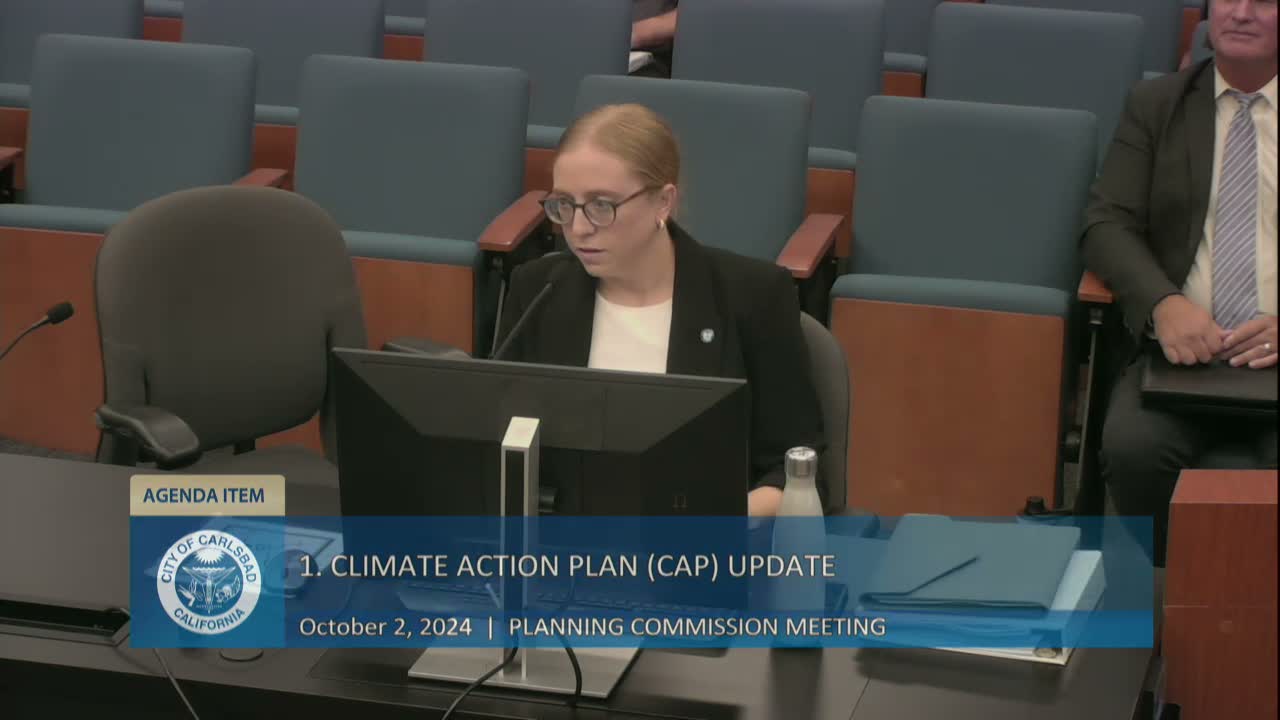
The staff presentation, given by Katie Hendrick, the city's Climate Action Plan administrator, outlined four options. Option 1 would meet the 2045 target while excluding three measures (including updated reach codes referenced as E3.2, E3.3 and E4.2 in the draft). Option 4 would adopt the draft as posted and exceed the target by about 6,000 metric tons of CO2-equivalent, but Hendrick warned that some reach-code measures have drawn industry objections and must pass a state cost-effectiveness review before local adoption.
Hendrick told commissioners the plan's combined implementation cost (existing, new and expanded programs across the planning horizon) is roughly $71,000,000, with new and expanded programs comprising about 7% of that total (a little over $5,000,000) in the first five years. She pointed commissioners to Appendix E of the draft update for the implementation-cost analysis and said an author of that analysis was available to answer technical questions.
Scott Andrews, director of the Energy Policy Initiative Center at the University of San Diego, told the commission that standard climate-action inventories typically do not present formal statistical "error bars." He explained the difference between a "business as usual" baseline (no new policy) and a "legislatively adjusted" baseline that factors in state and federal measures, and he recommended periodic inventory updates to monitor progress.
Public testimony reflected a sharp divide. Environmental groups and residents urged the commission to adopt Option 4 and retain reach-code measures, arguing broader measures are needed to address the climate emergency and public-health concerns tied to gas appliances. "We need to do everything we can at every level of government," said resident and Clean Energy Alliance community-advisory member Paige Desino.
Business and housing stakeholders, including representatives of NAOP/BOMA, the California Apartment Association, the San Diego Regional Chamber of Commerce and the Building Industry Association of San Diego County, urged the commission to adopt Option 1 or delay reach-code mandates. Craig Benedetto, representing NAOP San Diego and BOMA San Diego, warned of costs and feasibility concerns and urged a balanced approach: "Take your A, don't shoot for A plus," he said.
Commissioners who supported Option 1 cited uncertainty over long-range baselines, the lack of a private-sector financial-impact study and the city's concurrent housing challenges. Commissioners who favored a more aggressive package emphasized urgency and the city's role in reducing emissions.
The commission noted that the city council remains the approving body for the climate action plan update; staff said the council will hear the item in November 2024. Hendrick also reminded commissioners that the SEIR mitigation requires the council to adopt an updated climate action plan within a defined window so the city can continue to rely on the CAP for streamlined project review.
With the addendum certified, staff said projects consistent with the adopted CAP could qualify for streamlined CEQA review; without the adopted CAP, future projects would face project-by-project greenhouse-gas analysis and additional CEQA review.
The planning commission closed the public hearing after taking the two votes and then moved to routine departmental reports before adjourning.