Get Full Government Meeting Transcripts, Videos, & Alerts Forever!
Get email alerts on the Budget Midyear topic
No spam. Unsubscribe anytime.
Council approves FY2025 midyear budget monitoring report as departments warn of structural shortfalls
Summary
San Diego’s Department of Finance told the City Council the city faces growing revenue shortfalls—driven largely by weaker sales tax and a $33.2M SDG&E franchise payment reduction—and outlined mitigation options. The council approved the midyear monitoring report 8–1 after presentations from DOF, police and the IBA.
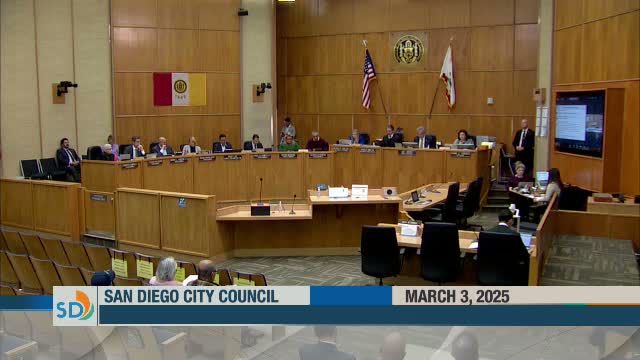
San Diego — The City Council on March 3 approved the Department of Finance’s FY2025 midyear budget monitoring report after a multi‑hour presentation that laid out falling revenues and rising personnel costs.
Rolando Charvall, the city’s finance director, told the council the midyear projections show a structural challenge: major general fund revenues are projected to fall $26.9 million below the adopted budget and general fund expenditures are expected to exceed budget by roughly $108.9 million, driven largely by a projected $29.4 million shortfall in sales tax and a $33.2 million reduction in SDG&E franchise fee receipts. “These are not easy decisions,” Charvall said, urging a combination of cost controls and revenue actions to protect core services.
DOF staff outlined several mitigation measures the council could pursue in the short term, including the parking meter rate increases already enacted, possible parking citation fee hikes, select user‑fee changes and a proposed 2 percent increase in the cannabis business tax as options to narrow the near‑term gap.
The Police Department also presented, saying staffing shortfalls and backfill overtime are the primary drivers of its projected overtime overage. The chief reported the department is about 60 officers short of daily minimums and estimated about $10 million in overtime above the budgeted amount on an approximately $46 million overtime budget. “Overtime is what we use to bridge the gap to meet that bare minimum level,” the chief said.
The Office of the Independent Budget Analyst (IBA) reviewed the midyear report and highlighted the same headline risks. Charles Modica, the independent budget analyst, emphasized that vacancy savings, hiring freezes and other mitigation directives were factored into the midyear numbers, but that much of the budgetary pressure remains revenue‑driven.
Public commenters urged transparency and diligence in closed‑session items and raised concerns related to a potential cannabis business tax increase, arguing it could push patients and customers to the unregulated market. Multiple cannabis industry stakeholders warned that layering a city increase atop a state excise tax hike could harm legal retailers and patients.
Councilmember Von Wolpert moved to approve staff’s recommendation; Councilmember Whitburn seconded. After further council discussion and additional public testimony, the council adopted the midyear monitoring report by roll call vote, 8–1, with Councilmember Foster voting no.
What happens next: DOF said it will continue monthly monitoring and report updated projections in the third quarter monitoring report. Councilmembers and staff particularly flagged recruitment, overtime controls and continued dialogue with SDG&E on franchise accounts as items for follow‑up.