Get Full Government Meeting Transcripts, Videos, & Alerts Forever!
Get email alerts on the Energy topic
No spam. Unsubscribe anytime.
San Diego Community Power reports lower rates, battery pilot and $124 million regional funding
Summary
San Diego Community Power told the City Council it is offering discounted rate options, running a residential solar‑plus‑battery pilot that prioritizes communities of concern, and will administer a $124 million regional energy network award for efficiency and workforce programs.
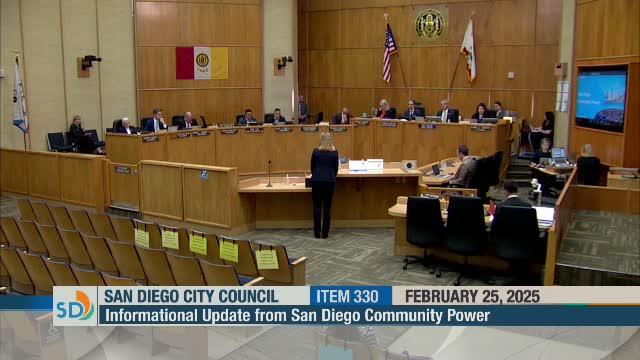
Karen Burns, CEO of San Diego Community Power, briefed the City Council on Feb. 25 about the agency’s 2025 rates, customer products and local programs.
Burns said SDCP’s main product, PowerOn, is currently about 3% less expensive than the investor‑owned utility’s comparable product and that a new affordability product, PowerBase, is offered at roughly a 5% discount. She said customers can also opt for Power100 (100% clean annual content) or GreenPlus for commercial customers seeking lead‑point advantages. “For a second year in a row, we have been able to lower our electric rates for our customers,” Burns told the council.
Burns described pilots to shift energy use away from peak hours — Smart Home Flex (thermostat optimization), EV Flex Connect (managed charging incentives) — and a residential solar+battery pilot that has installed batteries for households, including one‑third in communities of concern and CARE/FERA customers. She said SDCP has signed 13 long‑term power purchase agreements totaling more than 1.5 gigawatts and nearly 2 gigawatts of storage contracts, which the agency expects will help stabilize costs as projects come online.
Burns also described a recently awarded $124 million regional energy network grant that will fund energy efficiency, codes and standards, workforce development and other programs that launch over the next 12–18 months. She said SDCP’s strategy aims to balance renewable growth, fiscal prudence and local benefits such as job creation and distributed energy in disadvantaged neighborhoods.
The presentation drew questions from council members about the regional energy network timeline, time‑of‑use rates and community outreach; Burns said SDCP will coordinate public materials, bill comparisons and continue community advisory work.