Get Full Government Meeting Transcripts, Videos, & Alerts Forever!
Get email alerts on the Water Rates topic
No spam. Unsubscribe anytime.
Council reviews proposed 9% water-rate increase, meter-size infrastructure fee and new water tower need
Summary
City staff proposed a roughly 9% water-rate change, a meter-size "infrastructure" fee tier and long-term projects including a new Water Tower 3 and Business 24 water-main replacements; staff said water/sewer must be funded by system users and cannot be subsidized from sales tax or general fund revenues.
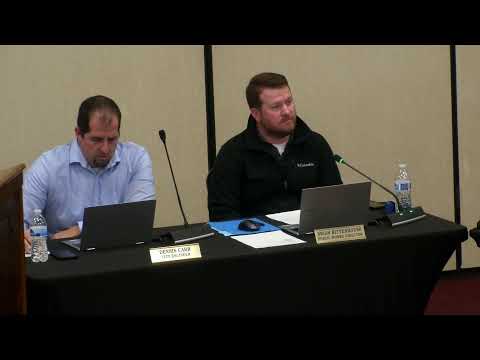
City staff on April 14 asked the Washington City Council to consider a revised water-rate structure that would include a roughly 9% increase and a new meter-size-based infrastructure fee.
The proposal, presented by Dennis and finance staff Joni with technical input from Scott of CMT, would move from a single fixed fee to a meter-size infrastructure fee that treats tax-exempt entities (schools, churches) differently if they provide tax-exempt documentation. Staff said the 9% request reflects an adjustment beyond the 5.2% CPI baseline the ordinance currently cites and is intended to better cover ongoing operations, a planned large water-main reconstruction and increased debt service.
Why it matters: staff highlighted several drivers behind the rate discussion. Personnel costs would rise roughly 4.5% and operations about 3.5% year over year; stormwater-related debt service will become a full payment this year (staff cited about $470,000). Capital spending is down about 28.8% compared with the prior year because several major projects concluded.
Technical drivers for a new water tower: Scott, an engineer with CMT, told the council Water Tower 3 is driven by three main needs: meeting ISO fire-flow guidance (350 gallons per minute for three hours, roughly 630,000 gallons), complying with Illinois EPA (IEPA) Title 35 design guidance on average-day storage (the city's average-day demand was described as about 1,150,000 gallons), and improving hydrant flows in the northeast part of town (estimated gains of roughly 800 gpm in that area). Scott said the IEPA storage guidance is used for design even if enforcement action is uncommon.
Funding constraints and policy limits: several council members asked whether general sales-tax revenue could be tapped to subsidize water projects. Joni and Dennis advised the council that water and sewer operate as enterprise funds and therefore should be paid by system users; using general sales-tax revenue to subsidize the water fund would constitute commingling and risk audit findings and could negatively affect IEPA loan reviews. "You can't commingle the funds," Joni said, adding that IEPA reviews rates when communities apply for loans.
Timing and priority questions: council members pressed staff about project timing, including Sunnyland redundancy and where projects fall in the capital plan; staff said Sunnyland redundancy is currently shown for 2026–27. Staff also emphasized that coordinating water-main replacement with IDOT's Business 24 reconstruction will reduce mobilization and traffic-control costs and produce lower overall construction costs.
What happens next: staff said a draft ordinance reflecting corrected totals and the infrastructure-fee language will be presented next week. Council did not take a final vote on rates during the meeting and requested clearer documentation on how the proposed fee appears on public rate sheets.