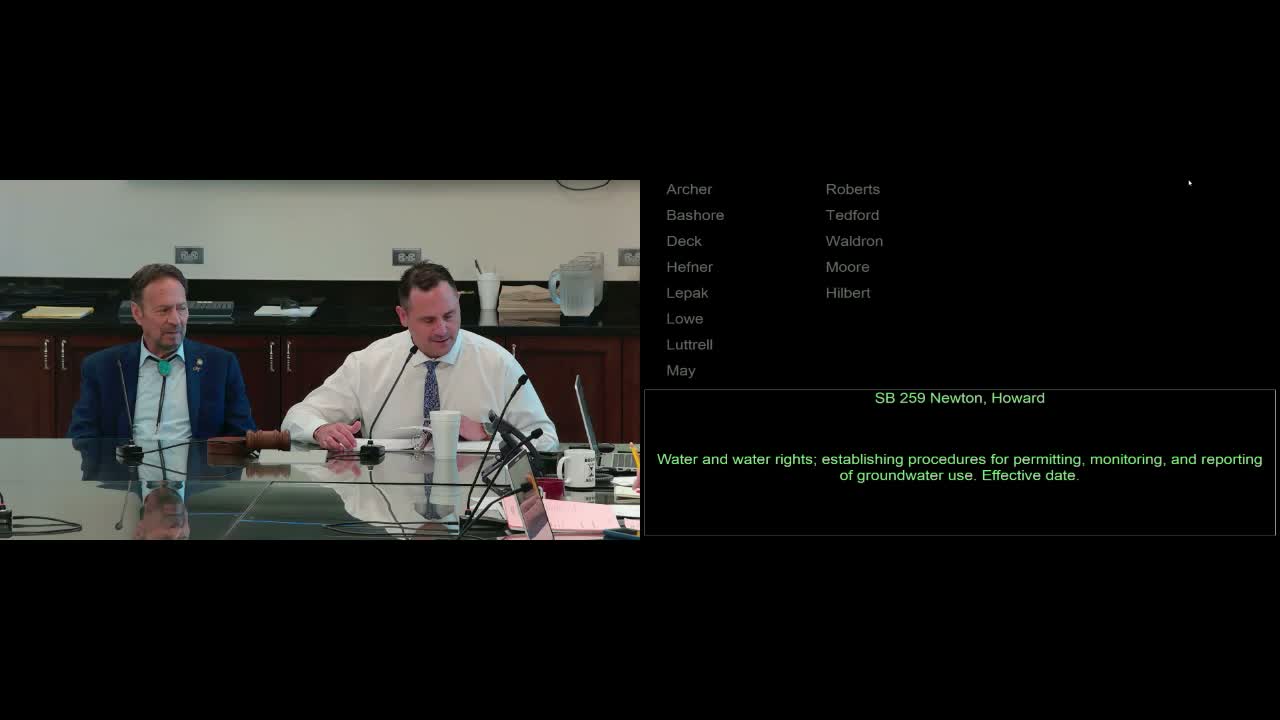
Rep. Newton’s water-measurement bill advances from committee after unanimous 8-0 vote
Loading...
Summary
A legislative committee voted 8-0 to report Senate Bill 259 out do pass after adding an amendment that would require permitted high-volume groundwater users to meter usage, allow five-year averaging, and bar traditional evaporative cooling for data centers that rely on groundwater.
A legislative committee advanced Senate Bill 259 on a unanimous 8-0 vote after adding an amendment that would tighten metering and cooling requirements for permitted, high-volume groundwater users.
Representative Newton, the bill’s sponsor, told the committee the measure targets large groundwater users such as data centers and irrigation operations and would require a central meter or alternate measuring device so regulators can track actual withdrawals. "This water is essential to life," Newton said, arguing measurement and limits are needed to preserve aquifers for future generations.
The amendment offered by the chair narrows the bill’s approach for data centers that rely on groundwater: such facilities would have to use low-consumptive cooling — for example closed-loop systems, dielectric cooling fluids or air cooling — and would be prohibited from traditional open evaporative cooling, the chair said. "If groundwater is the primary cooling source for a data center, that facility must use some form of low-consumptive cooling," the chair said while explaining the amendment.
Newton said the bill applies to permitted groundwater users only (not domestic users) and would not reduce a user’s existing permitted allotment if they fail to use their full allocation in a given year. The bill also directs the Oklahoma Water Resources Board (OWRB) to investigate complaints of waste and allows fines scaled to the severity of abuse, Newton said.
Key technical provisions include a five-year averaging approach that allows up to 150% of a permitted allotment in a single year provided the five-year total remains within the permitted limit, and phased metering requirements: Newton identified January 2027 as a compliance milestone for certain users and said other affected users would have up to eight years to install meters or equivalent measuring devices. He told the committee that typical metering hardware runs "between $1,750 and $4,000," and said the bill includes a phase-in to make compliance manageable for permit holders.
Lawmakers questioned budget and enforcement implications. Representative Pack asked whether monitoring and enforcement would require ongoing appropriations or could be covered by OWRB fees; Newton said there is a projected cost to the OWRB but that the work would be covered by the board’s existing fee schedule and that he would provide the committee’s fiscal analysis. Representative Waldron pressed why the bill mandates metering instead of relying on voluntary measures; Newton pointed to stewardship concerns and cited research on the Ogallala aquifer’s depletion risk as justification for a mandatory system.
The committee took a do-pass motion, the clerk recorded multiple affirmative votes (Archer, Low, Heffner, Deck, Latrell were named during the roll call), and the chair announced an 8-0 tally in favor. The committee reported the bill out do pass and then adjourned.
Next steps: the committee reported SB 259 out do pass; the bill will move to the legislature’s next procedural stage for scheduling and further consideration.