Senate committee advances plan for fee on outbound money transfers amid fintech and military concerns
Loading...
Summary
A proposed Tennessee levy on licensed money transmitters’ transfers to foreign countries would raise an estimated $55 million annually for childcare, housing and workforce programs; fintech companies, small businesses and military families warned it would burden remittances and cross‑border commerce.
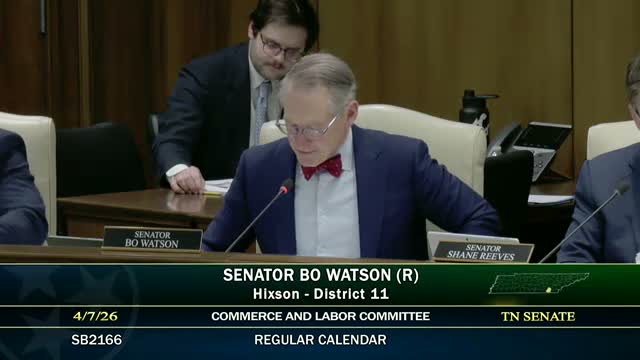
Sen. Jeremy Watson (sponsor) told the Commerce and Labor Committee that an amended bill would place a modest user fee on licensed money transmitters for transfers from Tennessee to locations outside the U.S., capped at $10 for transfers of $500 or less and 2% for amounts above $500. “The user fee as amended will recoup state revenue of roughly $55,000,000 per year,” he said, proposing the revenue split among the general fund, TennCare buybacks, child care, workforce housing and teacher internship funds.
The proposal drew immediate opposition from fintech and small‑business groups. Sarah Mamula of the Financial Technology Association said the bill “would directly impact Tennessee families and taxpayers, particularly working‑class and military households for whom international remittances are a financial lifeline.” She warned the bill could ensnare typical peer‑to‑peer transfers and commercial supplier payments that use fintech rails.
Kevin McAdams, a CPA and NFIB adviser, said small businesses use non‑bank money‑transmit providers for lower foreign‑exchange costs and speed. “Small businesses that depend on cross‑border payments to pay suppliers or contractors operate on thin margins; this tax would be an unreasonable new business cost,” he told the committee.
Sen. Watson answered repeatedly that the measure targets licensed money transmitters, not traditional bank ACH transactions, and pointed to Oklahoma’s long‑standing statute as precedent. Committee counsel summarized the legal reading similarly: the bill applies to traditional transmissions made by entities licensed under state money‑transmission law, not ordinary bank ACH. Still, members pressed for clarity on peer‑to‑peer services (Venmo, Zelle, PayPal) and whether typical family transfers would be taxed; witnesses said the drafting could trigger coverage of some digital wallets and fintech pathways unless explicitly exempted.
The committee adopted Commerce amendment 1—narrowing and defining covered transmitters and allocations—and sent the bill to the Finance Committee for further review (vote reported 7 ayes, 2 no). Sen. Watson said he expects more technical work in Finance and invited continued stakeholder negotiation. Opponents urged lawmakers to amend or pause the proposal to avoid unintended burdens on military families, remittance recipients and small exporters.