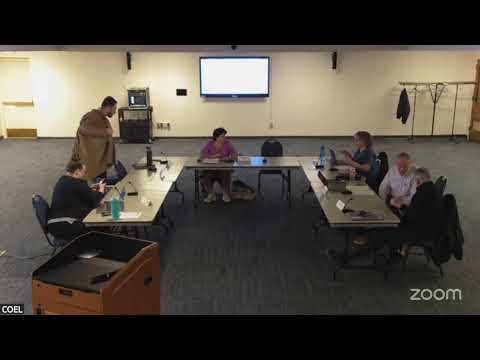
Financial review committee lists income tax, authorities and OPEB funding as top priorities
Loading...
Summary
East Lansing’s financial review committee set a multi‑item work plan — including an income tax decision, exploring fire and parks authorities, analyzing retiree health/OPEB funding and a possible event surcharge tied to MSU — and requested legal guidance; no new revenue measures were approved at the meeting.
The East Lansing Financial Review Committee on the meeting set a list of priority topics to study in coming weeks, including whether to recommend renewing the city income tax, researching the formation of a fire or parks authority, evaluating retiree health (OPEB) financing and examining a possible surcharge on Michigan State University event tickets to cover city services.
The committee’s chair led the discussion and asked staff to obtain legal opinions on whether forming special authorities or adding event surcharges would be permissible. "We asked to have someone come and talk about authorities and how that would work," the chair said, noting the city attorney had not yet responded and that staff would follow up.
Why it matters: Committee members framed the work as a step toward closing a budget gap. The chair highlighted retiree health as a potential source of savings and said, "we learned that if we put 11,000,000 in, we would no longer have to pay as we go," urging that funding options for the OPEB trust be explored.
Staff also clarified that a recent memo about debt service indicates the city intends to issue debt paid from participating funds — for example parking or parks and recreation revenues and the general fund — rather than levy a resident debt millage. "We confirmed that the intention would not be to do a debt millage for the residents, but that it would be issuing debt that would be paid for by the city," a staff member said.
Members raised a range of specific research questions to be added to future agendas: whether the income tax should be placed on the ballot again (and for what term), legal steps and limits for creating authorities, the legality and administration of a ticket surcharge, potential changes to drain and streetlight assessments, and whether the city can alter revenue sharing rules to account for temporary residents such as students living in MSU dorms.
Downtown business fees and public‑safety cost recovery were a notable strand of discussion. One participant argued the city’s previous fee structure tied fees to venue capacity and effectively charged businesses that generate higher public‑safety costs; that structure was later removed and the participant urged revisiting it as a way to recapture costs and create behavioral incentives. "There are a couple of bars in particular that consume a lot of public-safety services," he said, arguing the city should consider monetizing those costs.
The committee did not take substantive policy votes during the meeting. It approved routine items by voice vote — the Feb. 19 and March 19 minutes, the agenda and a motion to adjourn — and created a small subcommittee to meet with finance staff to follow up on detailed budget questions. The chair said a report back on the financial review team’s earlier recommendations — what has and has not been implemented and effectiveness assessments — will be on the next agenda.
What’s next: Staff were asked to secure the city attorney’s guidance on authorities and the event surcharge, assemble relevant documents cited during prior debates (including Responsible Hospitality Council materials), and return with memo responses and follow‑up information at the next meeting. The subcommittee of the chair, Anne and Robbie will meet finance staff before the committee’s next meeting.
Actions at a glance: The committee approved minutes for Feb. 19 and March 19, approved the meeting agenda, and voted to adjourn; no ordinances, resolutions, or new fees were enacted.