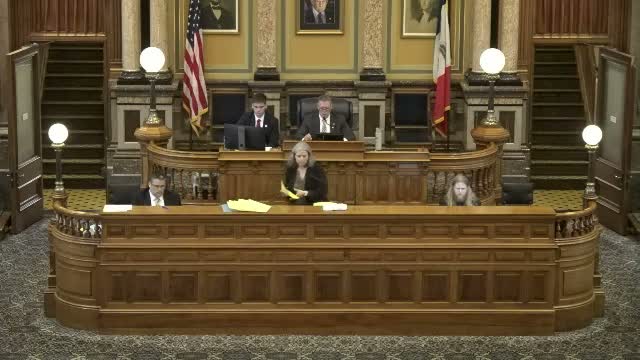
House approves fee on international wires to fund anti‑trafficking, prison and school safety programs
Loading...
Summary
House File 2750, establishing a fee on international wire transfers with estimated revenue of roughly $37–54 million, passed after debate over revenue allocation; a proposal to allocate 90% to the office to combat human trafficking failed, and an amendment allocating 70% to prison funding and 20% to school‑safety infrastructure passed; final passage was 60–32.
Representative Scott opened debate on House File 2750, describing it as a bill to establish a fee on international wire transmissions and to distribute proceeds to several priorities, including an office to combat human trafficking. Representative Wyckton Doll (opening an amendment) cited the fiscal estimate and said, "The fiscal note provided to us estimates combined total of 37 to $54,000,000. Of that amount, only 10% goes to the office to combat human trafficking, while 90% of that will go to the State of Iowa General Fund. This amendment prioritizes the office to combat human trafficking and requires 90% of the revenues raised to go to that office..." (Representative Wyckton Doll)
That proposal to prioritize 90% to the trafficking office (amendment H8333) was debated and later failed on the record (30 yeas; 63 nays). Representative Scott later offered an amendment (H8329) providing that "70% of the monies will go to the prison fund and 20% to school safety infrastructure," which the House adopted. The underlying bill, as amended, was then read for final passage. The clerk reported 60 ayes, 32 nays and 8 absent or not voting; the bill passed the House.
Key details recorded on the floor: the fiscal note range ($37–$54 million) was cited during debate; the office to combat human trafficking was described by sponsors as an intended beneficiary but floor amendments altered the distribution. Opponents cautioned that program capacity is limited — one speaker noted the trafficking office currently had only two staff and about $200,000 in existing funding, arguing it could not absorb a large influx immediately.
Next steps: House-passed bill will be sent to the Senate. Exact allocations and program implementation will depend on enrolled bill language and subsequent administrative rulemaking or appropriations actions.
Provenance: Floor debate, amendment votes, and final passage recorded on the House floor. (Provenance: SEG 491 → SEG 681.)