Get Full Government Meeting Transcripts, Videos, & Alerts Forever!
Get email alerts on the Municipal Tax Reciprocity topic
No spam. Unsubscribe anytime.
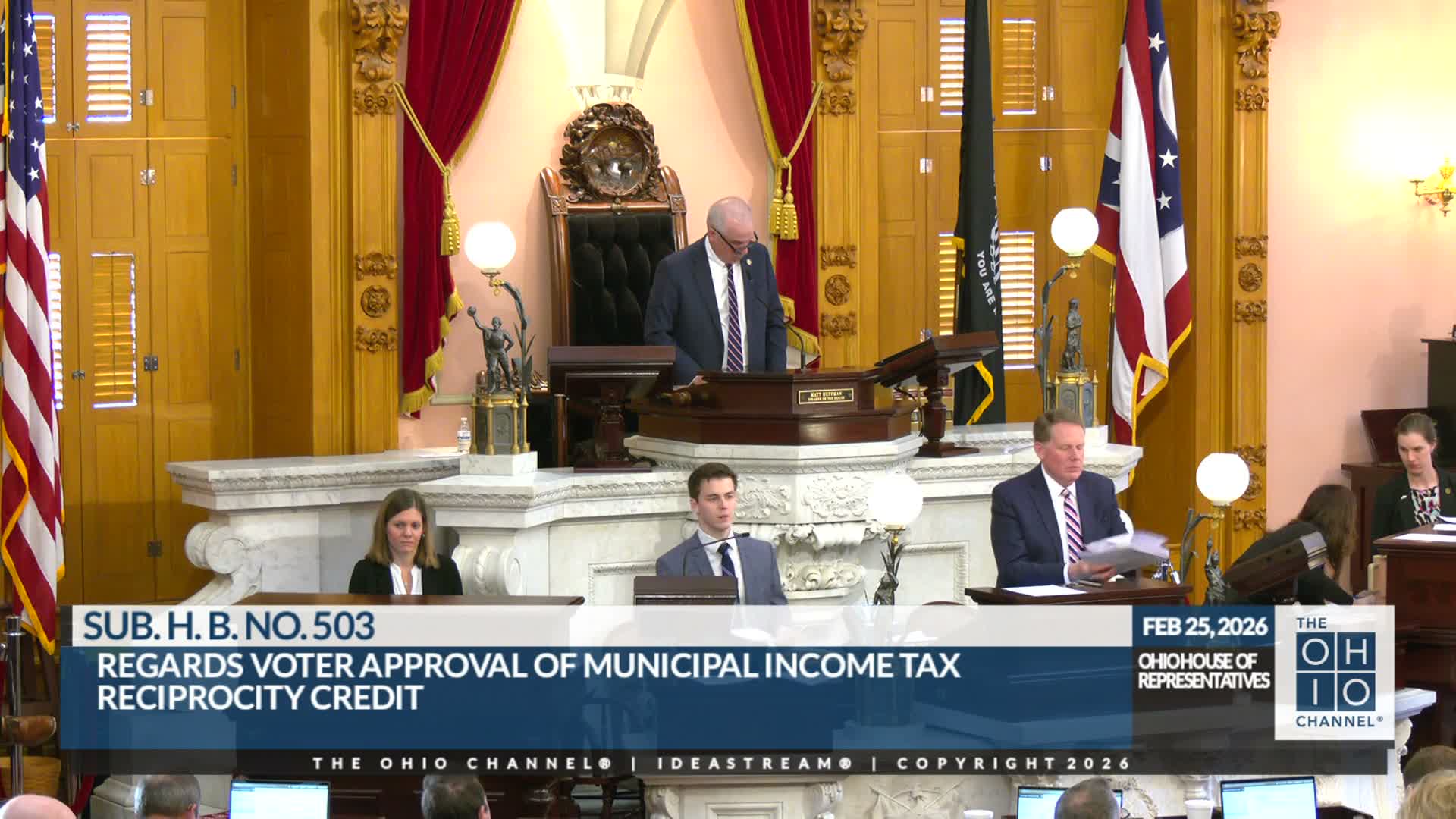
House approves requirement for voter approval before municipalities cut reciprocity tax credits
Summary
The House passed House Bill 503 to require voter approval before municipalities can reduce or repeal reciprocity credits that prevent double taxation on commuters; supporters said it protects taxpayers and opponents said it undermines local control. The measure passed 65-25.
The Ohio House approved House Bill 503, a measure sponsors described as returning tax decisions affecting reciprocity credits to voters rather than allowing local officials to unilaterally reduce those credits.
Representative Workman (speaker 29), the bill sponsor, said the measure protects workers from double taxation and gives voters tools to preserve reciprocity credits that offset municipal income taxes paid to an employee's work city. “This puts genuine control back in the hands of the people for tax decisions that directly impact their paychecks,” Workman said on the floor.
Representative Romer (30) and other supporters framed the bill as codifying voter protections and requiring the Department of Taxation to study municipal income taxation. Representative Troy (31) said the substitute version was improved to remove retroactivity and added a directive for a comprehensive study of municipal income tax rules.
Opponents warned of threats to local-government revenue and services. Representative Rogers (speaker 2) said the measure is “an attack on local government control,” arguing that municipal income tax revenues fund police, EMS and fire services and that changes could force service reductions. Rogers noted that more than 70% of municipalities already offer full or partial reciprocity credits and called the bill a solution in search of a problem.
The House carried the measure by recorded roll-call vote, 65 in favor and 25 opposed. Sponsors said the bill also includes a Department of Taxation study and mechanisms to prevent combining tax increases with reciprocity changes on the same ballot, as described on the floor.
The bill now proceeds to further enrollment steps; sponsors and opponents both signaled continued interest in implementation details and in the Department of Taxation's forthcoming study.