Get Full Government Meeting Transcripts, Videos, & Alerts Forever!
Get email alerts on the Recovery Housing topic
No spam. Unsubscribe anytime.
House passes bill to certify recovery housing, criminalize kickbacks and create task force
Summary
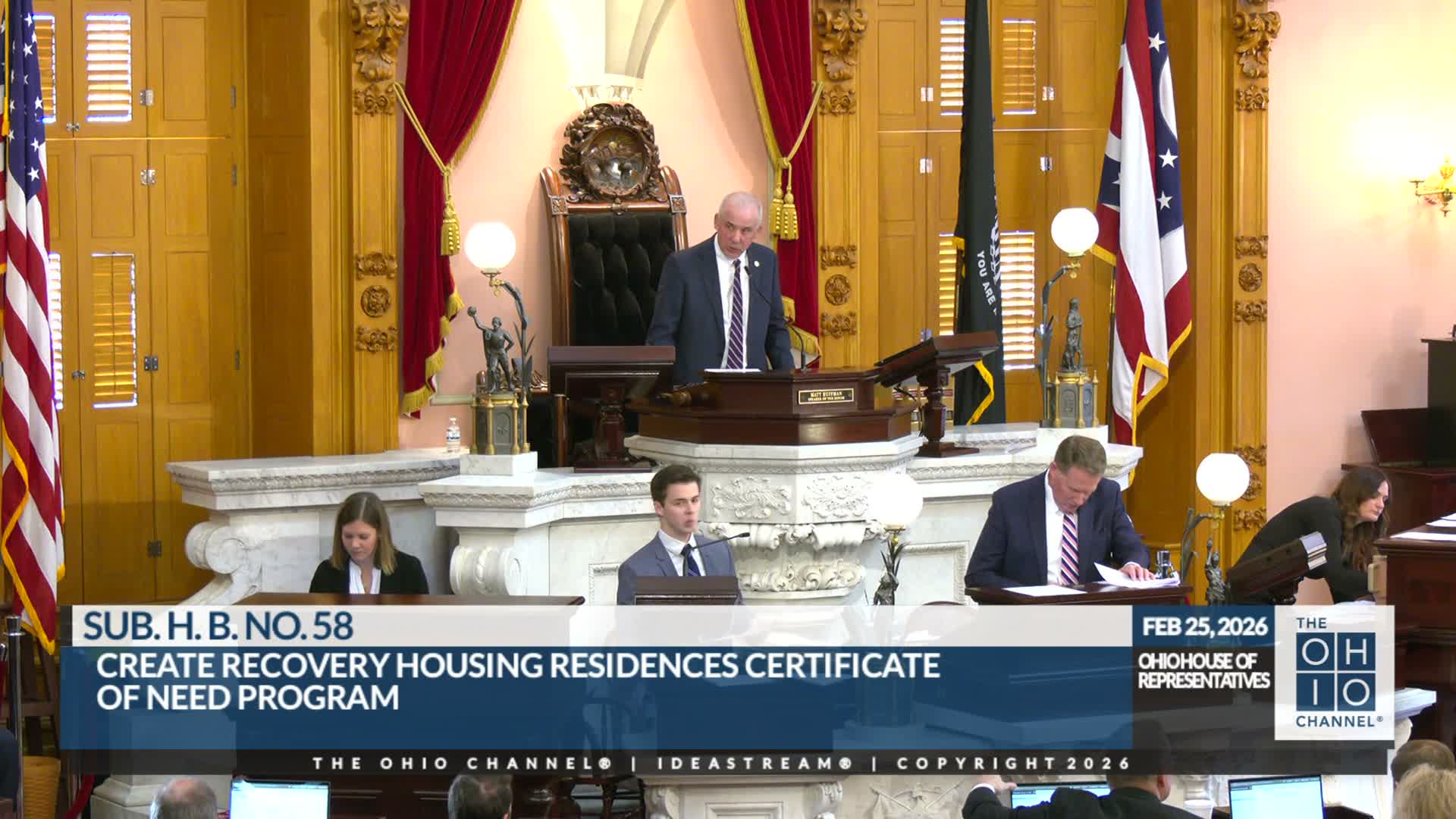
The House passed Substitute House Bill 58 to establish statewide certification and oversight of recovery housing, authorize penalties for bad operators, require transportation home for court-ordered patients who do not complete treatment, and create a statewide recovery housing task force.
The Ohio House on the floor passed Substitute House Bill 58, a measure sponsors said will set statewide standards and strengthen oversight for recovery housing across the state.
Representative Pizzoli, the bill sponsor, told colleagues the legislation responds to cases in which people court-ordered into recovery were placed in unsafe facilities. “In Ohio, there is more oversight to open a Chipotle than a recovery house,” Pizzoli said, urging members to support certification standards, local enforcement authority to shut down noncompliant operators, criminal penalties for kickbacks and referral payments, transportation for patients discharged without treatment completion, and creation of an Ohio Recovery Housing Task Force.
Supporters framed the bill as a public-health and public-safety reform. Representative Jerrells said the measure reflects lived experience of families who believed a loved one was entering a legitimate recovery placement only to find exploitation and unsafe conditions. “Recovery was failing Tom,” Jerrells said in describing a constituent whose placement had dangerous conditions.
The House recorded a roll-call vote of 90-0, and the bill was passed and entitled as an emergency measure. The measure requires certification standards to be set by the Department of Behavioral Health (as described by sponsors) and establishes enforcement mechanisms proponents said will enable local officials to penalize and close bad actors.
What the bill does and what remains to be decided: Sponsors said the bill moves oversight into state-level standards while preserving local enforcement tools. It also creates a task force to study capacity, density and inspection practices. The bill text as read on the floor includes criminal exposure for certain referral payments and a transportation requirement for court-ordered patients who do not complete treatment; implementation details and rulemaking timelines will depend on the Department of Behavioral Health once the law is enacted.
The House action closes with passage; next steps include any enrollment procedures and, where required, agency rulemaking to adopt the certification standards referenced on the floor.