Get Full Government Meeting Transcripts, Videos, & Alerts Forever!
Get email alerts on the Pension Pickup Transparency topic
No spam. Unsubscribe anytime.
Committee hears proponent testimony for bill to bar public-employee pension "pickups" and require full disclosure
Summary
Proponents at a House Insurance and Pensions Committee hearing urged passage of House Bill 473 to end employer-paid employee pension contributions (the "pickup" and "pickup on the pickup") and to require full disclosure of total compensation; lawmakers pressed witnesses on local control, tax effects and hiring competitiveness.
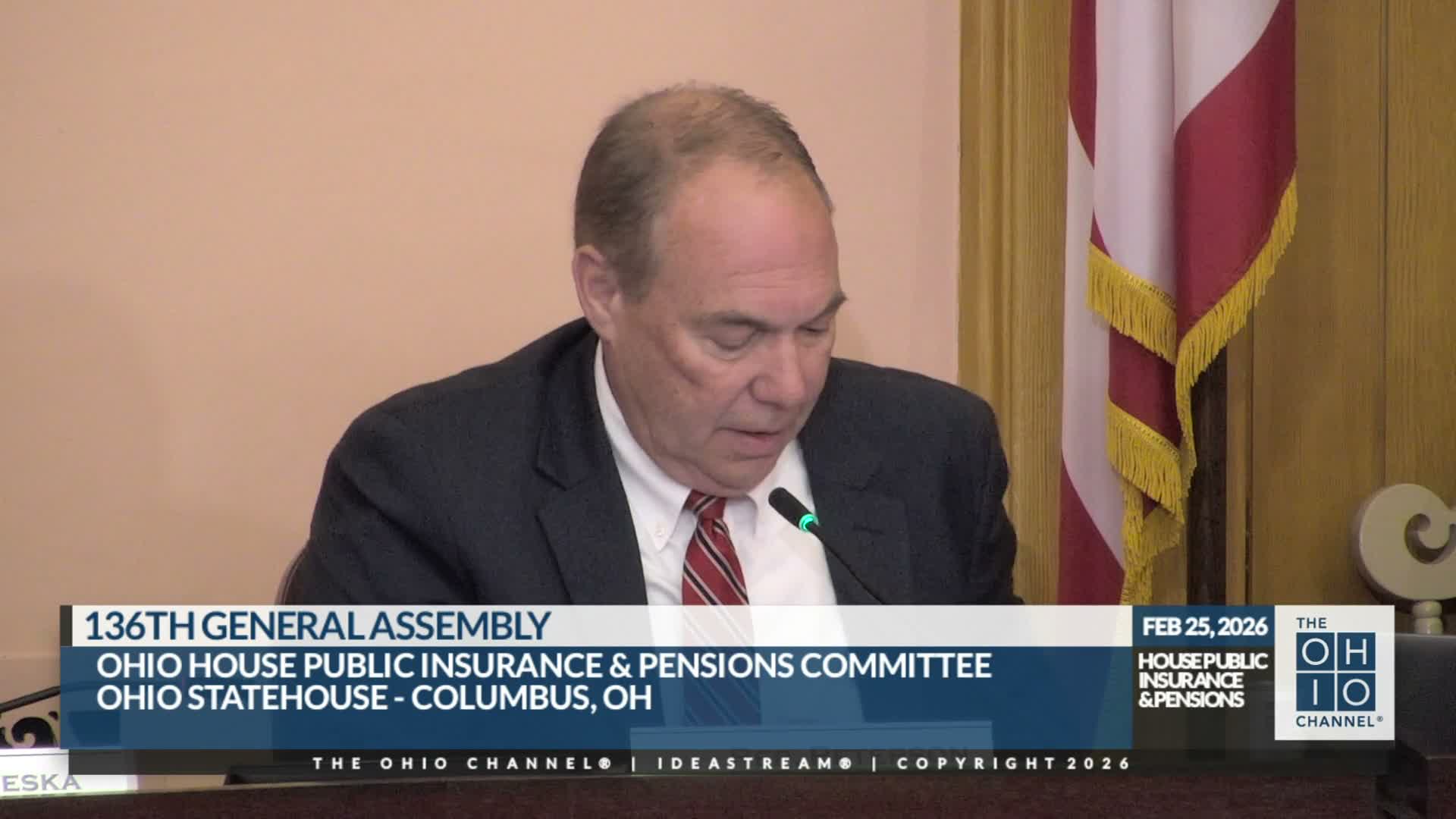
Chair Peterson convened the House Insurance and Pensions Committee and heard proponent testimony on House Bill 473, which would prohibit local employers from paying an employee's public retirement contribution (commonly called a "pickup") and would bar a secondary "pickup on the pickup." Two proponent witnesses told the committee the change would improve transparency and long-term fiscal stability for local governments.
Harland Waite, who identified himself as a current board president of the Ashbelle County Educational Service Center and a longtime local school-board official, told the committee he supports the bill because pickups obscure the true value of executive compensation. Waite cited a Jefferson Gazette article (02/19/2026) showing a treasurer's published annual salary of $110,131.04 and said an additional $11,013.10 of pickup compensation was not noted in the paper. "I simply advocate for the open and complete transmission of the information to the public concerning executive compensation," Waite said, arguing that publishing the total package would give taxpayers clearer information.
Aaron Thomas, mayor of the village of South Bloomfield, said HB 473 would bring clarity and accountability for small communities that have used pickups to appear competitive. "Wages should be wages. Retirement contributions should be shared as designed," Thomas told the committee, adding that his village once converted pickups into raises that effectively left the locality absorbing the cost. He said the bill also would prevent local agreements from creating a competitive imbalance between neighboring jurisdictions.
Committee members questioned witnesses over three central concerns: local control, tax effects, and hiring competitiveness. Representative Bridal raised a home-rule concern, asking whether state action would usurp local authority under Article II, Section 34 of the Ohio Constitution; Waite said he respects local control but believes a statewide rule is needed to level the playing field. Representative White asked why the state should override locally bargained compensation for all communities; Thomas replied the bill would standardize obligations and give taxpayers clearer notice of long-term liabilities.
Several lawmakers asked about the fiscal and payroll impacts of eliminating pickups. Bridal read an excerpt of written testimony from Ben Collins (a township administrator) claiming pickups saved Plain Township about $1,000,000 over the past decade and reduced 2024 payroll costs by roughly $120,136 on total wages of $5,700,000; both proponent witnesses said their localities had not completed a tax-adjusted, dollar-for-dollar payroll analysis. Representative Glassburn pressed Thomas on whether his village had accounted for the tax advantage employees receive when a pickup is used instead of higher wages; Thomas said the village did not perform a tax-adjusted calculation and that residents prefer direct employee responsibility for pension contributions rather than continuing pickups.
Supporters told the committee they are not opposing retirement benefits but want statutory clarity that employee contribution obligations remain the employee's responsibility and not a negotiable local employer obligation. No committee vote occurred during the hearing. Chair Peterson made brief announcements about upcoming business, including a planned hearing on House Bill 376, and adjourned the committee.
Next steps: The committee did not vote on HB 473 during the session; the bill's future schedule was not set during the hearing.