Get Full Government Meeting Transcripts, Videos, & Alerts Forever!
Get email alerts on the School Safety topic
No spam. Unsubscribe anytime.
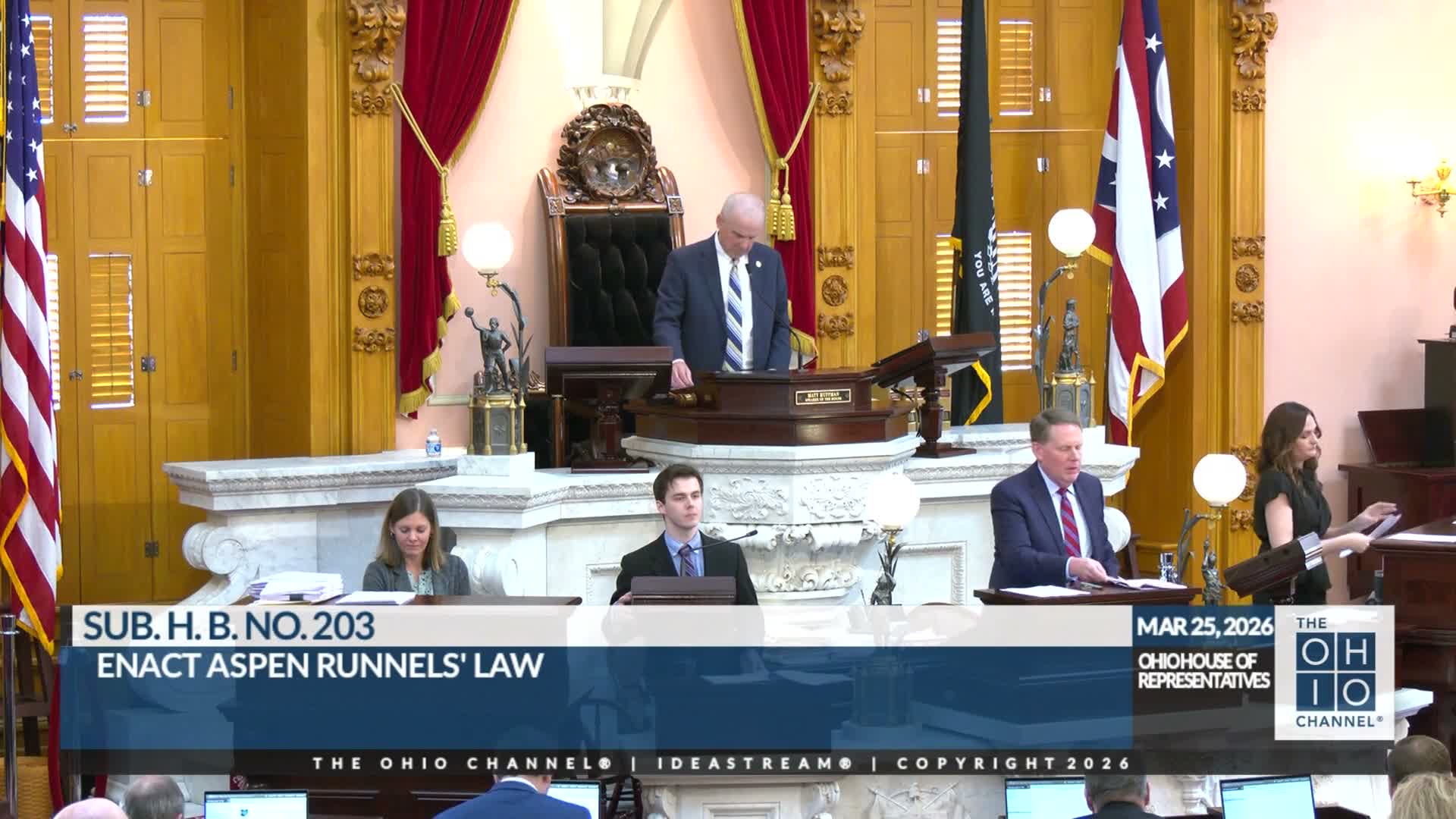
House passes 'Aspen Reynolds Law' to increase penalties in active school zones
Summary
Ohio lawmakers passed H.B. 203, named for a student killed in a school crosswalk, raising penalties for vehicular assault and homicide in active school zones, adding signage requirements and license-reinstatement conditions; sponsors framed it as justice for families and a safety measure.
The Ohio House on March 24 approved House Bill 203 — the Aspen Reynolds Law — to increase penalties for certain traffic offenses, including vehicular assault and vehicular homicide, when those crimes occur within active school zones.
Representative Thomas Hall, who led the floor discussion, told colleagues the bill resulted from community advocacy after a May 2024 fatality in his district and sought to align school‑zone penalties with enhancements used in construction zones. "The piece of legislation before us today seeks to increase the penalties for certain traffic offenses and vehicular manslaughter and homicide within active school zones," he said, describing added signage requirements and license-reinstatement conditions for offenders.
Supporters, including Representative Williams, said the measure was a "straightforward, common sense change" to protect students and urged colleagues that "we owe it to our children the same protection in and around our schools" as is provided to workers in construction zones. The bill's sponsors credited local officials and family advocates who testified in committee.
The House passed the bill by voice and recorded tallies (95 affirmative votes, 0 negative), and the title was agreed to on the floor. The sponsor noted coordination with local agencies and the bill includes provisions permitting courts to impose enhanced penalties and to require remedial instruction or proof of financial responsibility before license reinstatement.
Because the bill was framed as both a criminal‑justice enhancement and a school‑safety measure, supporters emphasized signage and community outreach in addition to statutory changes; the transcript records committee-level work and sponsor amendments intended to address local concerns.