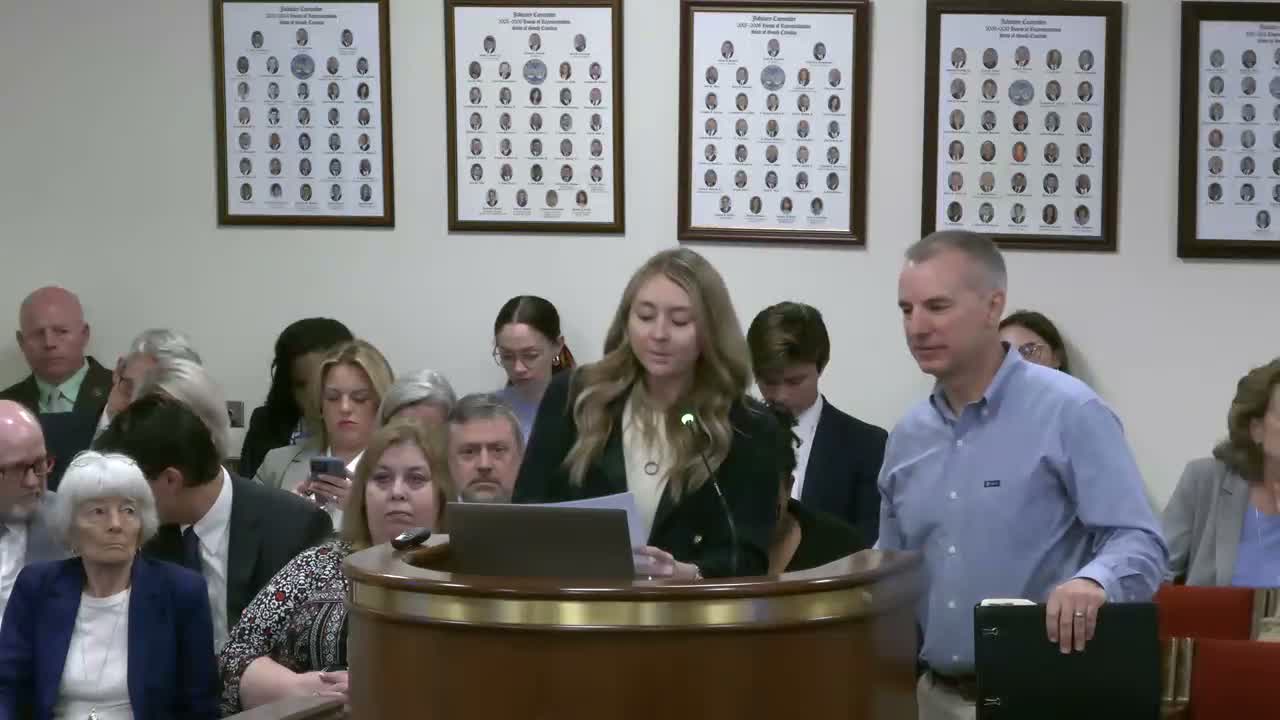
Subcommittee hears wide-ranging testimony on S.52 felony-DUI changes, with victims and advocates sharply divided
Loading...
Summary
The Criminal Law Subcommittee took hours of testimony on Senate Bill 52, which would change felony DUI definitions, sentencing and procedures. Supporters urged more rehabilitation and ignition-interlock use; solicitors backed several provisions but warned about limiting prosecutorial discretion; victims opposed reclassification to nonviolent and urged protections for survivors.
The Criminal Law Subcommittee heard extensive testimony on Senate Bill 52 on S.52, a broad package of changes to South Carolina's DUI statutes that would create new felony classifications, revise sentencing ranges and add procedural and restitution provisions.
The hearing opened with testimony from family members and advocates who pressed lawmakers from opposite perspectives. Jessica Yarbrough told the committee she supports making felony DUI a presumptively nonviolent offense to promote consistent outcomes and expand access to rehabilitation; "Every individual serving these sentences will return to our communities," she said, arguing a nonviolent baseline "promotes accountability and consistency and rehabilitation." Her point was echoed by other family members who asked the committee to reduce judicial disparity across counties.
Several victim advocates and surviving-family members urged the opposite. Lisa Hagberg, who said her daughter, Shalisa Mills, was killed by a speeding, intoxicated driver, said the crash was "violent" and asked lawmakers to review statewide homicide sentencing statistics rather than a small sample. Randall William Smith Sr., who identified himself as a victim and a longtime advocate, objected to retroactive reclassification unless victims' families have a clear, enforceable role in petition decisions.
Experts and stakeholders gave technical testimony. Thomas Nelson, representing the South Carolina Association of Criminal Defense Lawyers, said the bill contains numerous drafting problems across 29 sections: he supported creating a second-degree felony DUI in principle but warned that provisions such as a property-damage trigger for felony exposure and a new felony reckless-driving definition are vague and could sweep in low-risk conduct. He also said restitution language there duplicates provisions in Title 17 and lacks procedural rules for hearings.
Solicitor Rick Hubbard, speaking for solicitors, said his office supports S.52's direction — especially provisions addressing moderate and great bodily injury and gaps in child-endangerment charges — but flagged a "red flag" regarding reductions in prosecutorial discretion. Hubbard urged the committee to consider funding for implementation, describing a request for $7,400,000 to add prosecutorial staffing across circuits and handle increased magistrate caseloads.
The hearing also focused on ignition interlocks and temporary alcohol licenses. Chase Glasser of Consumer Safety Technology (SAFE Coalition) urged pairing administrative license suspension with mandatory interlock use to close what he called a loophole that allows arrestees to obtain temporary licenses without interlocks; he cited research and device data, saying interlocks in South Carolina blocked roughly 3,200 attempts to start a vehicle above 0.08 BAC and more than 20,000 attempts above the device's 0.02 preset in 2023. Lawmakers pressed him on constitutional and due-process concerns; Glasser said contested-case hearings must remain but argued interlocks substantially reduce recidivism.
Public health and treatment providers also spoke. Mara Jones, executive director of Alpha Behavioral Health Center and representing the Behavioral Health Service Association, asked lawmakers to raise fee caps for required alcohol/drug education and treatment (proposed increases: $500'$1,000 for education; treatment cap to $4,000 with a $5,000 ceiling and CPI indexing) to keep providers solvent and maintain program availability; she cited national evidence that evidence-based ADS programming reduces repeat offending but said the committee's most recent state-level outcome report is dated.
Committee members repeatedly sought data and legal clarity. Representatives asked for local recidivism rates while noting South Carolina's high DUI-fatality rate; they pressed solicitors for examples of statutory technicalities that make convictions difficult; and victims asked for explicit protections and clarity on retroactivity and petition processes so families would not be forced back into court without safeguards.
The committee did not take a vote; members said additional hearings would follow to refine drafting, collect requested data and hear those who did not get to speak. Chair Jeff Johnson closed the hearing and invited people to sign up for the next session.
The committee's next steps include requests for: specific prosecutorial examples of statutory gaps, updated state outcome reports on ADS programs, local data on interlock recidivism, and revisions to petition language addressing victim notification and consent.