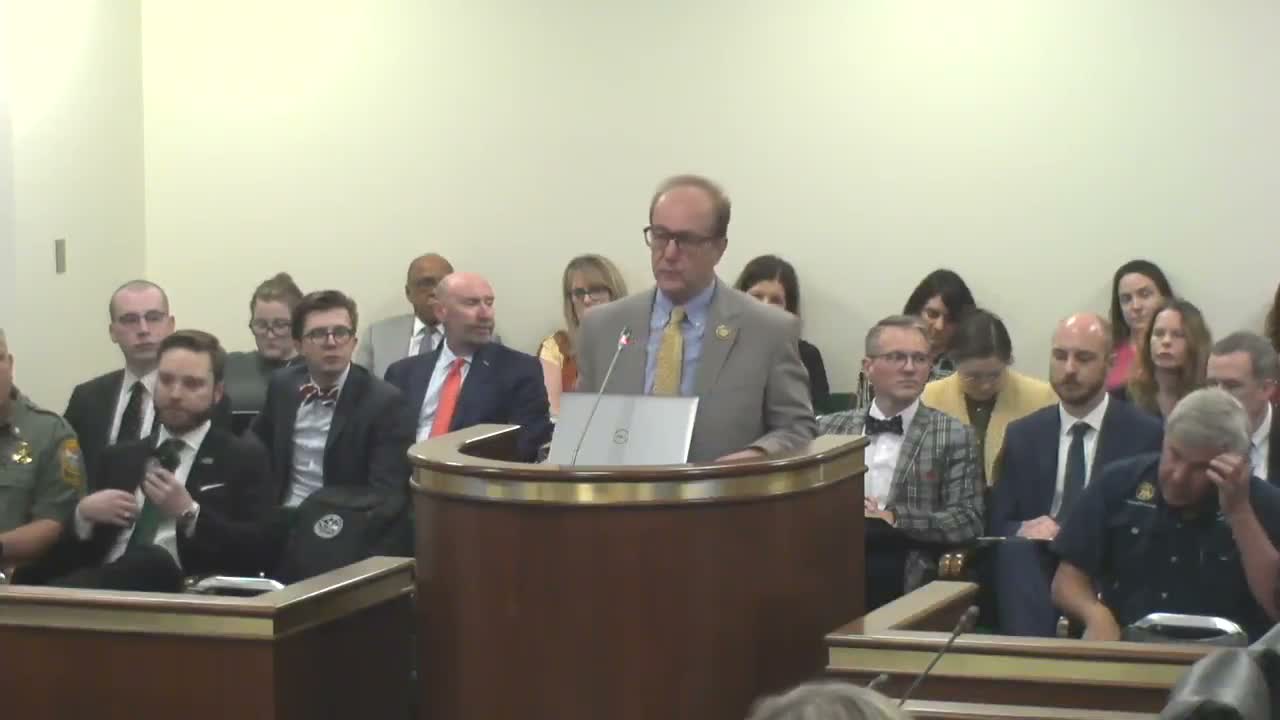
Committee adopts Bill 3,771 to require marine survey stickers for boats left in state waters
Loading...
Summary
The committee unanimously adopted Bill 3,771 requiring boats anchored in South Carolina tidal waters beyond about two weeks to display a marine-survey inspection sticker provided by private surveyors; DNR and nonprofit partners testified on removals, costs and enforcement steps.
The committee voted unanimously to adopt Bill 3,771, a measure that would require boats left at anchor in South Carolina tidal waters for more than two weeks to display a marine survey inspection sticker, testimony at the hearing said.
Representative Hartnett introduced the measure and said the sticker would be issued by private surveyors at no cost to the state; the requirement is intended as a preventative step to stop uninsured or derelict vessels from being left to sink in state waters. ‘‘This bill will require owners of boats kept at anchor in the tidal waters of South Carolina for more than 2 weeks to have a marine survey inspection sticker,’’ Hartnett said during his presentation.
Rudy Scioscia, who runs a nonprofit that helps remove derelict vessels, told the committee that abandoned boats moved into South Carolina waters from other states create safety, ecological and navigational hazards. He described the proposed survey as a brief checklist—whether the boat runs, whether there is a working head, and whether the hull leaks—and said accredited surveyors could complete it quickly. "If the guy can show me that everything works on it, then, you know, I can be on and off his boat in 10, 15 minutes," Scioscia said.
Major Michael Paul Thomas of DNR law enforcement described the agency’s abandonment process. DNR placards vessels with contact information, attempts to contact the titled owner by email and letter within about 24–48 hours, and then begins a 14‑day period after which it may initiate removal procedures if contact cannot be made. He said the abandonment process would be halted if an investigation shows a vessel was stolen and efforts would be made to return it to the owner.
Brett Mulligan, identified in testimony as a DNR director, told the committee that removals are expensive and that the agency and its nongovernmental partners have stretched the available funds. He said DNR has roughly 83 boats under its oversight that would be costly to recover—commercial lifts can run about $50,000 for large recoveries—and that last year’s appropriation of about $750,000 does not cover all anticipated costs. Mulligan also noted potential enforcement under the Pollution Control Act and the federal Clean Water Act for vessels that release pollutants into waterways.
Testimony included figures on removals and penalties that were presented aloud but were not recorded as an official roll call: committee members were told that roughly 287–290 derelict boats had been removed to date and that penalties for failing to display a sticker were described in testimony as either $100 or $500. The bill text and enforcement mechanics were not read into the record line-by-line; the committee asked staff to ensure clear language on exemptions and stolen‑boat handling.
After discussion, the committee adopted a strike‑all amendment to the measure and then voted to adopt the bill as amended. The chair declared both the amendment and the bill adopted unanimously; no roll‑call vote was recorded. The committee directed staff and DNR to refine implementation details including the process for identifying titled owners and coordinating removals.
The committee did not provide a timeline in the hearing for when the new requirement would take effect; committee members asked staff to clarify that point in follow-up work.