Get Full Government Meeting Transcripts, Videos, & Alerts Forever!
Get email alerts on the Evidence Admissibility topic
No spam. Unsubscribe anytime.
Appellate panel urged to reverse over admission of marijuana and character evidence in Sadio v. Finland
Summary
At oral argument in Sadio v. Finland, appellants' counsel asked an appellate panel to reverse and remand for a new trial on liability, arguing the trial court improperly admitted evidence of marijuana possession, prior use and a juvenile conviction that was speculative and unduly prejudicial; respondent's counsel said the totality of the circumstances made the evidence probative.
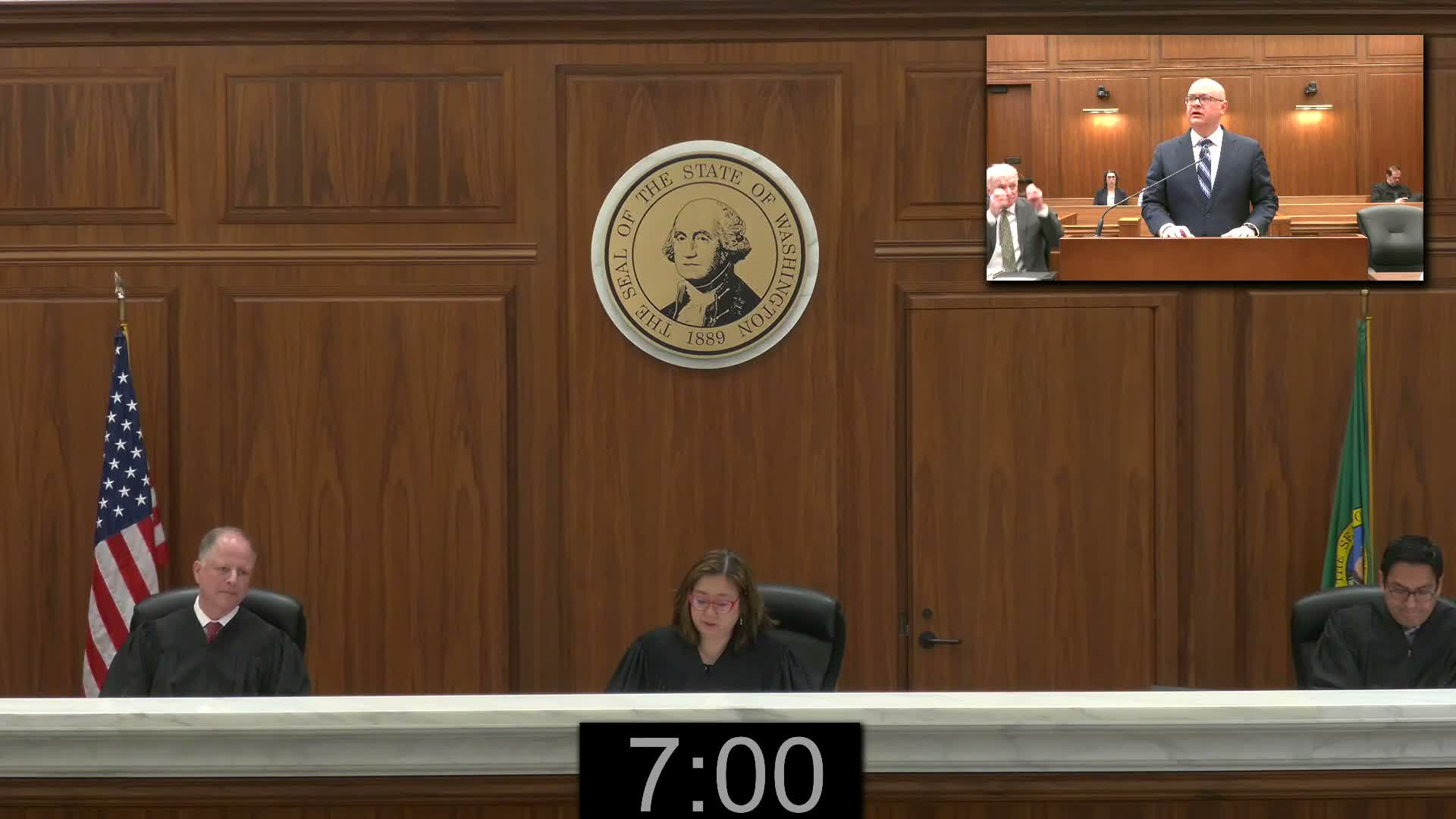
At oral argument, appellants' counsel Gary Mank asked the court to reverse the judgment on a jury's verdict and remand for a new trial on liability, arguing the trial court improperly admitted inflammatory evidence about the decedent's marijuana possession, prior use and a juvenile conviction.
Mank told the panel that "this case is really about the boundaries on a trial court's discretion to allow inflammatory evidence of drug use and deposition demeanor," and argued the record contained no direct proof tying marijuana use to impairment at the time of the collision. He said the evidence admitted at trial amounted to speculation rather than proof that the conduct of Alexander Finland contributed to the crash.
The panel repeatedly questioned how the record could support an inference of impairment absent direct physiological or behavioral evidence. One judge asked whether evidence that Finland "had taken it, had an effect" could be shown by circumstantial evidence and whether past use, without a demonstrable effect at the time of the accident, risked impermissible propensity inference. Mank replied that the line was crossed when the prosecution introduced the juvenile conviction and repeated testimony about past frequent use, which he said shifted the focus from impairment to character.
Respondent's counsel Howard Gutfreund urged the court to affirm. He argued the probative value of evidence that a person smoked marijuana 30 to 40 minutes before an accident is that it makes impairment more likely, and that jurors may rely on a combination of officer observations (including the odor of marijuana), the location and quantity of marijuana in the vehicle (described at argument as 80 grams in the passenger seat), and expert testimony to evaluate impairment. "The probative value of use was that it made it more likely than not that someone who smoked marijuana 30 to 40 minutes prior to the accident was impaired," Gutfreund said.
The panel and counsel debated the line between admissibility and weight, with judges pressing whether cross-examination and jury instructions could cure potential prejudice. Counsel for the appellant emphasized ER 403 and ER 404's limits on propensity evidence and relied on Gerlach as authority for treating speculative intoxication evidence skeptically; respondent's counsel stressed deference to the trial court's balancing of probative value and unfair prejudice under the abuse-of-discretion standard.
Both sides framed the dispute as central to who was on the wrong side of the center line at the time of the crash: appellants contended the trial court's admission of stacked evidence (possession, prior use, juvenile conviction, and the Fifth Amendment invocation) unfairly prejudiced the jury; respondent contended the totality of the circumstances permitted a reasonable jury to infer impairment and resolve competing credibility claims.
The attorneys did not receive a decision at argument. Appellants asked for reversal and a remand limited to liability; respondent proposed affirmance and conceded that, if liability were retried, damages need not be re-litigated. The court panel's ruling was not announced at the close of argument.
Ending: The panel heard rebuttal from respondent's counsel and additional prosecution-side argument about Gerlach, cumulative-error doctrine and how the evidence was used in closing argument. The court took the matter under advisement; no opinion was issued during the session.