Get Full Government Meeting Transcripts, Videos, & Alerts Forever!
Get email alerts on the Natural Resources topic
No spam. Unsubscribe anytime.
House Natural Resources committee approves amended bill 02/24 to consolidate river basin statutes, raise accident-reporting thresholds
Summary
The House Committee on Natural Resources voted 11–0 to advance amended bill 02/24, which consolidates river basin commission statutes into a single code section, updates administrative definitions, and raises boat and off‑road-vehicle accident reporting thresholds from $750 to $2,000.
The House Committee on Natural Resources on Tuesday approved an amended version of bill 02/24 that consolidates river basin commission statutes and makes a range of administrative changes to Title 14, including raising the monetary reporting threshold for certain accidents.
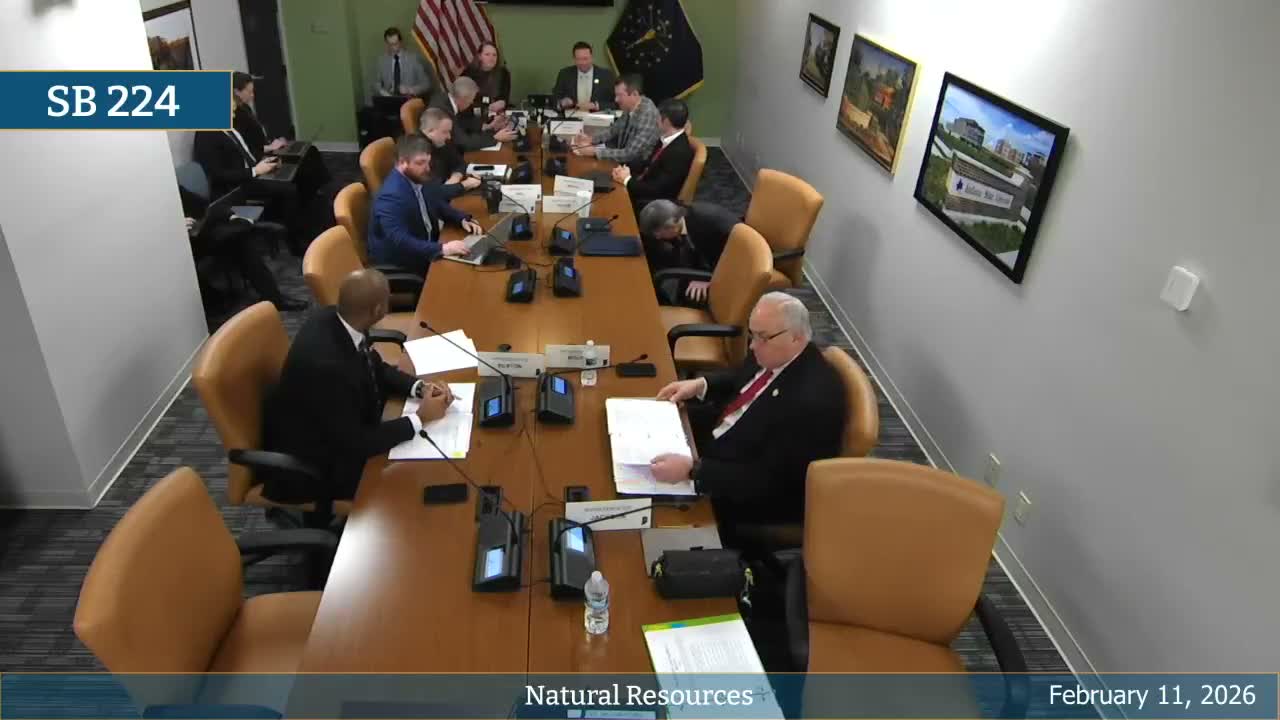
Chair Shane Landauer opened the hearing and described Amendment No. 11 as a code cleanup intended to place river basin commissions under one section of statute without stripping any existing powers. "We were simply trying to, I think, probably put simply, it was a kind of a code cleanup," Landauer said when introducing the amendment.
Matt Meersman, director of the Saint Joseph River Basin Commission, told the committee the amendment preserves each commission’s authority while creating a flexible model other basins could adopt. "It's not gonna, you know, take away any of our powers or change anything about the way we do," Meersman said, and indicated his commission supports the change after early review.
Camden Morrell of the Association of Indiana Counties, testifying on behalf of the County Surveyors Association, also expressed support, calling the amendment a condensation of the statute that keeps authority in place.
John Ketsenberger of The Nature Conservancy of Indiana said he supported the bill generally and the recreational-use language added in the Senate. Committee members asked for and received clarification that the bill’s recreational-use liability protections do not apply to homeowners’ backyards or private porches; protections apply only to a trail’s legal easement or right-of-way. "That easement is protected, but not their swing set or their porch or something like that," Ketsenberger said.
Chris Smith, deputy director of the Department of Natural Resources, gave a section-by-section summary of the bill. He said Section 1 aligns administrative-code definitions with the definitions in Title 14 so terms remain consistent across code and administrative rules. Sections 2–5 and Section 12 repeal language for the "Hometown Indiana" grant program, which Smith said has not been funded since the late 1990s. Other provisions move certain longstanding administrative-code provisions into statute (for example, archaeological-permit rules and parts of the shooting-preserve code), update license names, and clarify the Natural Resources Commission and administrative-law-judge procedures.
Significant substantive changes discussed included an update to observer requirements for watercraft towing activities (explicitly referencing wakeboarders and skiers) and an increase in the monetary threshold that triggers a required accident report. Under the bill, the reporting threshold for boat accidents would rise from $750 to $2,000 "to mirror the federal requirement"; the same increase would apply to off‑road-vehicle accident reporting. Smith also emphasized that an injury to a person involved in an accident would continue to trigger a reporting requirement irrespective of monetary damage.
Committee members asked whether Section 11 creates new licenses; Smith said it does not. "These licenses already exist," he said, explaining Section 11 lists existing licenses that carry an administrative remedy before an ALJ rather than creating additional licensing requirements.
After testimony and questions, the committee adopted Amendment No. 11 by consent and voted to pass the amended bill. A roll call produced an 11–0 vote in favor; the committee chair announced the bill was passed out of committee. The committee adjourned shortly afterward.
The hearing record shows support from river basin commissions and county surveyors for the consolidation; state natural-resources staff described the changes as largely administrative with some substantive updates to accident reporting, recreational-use liability phrasing, and other statutory modernizations.