Get Full Government Meeting Transcripts, Videos, & Alerts Forever!
Get email alerts on the Local Governance topic
No spam. Unsubscribe anytime.
Committee approves bill allowing towns to seek court removal of failing fiscal officers
Summary
House Bill 1381, which enables a municipal legislative body to petition a court to remove a municipal fiscal officer for limited failures such as illegal fees or extended nonperformance, passed the committee 10-0 after testimony and discussion of due-process safeguards.
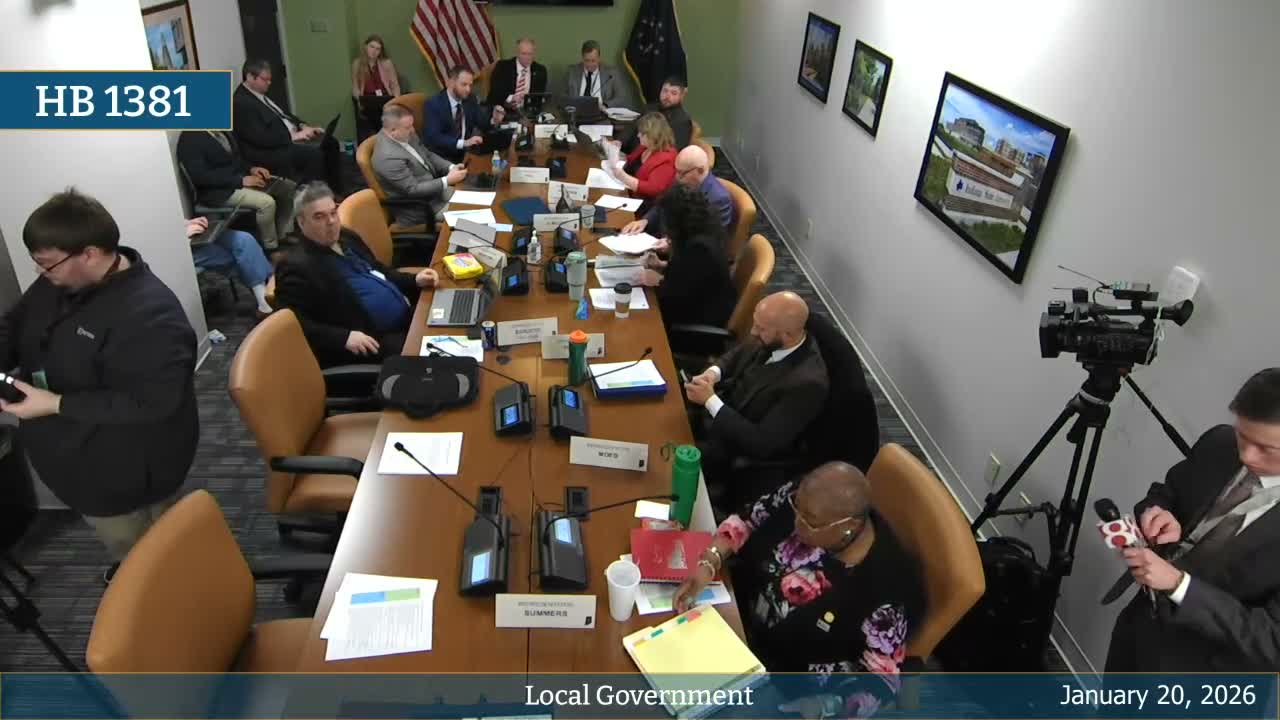
The Local Government Committee unanimously approved House Bill 1381 after a hearing that framed the bill as a targeted accountability measure for municipal fiscal officers.
Representative Smaltz presented HB1381, saying the measure gives cities and towns a narrowly tailored mechanism to petition a court to remove a fiscal officer for specific failures — including charging illegal fees, failing to perform duties, or prolonged absence — while preserving judicial review. “House bill 13‑81 is about accountability and continuity of government,” the author said.
Witnesses including AIM (Association of Indiana Municipalities) signaled cautious support, emphasizing the importance of clear standards, transparency and due process so the tool is not used for purely political disputes. AIM’s Amy Krieg told the committee that the inclusion of court review is an important safeguard and suggested the committee work on clarifying language to minimize unintended consequences.
Representative Johnson asked whether the bill provides enough guidance about what constitutes a reasonable amount of time in the office under modern hybrid work arrangements. The sponsor replied that some details could be refined on second reading and that ultimately a court would determine reasonableness in specific cases.
The committee moved to pass HB1381 as amended and recorded a unanimous roll call in favor (10‑0). The bill advances to the next stage with lawmakers and stakeholders expecting follow‑up amendments to tighten definitions and procedural protections.