Get Full Government Meeting Transcripts, Videos, & Alerts Forever!
Get email alerts on the Property Appraisals topic
No spam. Unsubscribe anytime.
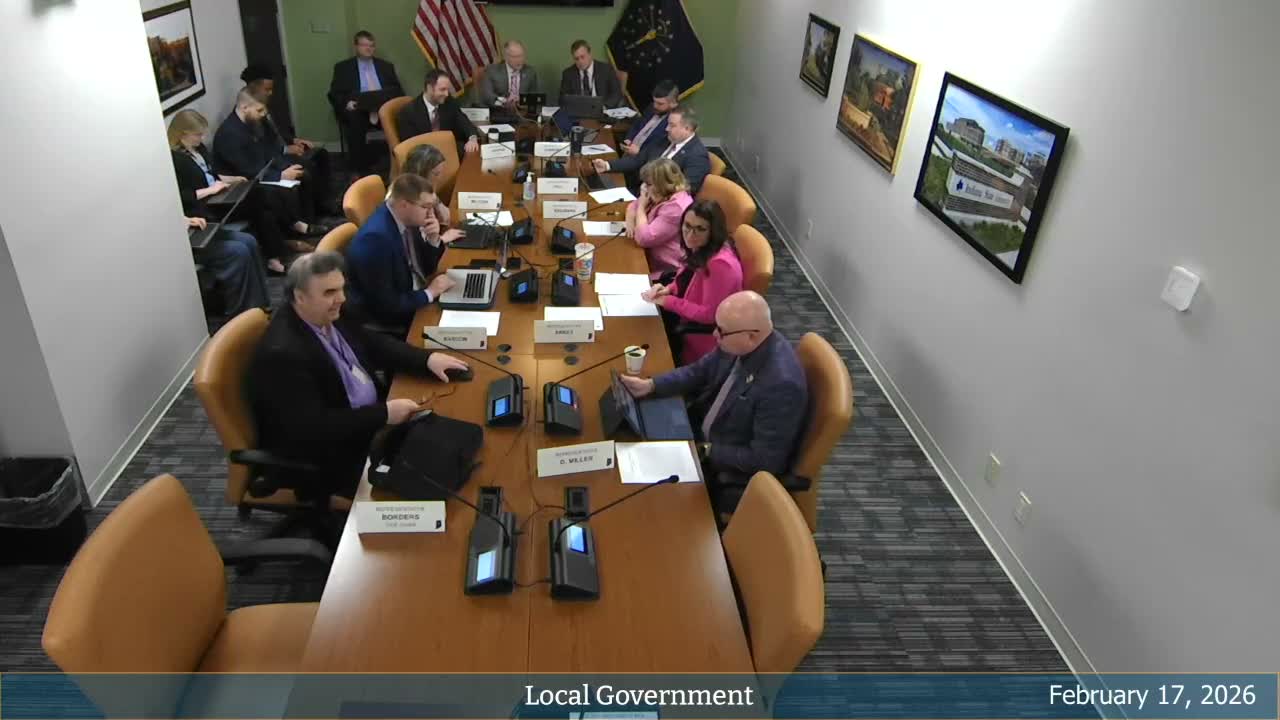
Committee advances bill to let Gary use averaged appraisals to move city parcels back to private ownership
Summary
The committee passed Senate Bill 232, which allows the City of Gary to use sampled average appraisals to set minimum offering prices for groups of similar parcels, aiming to reduce appraisal costs and speed property transfers back onto the tax rolls; the bill passed 13-0 after testimony from city officials.
The Local Government Committee voted to pass Senate Bill 232 after presentations from the bill presenter and local officials. The bill allows the city of Gary to conduct a set of sample appraisals (ten residential and ten grouped commercial samples) and to post annually an average value per square foot for residential lots and average value per acre for commercial parcels; those averages may be used to establish minimum offering prices for city-owned properties.
Representative Althoff (presenting) said Gary owns about 7,000 parcels and that the current statutory requirement for two appraisals per parcel makes returning properties to private ownership cost-prohibitive. "The goal is to bypass the need to create two appraisals for each property, saving time and money," the presenter said.
Eddie Melton, mayor of Gary, told the committee the city is in the midst of a wave of economic development worth roughly $4,000,000,000 and said the legislation would help convert city parcels into opportunities for families and businesses. Corey Sharp described the appraisal math: she said a single appraisal costs about $500, so two appraisals cost roughly $1,000 per parcel and that at 7,000 parcels the total would be about $7,000,000 under the current approach.
The bill includes conflict-of-interest language the senate added and an expiration provision noted in committee discussion; the presenter described the special method as time-limited. With no committee questions, a motion to pass was made, the clerk called the roll, and the committee approved SB 232 by a 13-0 vote.
The committee then proceeded to the next agenda item.