Get Full Government Meeting Transcripts, Videos, & Alerts Forever!
Get email alerts on the Housing Policy topic
No spam. Unsubscribe anytime.
Committee passes broad housing bill after hours of testimony on local control and fees
Summary
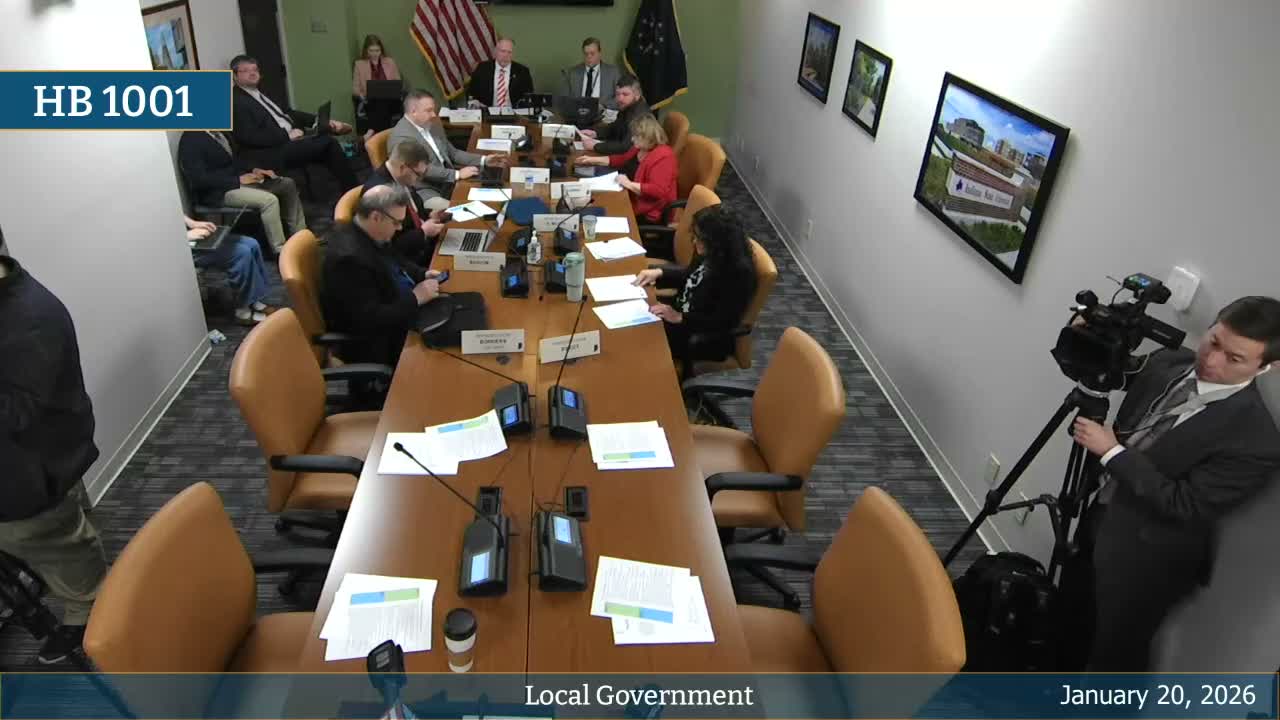
The Local Government Committee passed House Bill 1001 as amended (7-3) after more than two hours of testimony from builders, planners, mayors and housing advocates who debated impacts on local control, impact fees, ADUs and reporting requirements.
The Local Government Committee passed House Bill 1001 as amended after more than two hours of testimony that split planners and local officials from builders and housing advocates.
Representative Russell Miller, the bill’s sponsor, presented Amendment 3 and said it makes six substantive changes to the underlying bill, including narrowing townhome language to allow duplexes by right, making impact-fee changes prospective on July 1, 2026, permitting certain recreation impact fees for conversions at up to 50 percent of single‑family rates, and tightening accessory-dwelling-unit (ADU) standards to require a will‑serve letter from utilities and visual continuity with existing structures. “This is a huge paradigm shift of thought when it comes to local government,” Miller said, asking the committee to adopt the amendment, which the chair took by consent.
The bill drew broad support from industry groups and housing advocates. Jason Shelley, testifying for the American Institute of Architects (substituting for another representative), said architects support the legislation’s pro‑housing measures while acknowledging remaining life‑safety concerns. “We rise in support of this legislation,” he told the committee. Michael McQuillan of the Indiana Housing and Community Development Authority said the bill will streamline approvals and direct IHCDA to receive and analyze annual housing progress reports — including counts of proposals approved and denied and processing days — to help policymakers measure implementation.
Builders, the apartment industry and Habitat for Humanity pressed for reforms they say will increase supply. Marcy DeChong, president of the Indiana Builders Association, said Indiana faces a shortage of roughly 50,000 units and called regulatory costs one of four major drivers of housing price increases. “These kinds of rules raise costs, limit the number of homes, and reduce housing choices,” she said.
Local elected officials and planning staff raised objections centered on local control, fees and infrastructure. Scott Willis, mayor of Westfield, said his city derives roughly 90 percent of its tax base from residential property and warned that limiting park and road impact fees could “cripple our ability to keep up with what already is rapid growth.” Jacqueline Jelen, director of the Monroe County Planning Commission, and other planning officials sought clearer definitions for required reporting, asked how permit denials would be tracked, and raised concerns about funding and staffing burdens for ordinance updates.
Several witnesses emphasized the bill’s opt‑out provisions but cautioned that many communities may be unable to update codes quickly. Representatives of the Association of Indiana Counties, AIM (Association of Indiana Municipalities), and municipal managers flagged potential unintended consequences for emergency access, drainage and local budgets if state standards preempt local zoning without additional support. Town and county representatives urged clarification about how fees would be calculated and whether funds could be used to sustain planning and building departments.
After debate and a roll call, the committee approved a motion to pass HB1001 as amended. The committee recorded a 7‑3 vote in favor; Representative Johnson explained his 'no' vote citing concerns about reporting clarity and housing quality, and other members also announced 'no' votes during roll call. The bill will now proceed to the next stage in the House.
The committee’s consideration included technical changes to life‑safety language, ADU requirements and a prospective effective date for impact‑fee changes. Lawmakers and stakeholders signaled continued negotiations ahead as municipalities and the building industry seek implementation details and procedural guardrails.