Get Full Government Meeting Transcripts, Videos, & Alerts Forever!
Get email alerts on the Sb282 Compounding Medspa topic
No spam. Unsubscribe anytime.
Committee holds SB 282 after hours of testimony on compounding ingredient sourcing and med‑spa oversight
Summary
Lawmakers heard hours of testimony for and against SB 282’s vendor‑validation and med‑spa provisions. Patient‑safety advocates urged strict source verification and quick adverse‑event reporting; pharmacy owners warned that newly added amendment language could cut lawful access to compounded medicines. The bill was held for further amendment.
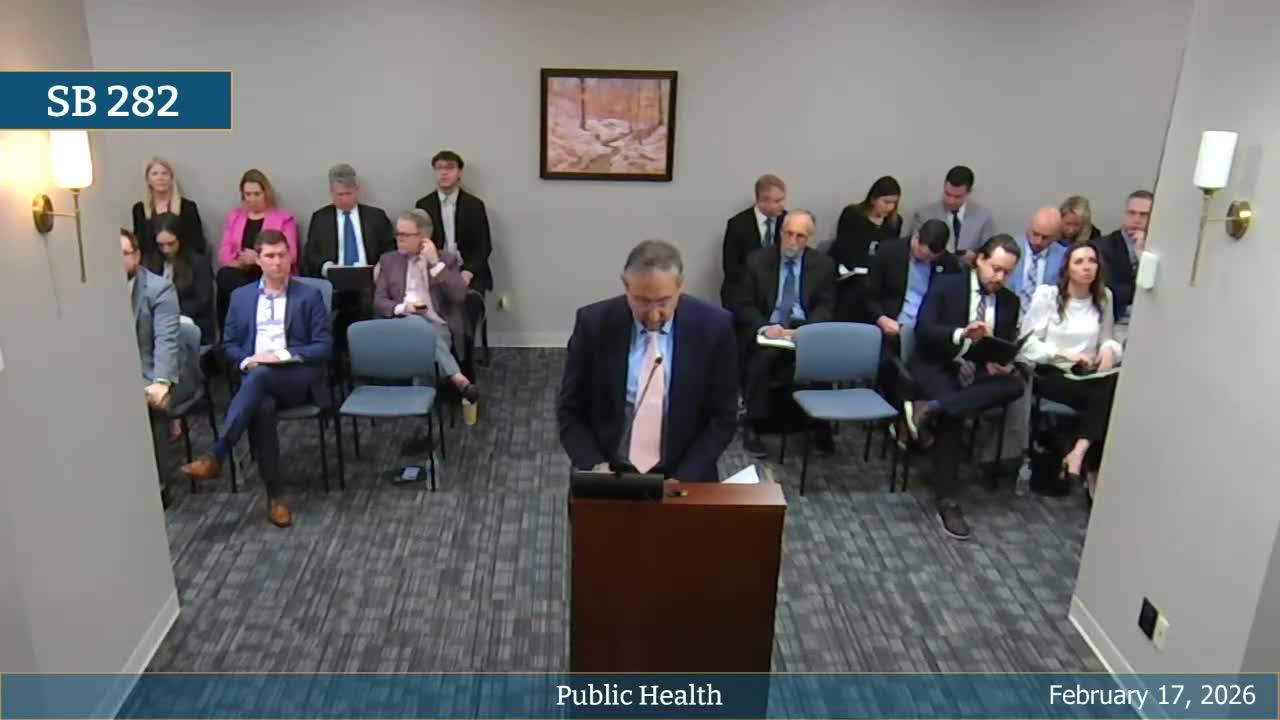
A state public health committee spent most of its session taking detailed testimony on Senate Bill 282, a wide‑ranging measure that would tighten sourcing and testing requirements for compounding pharmacies and add registration and oversight provisions for medical spas. After more than a dozen witnesses — from patient advocates, pharmacists and clinicians to trade groups and compounding business owners — the committee agreed to hold the bill so the chair can draft revised amendment language.
Patient‑safety groups and some clinicians told the committee that unsafe or unauthorized active pharmaceutical ingredients (APIs) have been making their way into U.S. supply chains, sometimes marked for compounding even when produced at facilities not registered with the Food and Drug Administration. Shabir Imbursafdar of the Partnership for Safe Medicines said vendor validation is ‘‘common sense’’ and warned that unauthorized API shipments and inadequate third‑party quality testing risk making compounded products dangerous. "Just one unauthorized manufacturer in China last year over the course of six months shipped 120 kilograms of the active ingredient for tirzepatide into the U.S.," he told the committee, and cited recent FDA warning letters as evidence that vendor verification is needed.
John Hertig, a licensed pharmacist and patient‑safety expert, told lawmakers he had seen more than 545 reports of serious patient harm tied to compounded tirzepatide and highlighted dosing and sterility failures that required hospitalization and increased poison‑center contacts. He urged requirements that compounders obtain certificates of analysis and ensure APIs come from FDA‑registered manufacturers.
Compounding pharmacists and businesses described existing safeguards they use: purchasing from registered manufacturers, reviewing certificates of analysis, sterility and endotoxin testing of sterile batches prior to dispensing, and adherence to United States Pharmacopeia (USP) standards. Ryan Hayes of Pure Pharmacy described PCAB accreditation and said a freshly released amendment’s language (references to undefined "pharmaceutical grade" ingredients or a new drug application requirement) could unintentionally block legally available compound preparations and limit patient access.
Clinicians and medical groups supporting med‑spa regulation stressed harms from unregulated or poorly supervised med‑spa activity — including infections, scarring and dosing mistakes in injectable cosmetic and IV therapies — and asked for clearer definitions of what constitutes a med‑spa, required supervision and reporting obligations. Industry trade groups said most med‑spas are legitimate medical practices and urged targeted enforcement to remove bad actors rather than broad, burdensome rules. Alex Thirsh of the American Med Spa Association described the difficulty of addressing both compounding and med‑spa issues in a single, expedited bill.
Committee members repeatedly asked whether the bill would regulate online vendors, whether Board of Pharmacy authority should expand to inspect med‑spa facilities, and whether new reporting timeframes (some witnesses supported a 5‑day adverse‑event window) provide adequate public safety protections. Several witnesses recommended the state adopt the 2023 USP standards that many leading compounding pharmacies have already implemented.
Although stakeholders disagreed on details, they agreed on two procedural points: the committee needs clearer, targeted amendment language and better enforcement pathways for known bad actors. Chair Barrett said she will work on an amendment and bring it back later in the week for additional consideration. No final vote was taken on SB 282 today.
Representative quotes: "Vendor validation is not radical — it's pretty common sense," said Shabir Imbursafdar of the Partnership for Safe Medicines. "There have been over 545 reports of patients that have been seriously harmed with compounded tirzepatide to date," John Hertig said, citing FDA safety signals and poison center activity. "This new amendment could eliminate access to legitimately compounded medications," warned Ryan Hayes of Pure Pharmacy.
Next steps: Chair Barrett will draft a revised amendment and schedule follow‑up committee consideration later in the week; the bill remains at the committee stage.