Board launches fiscal-sustainability metrics work group to spot struggling colleges early
Loading...
Summary
A newly formed business-affairs work group will develop standardized fiscal metrics, automated reports, and triggers (green/yellow/red) to detect colleges at fiscal risk; staff propose a pilot in FY27 and statewide adoption in FY28 with peer-review interventions.
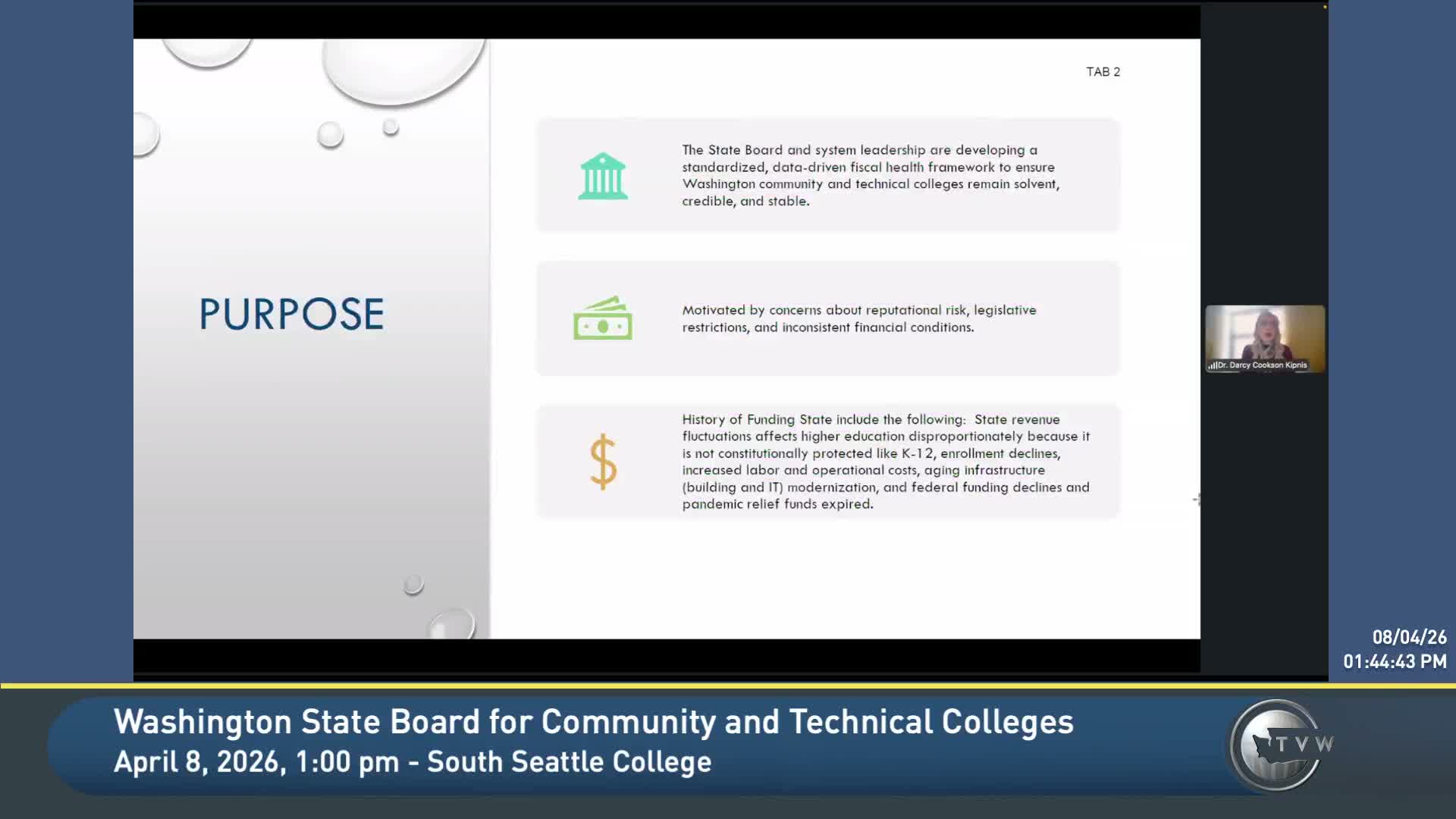
At the meeting, staff presented a new fiscal-sustainability initiative intended to give the State Board an early-warning system for colleges’ financial health. The work group — composed of business officers, CFOs and system staff — will develop a uniform set of financial metrics, standardized reporting definitions and a governance model for interventions.
Darcy Cookson Kipnis, who chairs the committee, said the group’s purpose is “to develop a standardized data driven fiscal framework to ensure Washington community and technical colleges remain solvent, credible, and stable.” Panelists emphasized that the framework aims to be predictive — detecting problems early — rather than a postmortem audit.
The work group listed guiding principles: a single standardized dataset (reducing redundant reporting), independent fair reviews, annual baseline reviews combined with increased monitoring at identified risk points, and automation wherever possible to reduce manual-entry errors. Presenters repeatedly flagged legacy and conversion issues tied to the systemwide enterprise platform (CTC Link) and high staff turnover in campus business offices as obstacles to data quality.
Panelists described a color-coded monitoring approach (green/yellow/red) tied to trigger definitions. If a college moves into yellow or red, the plan calls for more frequent monitoring and a mix of peer review, state-board staff assistance and targeted interventions rather than immediate punitive action. The group also plans to define which metrics should be monitored quarterly (for example cash-on-hand and short-term liquidity) versus those better suited for annual review (for example governance or leadership stability).
Timeline and governance: staff proposed a pilot in Fiscal Year 27 (volunteer colleges) and full implementation in FY28. The pilot is intended to test automated reports, scoring rubrics and peer-review processes before broader rollout. Presenters said this internal monitoring effort is distinct from performance audits the legislature may request and emphasized the work’s collaborative support role.
Why it matters: a standard, timely and credible set of fiscal indicators could let the board and peer institutions provide support before a college faces a crisis, reducing risk to students and regional program continuity.
Next steps: finalize metric definitions and reporting feeds, reduce question sets to a concise, operational dataset, recruit pilot sites for FY27 and publish a timeline and governance charter for review by the board.