State board says advocacy narrowed proposed cuts; running start funding trimmed pending tax change
Loading...
Summary
Board staff told members the legislative session left community and technical colleges in a better position than earlier forecasts after advocacy narrowed an initial 1.5% operating cut; summer running start funding was reduced modestly under Senate Bill 6260 with restoration linked to a future tax change.
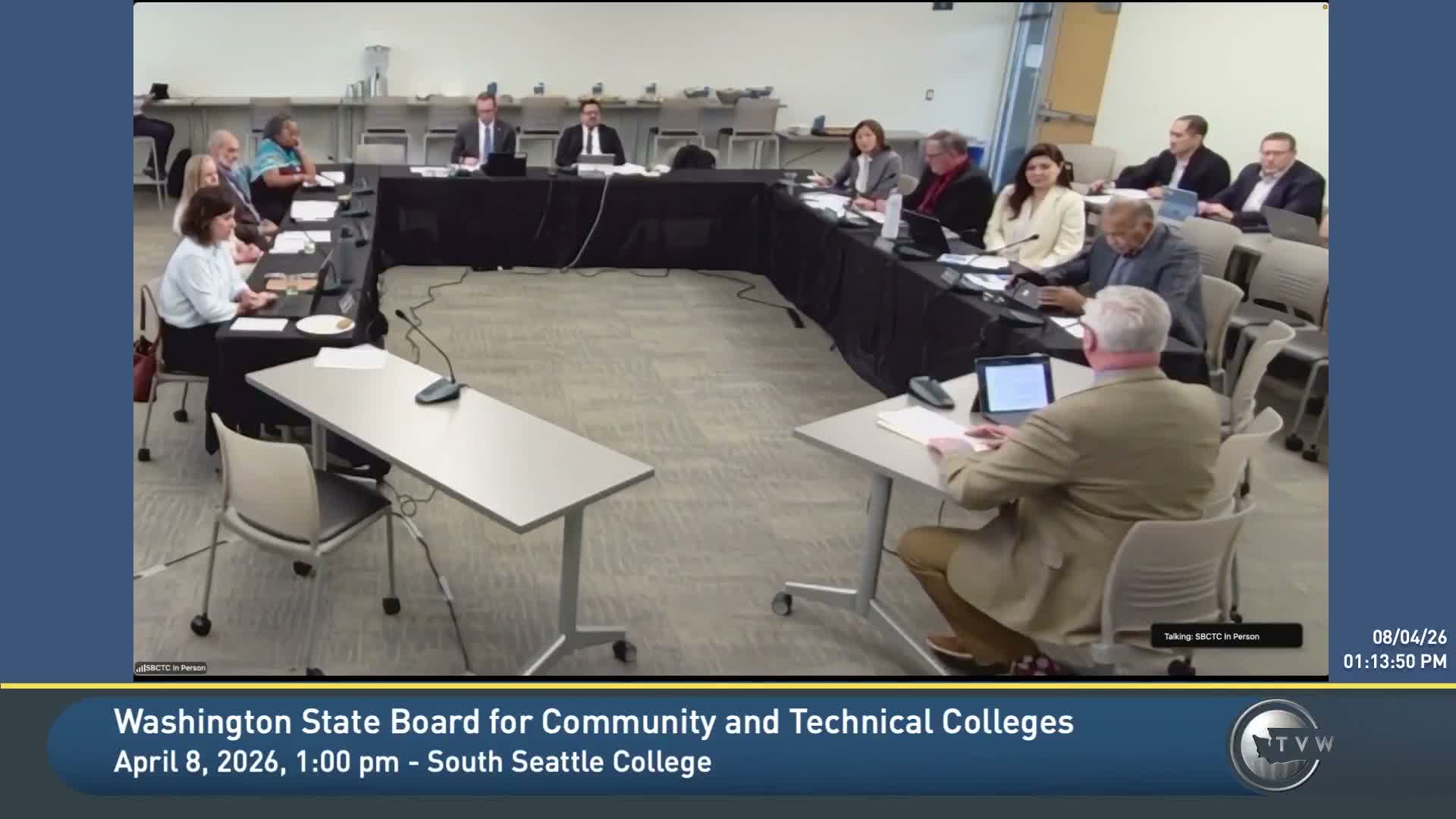
Board staff briefed the Washington State Board for Community and Technical Colleges on the 2026 legislative session and its implications for the system’s operating and capital budgets. The board’s legislative director summarized how early proposals from the governor’s office would have cut roughly 1.5% from the system’s operating budgets, and said coordinated advocacy helped narrow those impacts.
The legislative director told the board that the operating proposal the system initially faced would have left a significant gap but that staff and partner college presidents worked with legislators to limit the harm. He said the governor’s proposed changes included a rollback of a recent expansion of running start programs, but negotiations produced a partial solution: funding for running start in Senate Bill 6260 was reduced from an assumption of 1.4 full-time-equivalent students to 1.3 (a roughly $7 million hit), with language that would restore full summer running start funding if a future millionaire’s tax is enacted in 2029.
The board’s presentation also described how staff closed an operating shortfall by transferring one-time capital funds into operating this biennium. “We were able to close that operating gap with one-time funds moved from the capital budget — building fees,” the legislative director said, noting the legislature moved $72,000,000 of student building fees into the operating budget in the supplemental session to help cover immediate needs. Staff emphasized that the transfer was a timing and cash-flow decision for this biennium and said the system is monitoring building-fee collections closely.
Why it matters: the operating budget represents the ongoing capacity of community colleges to deliver instruction and services; reductions or one-time fixes can change program and staffing choices across campuses. Board members asked how the legislature treated four-year institutions compared with community colleges and were told the approaches were similar in several respects, including moving certain building-fee revenue into operating accounts.
The legislative director also flagged risks ahead: bargaining over state employee salaries, continuing pressures on utility and operating costs, and pending work linked to the McCleary decision and other funding obligations. Board members heard that staff intend to continue advocacy and to leverage relationships between college presidents, trustees and legislators to press for funding stability going into the next session.
Next steps: staff will continue to monitor allocations, report on any follow-up budget actions, and brief the board on how the running start implementation and funding language evolve over the coming months.