Get Full Government Meeting Transcripts, Videos, & Alerts Forever!
Get email alerts on the Gaming Casino Relocation topic
No spam. Unsubscribe anytime.
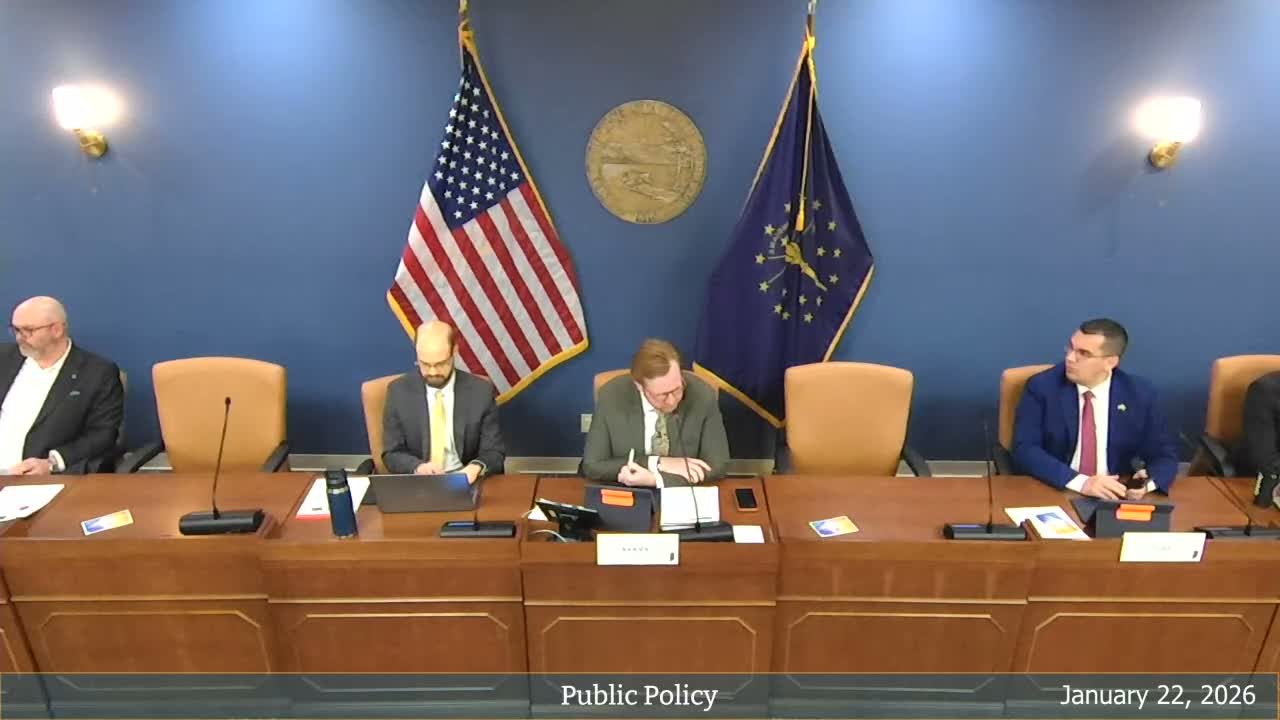
House Public Policy panel advances amended bill to relocate Rising Sun casino license, adds counties
Summary
The committee approved an amendment to HB 1038 that would relocate (not create) the Rising Sun casino license through a competitive process limited to current Indiana license holders, adding DeKalb, Steuben and Wayne counties; the amendment sets application dates, investment and compensation rules and passed the committee with a 9–1 recorded tally.
A House Public Policy Committee on Thursday advanced an amended version of House Bill 1038 that would allow the existing Rising Sun casino license to be relocated through a competitive process limited to current Indiana license holders and expand the list of eligible counties to DeKalb, Steuben and Wayne.
The amendment — taken by consent and later advanced out of committee — lays out a timeline for the Gaming Commission to accept applications from Oct. 1 through Dec. 1, publish a public summary by Jan. 15, accept supplemental sealed bids if needed, and approve or deny applications by April 15. It preserves the license cap by relocating an existing license rather than creating a new one.
Chairman Manning said the competitive process is limited to current Indiana licensees to allow the commission to complete required vetting in the compressed schedule, and the amendment requires the commission to hire a third-party consultant to determine fair market value for the Rising Sun license if the incumbent does not win. “We changed the approach. There is still a competitive process,” Manning said, outlining the timeline and eligibility rules.
Representative Justin Moed, who discussed an earlier amendment, said the changes would give OTB venues and horse-racing facilities greater flexibility to modernize. “This would allow them to modernize the gaming that is done inside those institutions,” Moed said.
Financial terms in the amendment include a $50,000,000 fee to the state (payable in installments) and a one-time $30,000,000 payment to the city and county of Rising Sun, triggered when the license transfers and the existing Rising Sun facility closes. The amendment also retains a $500,000,000 minimum investment requirement for a relocated facility, requires 60% of that investment be spent in the first phase and the remainder within five years, and adds anti-flip language including a $50,000,000 payment to the state if the facility is sold within ten years without meeting the investment threshold.
Local officials and industry representatives gave mixed testimony. Melissa Vance, president and CEO of the Wayne County Area Chamber of Commerce, told the committee that Wayne County has broad local alignment and a distribution plan for the revenue if it is selected. “We are...completely open to a referendum,” Vance said, adding that Wayne County believes its location near Dayton and Columbus will attract visitors.
Andy Bodenestel, city attorney for Rising Sun, cautioned the committee that a $30,000,000 lump-sum payment may not replace the long-term revenue the city and county would lose. He said the city and county historically receive about $5,000,000 combined annually and urged clearer redevelopment and remediation commitments from any licensee that vacates Rising Sun. “The figure in the amendment vastly undervalues the revenue that will be lost by the city and the county,” Bodenestel said.
Alex Stoyer, chief development officer for Full House Resorts (owner of the Rising Sun license), said the company supports limiting new licenses and that the relocation approach should not financially harm incumbent operators. “This is definitely a better approach than creating a whole new license,” Stoyer said, but asked for protections to ensure incumbents are compensated if they do not win the competitive bid.
The committee took the amendment by consent and later voted to advance the amended bill; the chair left the roll open briefly so absent members could arrive, and the final committee tally was recorded as 9–1 in favor of advancing the bill (with several members excused). The committee recorded no immediate floor action on specific land or redevelopment obligations; sponsors said fiscal staff and IEDC will continue work on details.
The bill will move to the next legislative stage with the amendments in place; sponsors said further fiscal and redevelopment details will be addressed in follow-up work with the state economic development agency and the Ways and Means Committee.