Get Full Government Meeting Transcripts, Videos, & Alerts Forever!
Get email alerts on the Bmv Agency Bill topic
No spam. Unsubscribe anytime.
House panel clears BMV agency bill that adds optional remote testing, clarifies CDL language and limits certain billboard ads
Summary
The Roads and Transportation Committee passed HB1200, an omnibus BMV bill containing remote proctored knowledge testing (excluding CDLs), a reduction in the driver’s license eligibility age to 16, codified English-proficiency language for CDLs, senior vision-exam timing changes, historic plate personalization, online renewal adjustments, and a deadline to remove billboards advertising criminal activity; the amended bill passed 13-0.
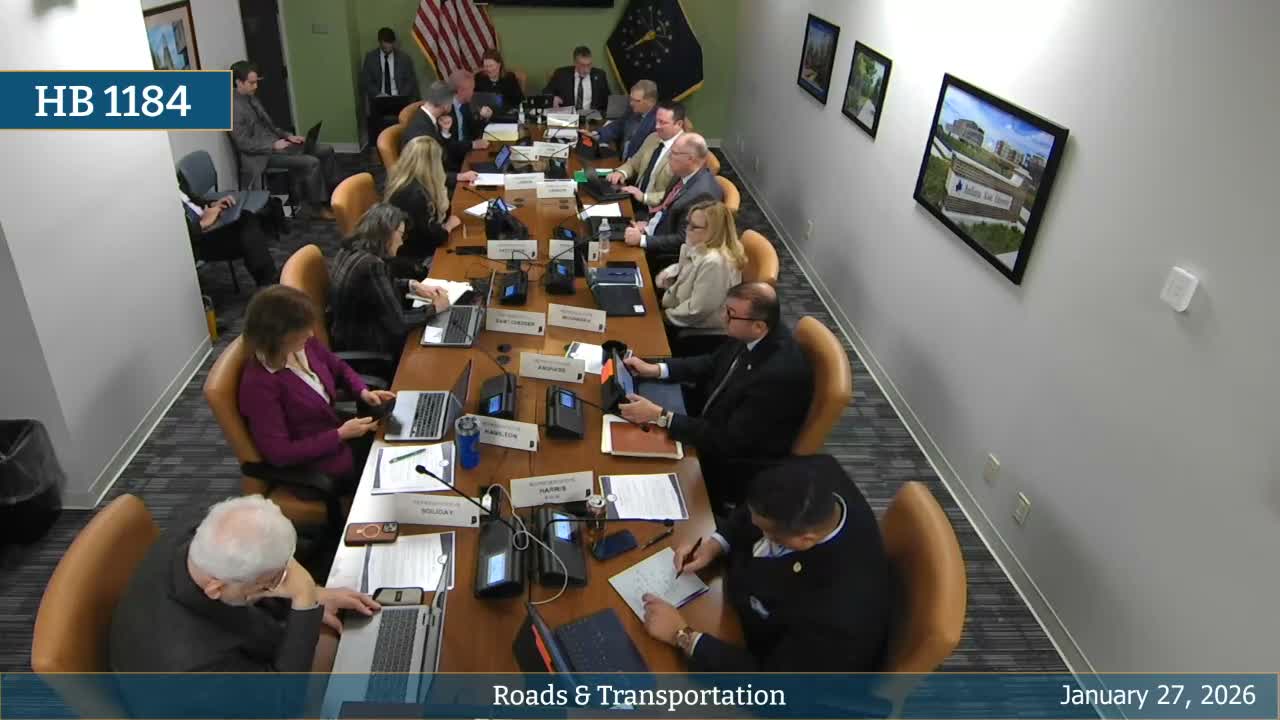
The committee considered House Bill 1200, the annual Bureau of Motor Vehicles (BMV) agency bill, and adopted multiple amendments before voting it out of committee.
BMV General Counsel Matthew Kestin testified in support and outlined the bill’s components as practical fixes intended to improve customer service and reduce branch congestion. Among the provisions Kestin described: authorizing optional, proctored remote knowledge exams for standard driver licenses (explicitly excluding CDL knowledge exams), clarifying non-expiring credential language for service members temporarily residing outside Indiana, replacing “one month” with “30 days” for renewal calculations, extending the vision-exam validity window for Hoosiers 75 and older from 30 to 60 days for remote renewals, allowing personalization for historic license plates, removing an online-renewal cutoff for ID cards expired more than 180 days, and deleting redundant questions about prior suspensions or felony convictions that BMV said are already covered by national databases.
Sponsor and committee amendments removed a rounding change that Ways and Means is addressing, struck a provision on junk vehicle titles that was removed from the bill, and added Amendment 8 to permit certain vehicles (for example buses) to use camera technology in lieu of exterior mirrors, aligning with evolving safety technology. The sponsor also offered Amendment 2 concerning billboard advertising, which would require removal of billboards advertising criminal activity by Oct. 1, 2026; the chair explained this follows last year’s policy intent and is intended to prevent companies from exploiting contract windows.
Ron Breimier, representing the Outdoor Advertising Association of Indiana, said the out-of-state companies responsible for many contested billboard ads are not members of his association and preferred a later deadline to give firms time to replace advertising. Kestin and the sponsor described other technical clarifications included in the amended bill, including a requirement that CDL applicants be English proficient (language mirroring federal standards) and that drivers be able to converse roadside in English. After discussion and testimony, the committee passed the amended bill 13-0.
The measure will be reported out of committee for further House consideration.