Goochland opens budget hearings as data‑center tax debate and utility fee increases draw public concern
Loading...
Summary
At public hearings April 7, Goochland staff advertised a $0.50 per $100 proposed real estate rate, previewed a FY27 budget with a general‑fund increase of about 4.6%, and presented a staff analysis showing a hypothetical 500,000 sq. ft. data center could generate millions in annual revenue — prompting resident concern about infrastructure, power needs and long‑term impacts.
The Goochland County Board of Supervisors opened public hearings April 7 on the proposed 2026 real estate tax rate and the FY27 county budget and fee schedule, and heard a staff presentation on the county’s Technology Overlay District and potential revenue from data‑center development.
Staff presented an advertised real estate tax rate of $0.50 per $100 of assessed value to offset a roughly 5% assessment increase. Denise Sandlin told the board the county’s general‑fund budget proposal is about 4.6% higher than the prior year, while an all‑funds figure is higher because of transportation and debt service items tied to capital projects.
Sarah Worley, deputy county administrator for economic and community development, briefed the board on regional competitiveness for data‑center projects and presented a modeled example of a 500,000 square‑foot campus. At the current Goochland data‑center rate of $0.40 per $100, staff estimated a 500,000‑sq. ft. facility could generate about $1.2 million in business personal property tax revenue and, combined with real estate tax, roughly $3.4 million annually; an AI‑focused center could produce materially more, staff said.
Several residents tied the data‑center conversation to the ValleyLink transmission debate, urging the board to consider the energy and water infrastructure such facilities require. Theresa Henderson warned that AI‑era data centers require high rack density and far greater power and cooling capacity than earlier generations, and said those infrastructure demands are tightly linked to transmission planning.
Staff also presented proposed utility fee changes based on a revised 2026 rate study: a 3% residential base and volumetric increase and similar commercial adjustments, plus a modest connection fee change. The proposed residential impact on a 4,000‑gallon bimonthly bill would be about $3.67 and the commercial bimonthly impact $5.71, staff said.
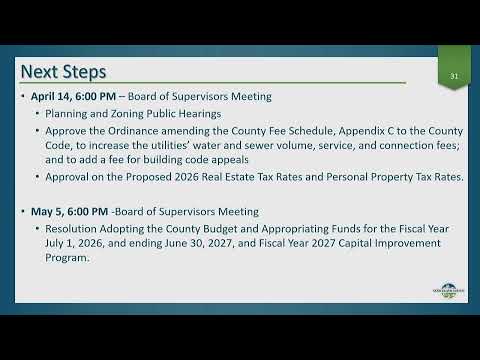
Public commenters voiced both support for long‑term economic development and concern that data centers are a short‑term fiscal fix that may not deliver sustained, diversified employment. The board took public comment and scheduled budget adoption and fee ordinance consideration for upcoming meetings (April 14 and May 5).