Get Full Government Meeting Transcripts, Videos, & Alerts Forever!
Get email alerts on the Transportation Infrastructure topic
No spam. Unsubscribe anytime.
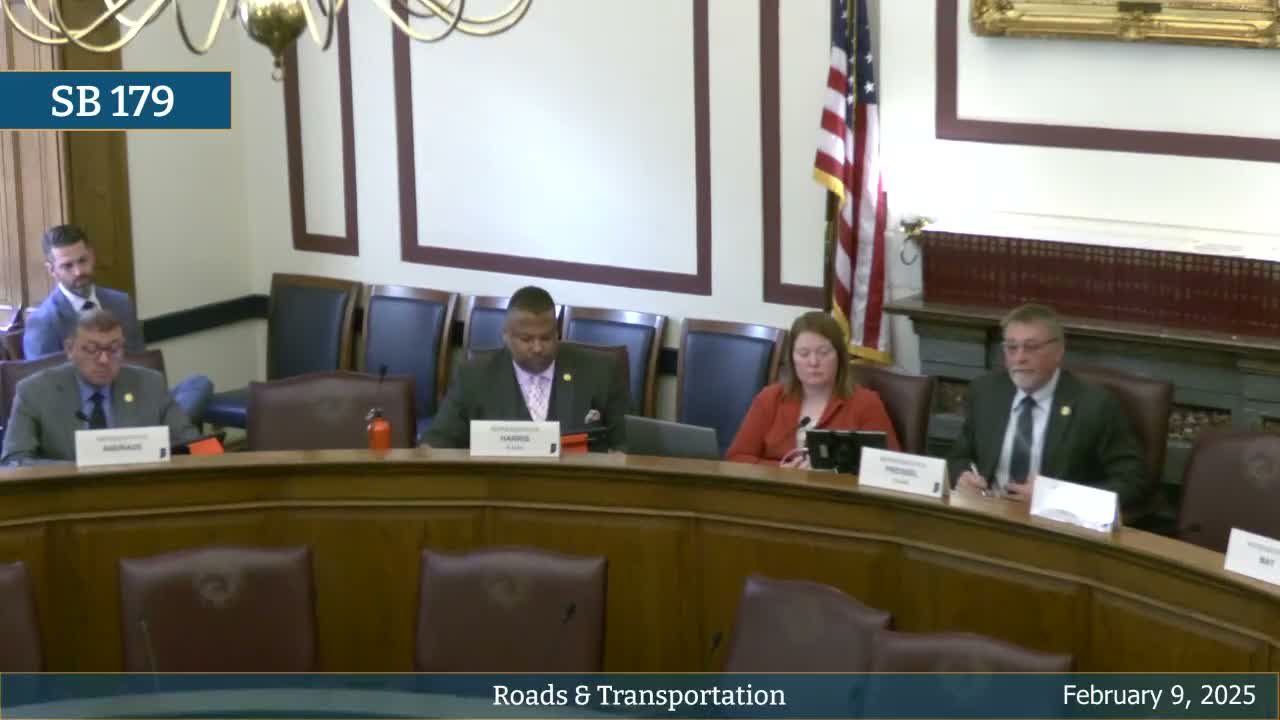
NDOT agency bill advances technical updates and grants but stalls over inspector liability
Summary
Senate Bill 179 would modernize NDOT GIS rules, accelerate local lane‑mile distributions and add $75 million for reconsidered Community Crossings grants — but debate over a provision limiting liability for private construction inspection firms prompted members to hold the bill for amendments.
Senate Bill 179, the NDOT agency bill, would make technical and programmatic changes to Indiana’s transportation law while creating a pathway for the department to assume federal environmental review responsibilities.
Matt Hubelar, secretary of transportation infrastructure, told the House Roads and Transportation Committee that the bill includes statewide updates to the state plane coordinate system and datum language that will let NDOT modernize GIS systems. The measure also clarifies that single‑trip trucking permits expire five days after issuance, accelerates lane‑mile distributions from June 30, 2027, to June 30, 2026, and sets aside $75 million to reconsider applicants who were denied Community Crossings matching grants in December. “These changes incur no cost to the agency and are purely technical in nature,” Hubelar said in testimony in support of the bill.
A contested element of SB 179 would limit liability for private construction engineering inspection (CEI) firms that perform observation, documentation and reporting for NDOT projects. Proponents, including Kristen Walker, an ACEC insurance adviser, and Michael Rowe, president of United Consulting, said frequent third‑party lawsuits and rising insurance costs are pressuring small CEI firms and that narrowly drawn immunity for observation tasks — as adopted in some other states — preserves taxpayer value by making privately contracted inspection feasible. Walker said CEI firms she represents sometimes face “3 or 4” suits a year and that underwriters are increasing deductibles and nonrenewing policies in response.
Opponents—including Sean Roth, a personal‑injury attorney, and Richard Hedgecock, president of Indiana Constructors Inc.—warned that broad statutory immunity could leave injured plaintiffs without recovery and shift risk to prime contractors or the state. Roth said immunity “in its very essence means you did breach the standard of care … and we’re going to give you a pass,” while Hedgecock argued that prime contractors control worksites and already indemnify the state; exempting CEI firms from negligence claims, he said, could force primes to bear liability for parties they do not employ or control.
The bill also contains language enabling Indiana to apply for NEPA assignment, a federal program that lets states assume responsibility for environmental reviews for federally funded highway projects. Hubelar said NEPA assignment has shortened review timelines in peer states and could reduce delays and costs for some projects.
Committee members on both sides acknowledged the competing priorities: lowering costs and insurance burdens for small professional firms, and preserving accountability for negligence and redress for injured parties. Chairman Rep. Jim Pressell said he would hold the bill to allow amendments and additional testimony next week, asking stakeholders to provide feedback on amendment language.
The committee did not vote on SB 179. The bill will return for further amendment and testimony.