Get Full Government Meeting Transcripts, Videos, & Alerts Forever!
Get email alerts on the Performance Based Rate Making topic
No spam. Unsubscribe anytime.
Indiana lawmaker previews limited performance-based rate-making bill to curb bill shocks and boost reliability
Summary
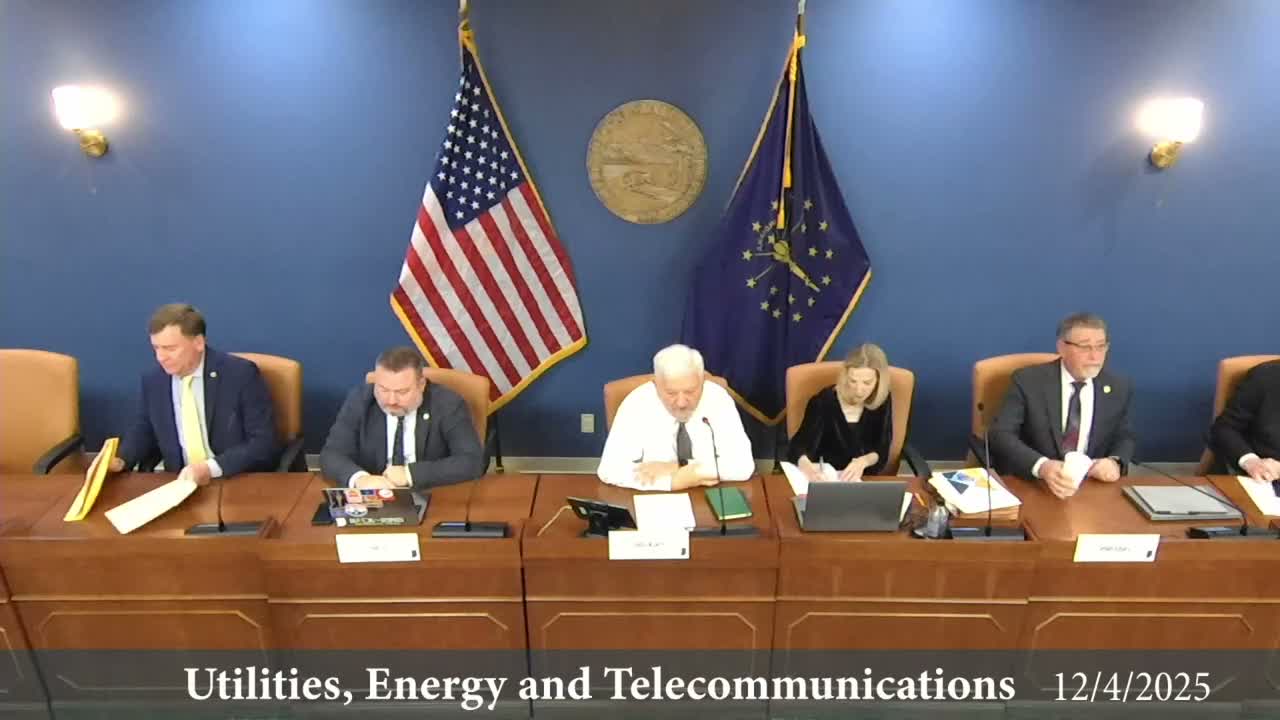
Representative Schonkweiler told the Utilities, Energy and Telecommunications committee she will introduce an incremental PBR bill next year that centers on resource adequacy, customer-focused reliability and affordability measures such as mitigating seasonal bill shocks, adjusting disconnection criteria, and exploring budget-billing options. Staff presentations highlighted trade-offs, large-load rules in HEA 1007, and a pending IURC docket.
Representative Schonkweiler previewed a bill the committee will consider next year that would take incremental steps toward performance-based rate making (PBR) for investor-owned electric utilities, focusing on reliability, resilience and near-term affordability for low-income households.
"This is the essence of performance based rate making or PBR," Representative Schonkweiler said, describing PBR as a way to define outcomes, measure utility performance against them and tie earnings to success. She repeatedly stressed the draft is conceptual and that negotiable details remain under discussion.
The bill, Schonkweiler said, would prioritize three areas: resource adequacy (planning for sufficient capacity), customer-focused reliability (measurable outage and restoration performance) and affordability. On affordability she described several near-term tools under consideration: steps to reduce seasonal bill shocks, review of disconnection criteria to account for extreme heat or cold advisories, strengthening utility assistance programs and exploring budget-billing adjustments so customers face smaller, more predictable true-ups.
"We're trying to do something that takes that [bill] shock out," she said, adding the proposal would include transparency on true-ups and that staff would aim to truing up twice a year rather than once.
Luke Wilson, chief policy officer at the Indiana Office of Energy Development, gave a technical overview of rate-making basics and the policy choices that drive costs into rates. Wilson described demand charges and cost allocation to explain why a brief spike in usage can create a large annual bill for some customers, using a water-pipe analogy: "A demand charge is essentially trying to account for ... how big of a pipe do you need for your maximum water use at a time?"
Wilson also walked members through the large-load treatment established under House Enrolled Act 1007: an expedited certification process and an "EGR" portfolio path. He said the statute lets a large customer and a generator structure payments so that a new large load can help cover fixed costs for the system, but that the expedited path requires strong financial assurances (for example, a customer committing to pay a large share of a project's cost).
Wilson highlighted a pending utility filing as a real-world example: a NIPSCO agreement with Amazon that he described to the committee as a roughly $7,000,000,000 deal tied to a 2.6-gigawatt natural-gas plant and 400 megawatts of battery capacity. He said Amazon has committed to pay transmission and generation construction costs and that NIPSCO has proposed returning some of that fixed-cost money to customers as a monthly bill credit in the utility's IURC docket.
A consultant who summarized the IURC-commissioned Christensen (CA Energy Consulting) study told members that no single, pure PBR model exists and that most jurisdictions implement a mix of multiyear rate plans and performance-incentive mechanisms (PIMs). The presenter said stakeholders in the state-level study were generally open to incremental, optional changes but warned of significant design complexity: data requirements, the difficulty of defining a valid "but-for" baseline to judge PBR success, and risks of unintended consequences when incentives shift utility focus.
Committee members raised several concerns and design questions. Representatives asked how the committee would demonstrate whether customers ultimately pay more or less under PBR, how to protect low-income customers, and whether certain statutory pathways could let utilities avoid the consumer protections the House had previously added. One member said the House had tried to limit consumer exposure when new generation is built but that the Senate had not preserved that limitation, a point flagged as an outstanding drafting risk.
The chair closed by reiterating the committee will not take public testimony or votes today and that staff would circulate the IURC materials. He said the committee expects to use limited hearing time in early January to continue deliberations. The meeting adjourned without votes.