Get Full Government Meeting Transcripts, Videos, & Alerts Forever!
Get email alerts on the Water Policy topic
No spam. Unsubscribe anytime.
Committee approves targeted changes to let water utilities track chemical and power costs
Summary
Senate Bill 241 would permit limited pass-through recovery for chemical and power costs in water/wastewater utilities (a tracker limited to these two categories), raise the conservancy-district withdrawal threshold from 2,000 to 3,000 customers, and add narrow economic-development language; committee passed the bill as amended 12-0.
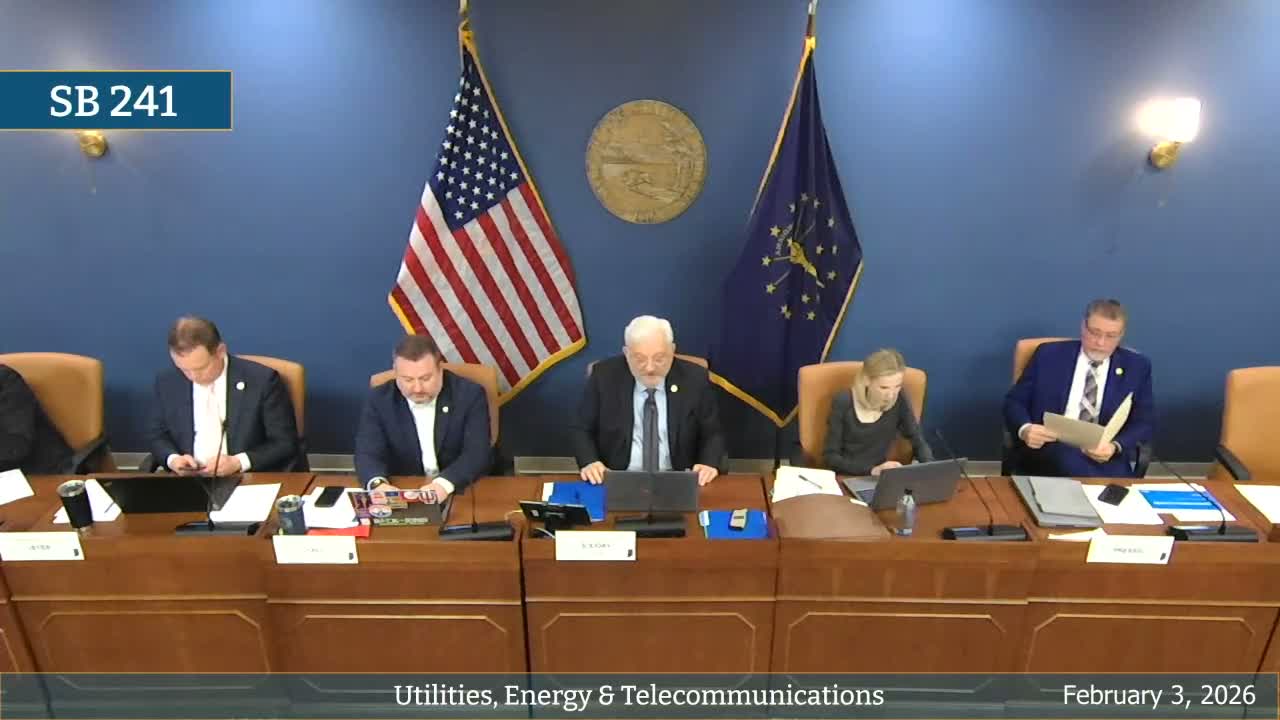
Sen. Cook told the committee that Senate Bill 241 is a targeted adjustment to the Service Enhancement Improvement (SEI) statute that would let water and wastewater utilities recover specific O&M costs outside their control—only chemical and power costs—through a true pass-through mechanism that credits customers if costs fall and allows recovery if costs rise. "This is a narrowly tailored update to SEI, allowing water and wastewater utilities to true up those specific O and M costs," Sen. Cook said.
Under the bill, a utility may petition the Indiana Utility Regulatory Commission for cost recovery only if at least two years have passed since the last rate case and chemical or power costs have changed by at least 3 percent. The legislation also raises the threshold for conservancy districts to withdraw from IURC jurisdiction from 2,000 to 3,000 customers and adds language enabling rural utilities to negotiate rate structures with high-volume users while protecting other customers.
Witnesses varied in tone. Bridget O'Connor of Citizens Energy Group said Citizens has deferred rate cases for most years and supports a mechanism that balances affordability and necessary cost recovery, noting chemical costs for her utility rose by over 100% since its last rate case in 2016. Joe Rampolla of the Indiana Industrial Energy Consumers said his group is neutral but generally cautious about tracking mechanisms; Kerwin Olsen (CAC) and others urged guardrails and attention to affordability.
The chair offered a narrow amendment to allow certain nonprofit workforce-housing providers relief on connection fees by permitting payment over time; the chair said the language was negotiated with utilities and staff to limit scope. Committee members asked for clarity about which organizations would qualify; the chair said he would follow up privately. The committee voted SB 241 out of committee as amended by roll call, 12-0.