Get Full Government Meeting Transcripts, Videos, & Alerts Forever!
Get email alerts on the Grid Modernization topic
No spam. Unsubscribe anytime.
Committee advances bill to study surplus interconnection service to speed grid additions
Summary
Senate Bill 240 would direct Indiana utilities to analyze 'surplus interconnection service' (SIS) in IRPs and require an IURC study to assess whether underused interconnection capacity can host new generation or storage, a measure proponents say could lower costs and avoid transmission upgrades.
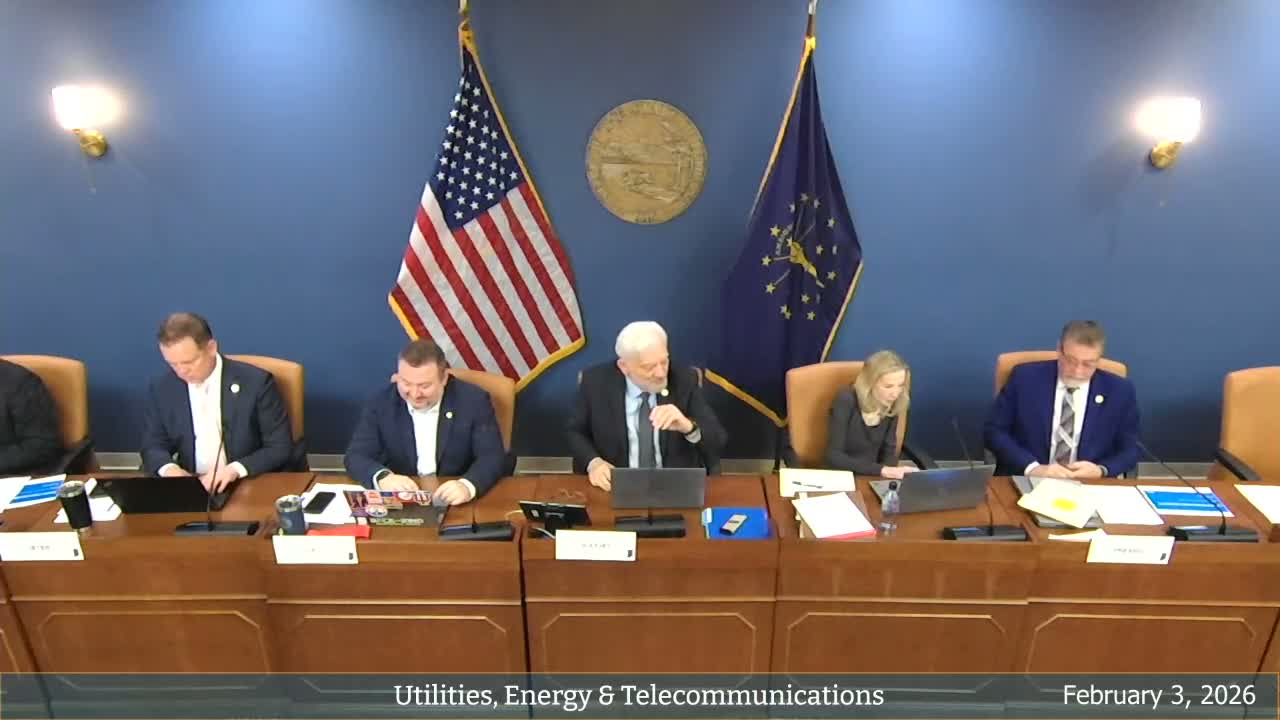
Sen. Cook (sponsor) told the House Utilities, Energy and Telecommunications Committee that Senate Bill 240 is intended to lower utility costs by creating a statutory framework for surplus interconnection service, or SIS, which allows new generation or storage to connect at existing generator sites and share interconnection capacity.
The bill would require electric utilities, after Dec. 31, 2029, to analyze whether SIS can meet immediate capacity and energy needs in their integrated resource plans (IRPs) and direct the Indiana Utility Regulatory Commission to study SIS implementation. “Providing SIS as an option for utility providers helps meet demand, reduce costs, and can defer or avoid expensive upgrades needed for new transmission,” Sen. Cook said.
The proposal drew support from policy and industry witnesses. Ginny Netherton of the Pew Charitable Trusts told the committee that national reforms at the Federal Energy Regulatory Commission and activity in regional transmission organizations have enabled SIS processes and that average interconnection delays nationally can reach roughly 40 months. "SIS is an underutilized mechanism that allows a new supply resource like energy generation or storage to piggyback off the underutilized interconnection of an existing resource," Netherton said. She cited analysis that more than 40% of existing Indiana generation operates at less than a 33% capacity factor and that underused sites could host significant gigawatts of new resources.
Industry and advocacy groups largely supported the bill as a study and reporting mechanism rather than a mandate. Carol Auslander of Advanced Energy United urged harmonizing numeric thresholds in the draft—pointing out the bill as written references a 25‑megawatt assessment threshold in one place and a 20‑megawatt definition elsewhere—and recommended lowering those limits to enable more projects to qualify. Luke Wilson of the Indiana Office of Energy Development described the bill as a tool to maximize existing grid injection points and provide a lower-cost path for new generation.
Committee members pressed witnesses on practical limits of SIS, including site specificity and the fact that SIS rights are subordinate to the original interconnection agreement. Netherton said SIS is typically eligible for only one year past the controlling large-generator interconnection agreement, a detail the committee said it would consider in future drafting.
The committee adopted a technical amendment narrowing reporting obligations by consent and voted SB 240 out of committee by roll call, 12-0. The bill now moves to the next stage of the legislative process for further consideration.