Get Full Government Meeting Transcripts, Videos, & Alerts Forever!
Get email alerts on the Public Health Modernization topic
No spam. Unsubscribe anytime.
Committee advances public-health modernization bill after briefing on $206.9 million rural-health award
Summary
The House Health Committee voted 13-0 to pass HB 13-58, the Department of Health agency bill, after a presentation from State Health Commissioner Dr. Lindsey Weaver about a $206.9 million federal Rural Health Transformation award and several consented amendments including changes to home health aide training and a Parkinson’s registry addition.
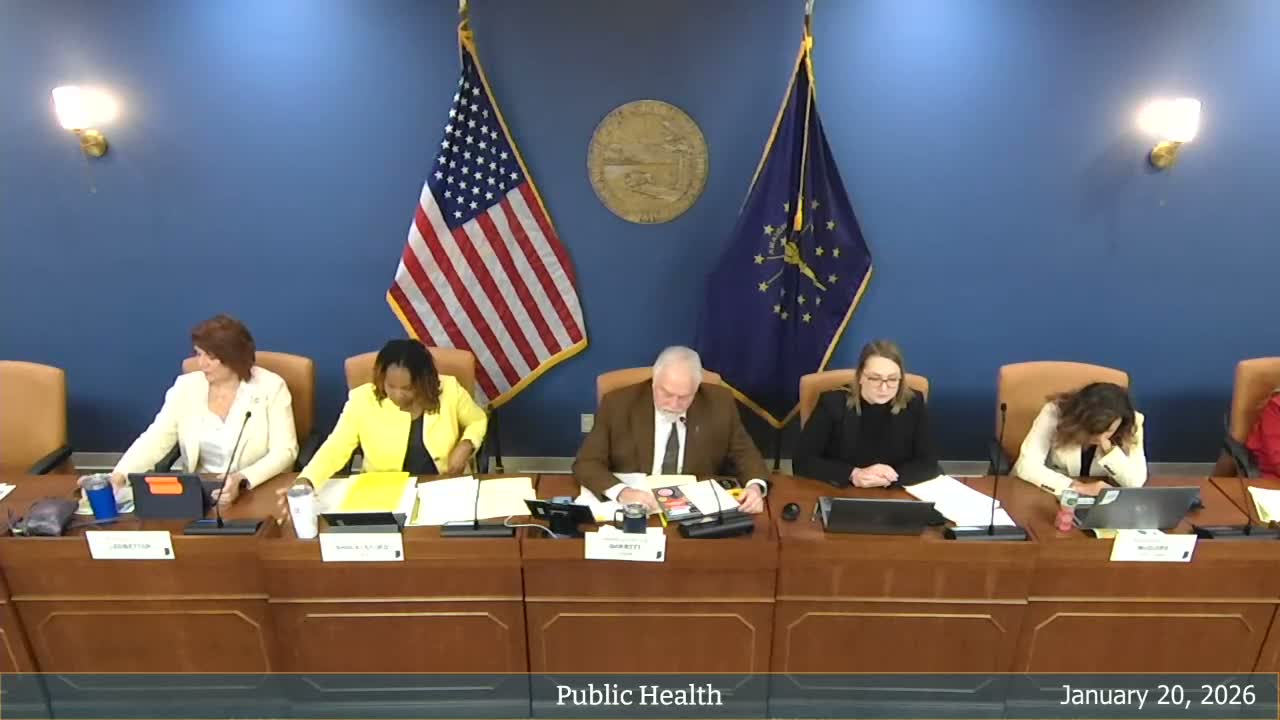
The House Health Committee on [date] passed House Bill 13-58, the Indiana Department of Health agency bill, by a 13-0 roll call after amendments were adopted by consent. Committee members heard a detailed briefing from State Health Commissioner Dr. Lindsey Weaver on a newly awarded Rural Health Transformation grant and on the bill’s modernization measures.
Dr. Weaver said Indiana was awarded $206,900,000 for the five-year rural transformation program and summarized 12 statewide initiatives intended to improve access, workforce, interoperability and behavioral-health capacity in rural communities. "We were really excited to find out on December 29 that Indiana was actually awarded 206,900,000.0," Dr. Weaver said, adding that the award includes regional grants and statewide programs designed with sustainability plans because the federal funding is one-time.
The bill also seeks to streamline Department of Health reporting and align certain deadlines with federal requirements. Ethan Wright, legislative and external affairs director for the Department of Health, told the committee the measure would align the department’s hospital reporting deadline with CMS’ Oct. 1 deadline and move annual reports onto a public dashboard to keep data more current.
Lawmakers adopted three amendments by consent during the hearing. Representative Goss Reeves presented Amendment 1, removing a statutory mandate that a home health aide competency program include at least 75 hours of training and 16 hours of classroom work before supervised practical training; Reeves said the prior standard was reducing access to care. "I am being told that the 75 hours is not improving that care. It is actually decreasing access to care," Representative Goss Reeves said. Representative Hamilton successfully sought consent to add Parkinson’s disease to the state’s chronic-disease registry, arguing registries can improve research and treatment; "better data will lead to better research and better treatments," Hamilton said.
The committee also discussed program details and oversight. Dr. Weaver said the first funding cycle requires rapid spending (20 months for the initial cycle) and that regional grants will be evaluated for outcomes and sustainability. Committee members asked whether the medical-school training requirements would apply to both Indiana University and Marian University; Weaver replied both schools had committed to implementing the rural-rotation and nutrition training components.
A motion to pass the bill as amended was made and seconded; a roll call produced unanimous support. The committee recorded the vote as 13-0 in favor. The bill now moves forward with the record that the agency reported a major federal award and detailed plans for deploying the funds across statewide initiatives and regional grants.
What’s next: the department will issue application materials and RFPs, and agency staff said they will provide further details on stipend amounts and other operational specifics in the application materials and pre-award oversight documents.