Get Full Government Meeting Transcripts, Videos, & Alerts Forever!
Get email alerts on the Utilities Rate Reform topic
No spam. Unsubscribe anytime.
Committee hears bill to allow three‑year rate plans, add summer shutoff protections and low‑income assistance
Summary
The Utilities, Energy and Telecommunications committee heard testimony on House Bill 1002, which would authorize three‑year multiyear rate plans with narrowly tailored performance incentive mechanisms, require low‑income assistance programs by July 1, 2026, and expand disconnection protections during extreme heat for LIHEAP‑eligible households. Supporters said the measure targets affordability; utilities warned technical language needs fixes.
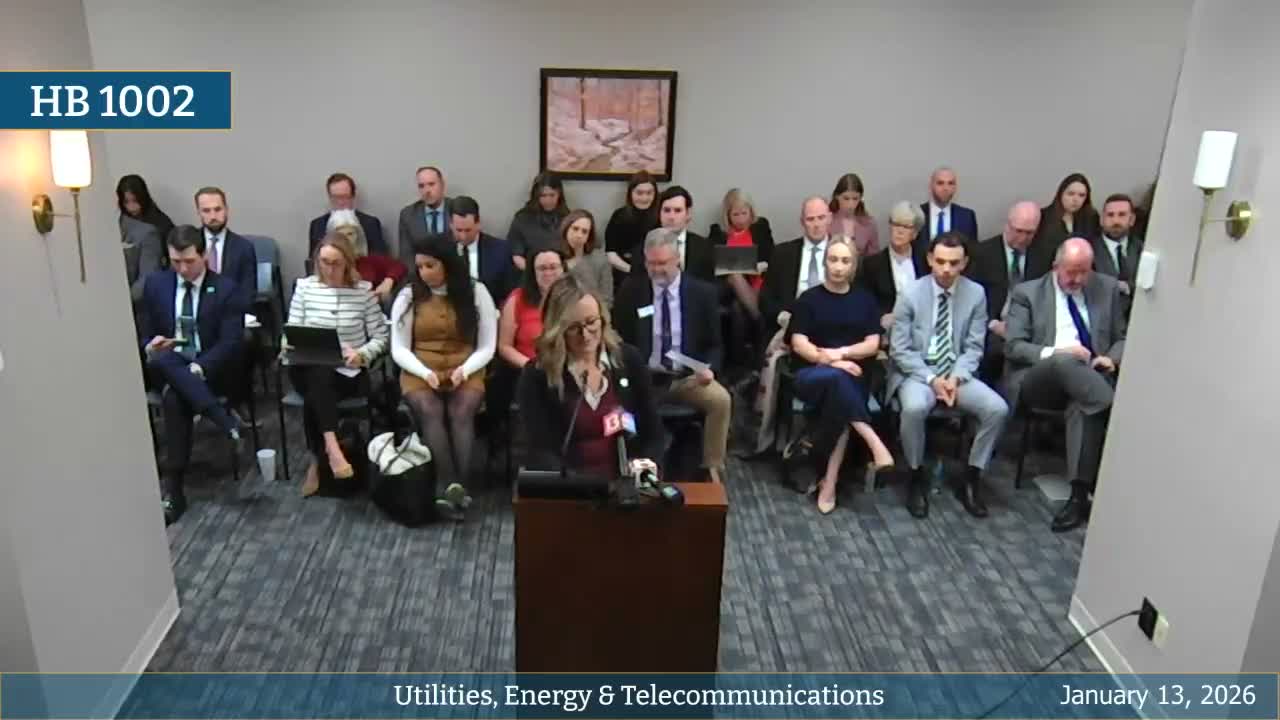
Lawmakers, utility representatives and consumer advocates spent more than two hours on Tuesday debating House Bill 1002, a measure that would let investor‑owned electric utilities file three‑year multiyear rate plans and bind payouts or penalties to a small set of performance incentive metrics while adding new consumer protections.
"This legislation is the direct outgrowth of that work," the bill sponsor, Representative Schonk Wyler, told the committee as she described the bill’s origin in an Indiana Utility Regulatory Commission (IURC) study of performance‑based ratemaking. She said the proposal seeks a "measured approach" that pairs multiyear planning with narrowly defined performance incentive mechanisms, preserves core IURC oversight and focuses on affordability, reliability and resilience.
The bill would require utilities under IURC jurisdiction to offer a low‑income customer assistance program by 07/01/2026 if one is not already in place and would expand protections against service termination during officially declared extreme heat events for customers who are eligible for and have applied to the state’s Low‑Income Home Energy Assistance Program (LIHEAP). Representative Schonk Wyler also described an automatic budget‑billing requirement with an opt‑out and a requirement that utilities perform reconciliations at least twice per year to reduce large, surprise true‑ups.
"This legislation is not necessarily fully baked, and it is imperative that we continue to hear feedback from Hoosier ratepayers, consumer advocates, and energy experts," the sponsor said, inviting revisions and public input as the bill advances.
Supporters and neutral witnesses said the bill advances important goals but urged clarifications. Olivia Smith of the Indiana Community Action Poverty Institute said the measure aligns with research showing utility bills are a mounting hardship for many households, but urged changing the bill’s "at least two" true‑up cadence to "no more than two" reconciliations per year and asked for a clearer heat‑event trigger that protects households during sustained high‑temperature stretches rather than relying on rare National Weather Service extreme‑heat declarations.
Carol Auslander of Advanced Energy United urged adding a peak‑load reduction performance metric and making the basis‑point rewards and penalties larger or tiered to better motivate utilities. Sam Carpenter of the Hoosier Environmental Council recommended additional metrics tied to distributed energy resources and clearer rules about how multi‑year plans will interact with existing trackers such as TDSIC/TDISC.
Utilities and some industry groups urged technical fixes and pushed back on parts of the funding design. Danielle McGrath, president of the Indiana Energy Association, said the association opposes the bill’s current language on procedural and technical grounds and cautioned against using recovered "lost revenue" as the primary funding mechanism without safeguards because that amount varies by utility and year. She said mandatory statewide budget billing could create administrative complexity and argued it might be better targeted to LIHEAP‑eligible customers.
Multiple witnesses — including Kerwin Olsen of the Citizens Action Coalition and Joseph Rumpala of Indiana Industrial Energy Consumers — asked for clearer filing requirements for multiyear plans so the Commission and intervenors receive the same level of information as in a traditional base rate case, and they warned that carving trackers out of the multiyear plan without careful integration could hide significant costs.
Representatives on the committee pressed the sponsor on implementation details: whether utilities should design low‑income programs or whether the IURC should approve program design; whether a National Weather Service extreme‑heat warning is the right operational trigger for a disconnection moratorium; how "normalized" performance metrics will be defined; and whether the bill provides enough detail in an initial multiyear‑plan filing for stakeholders to evaluate projected costs and returns.
Luke Wilson, the administration’s chief policy official on energy, urged support for the bill, saying multiyear plans and PIMs could reduce the need for frequent base rate cases and that redirecting recovered lost revenue could yield an estimated $30 million annually for low‑income households (an administration estimate provided at the hearing).
No votes were taken. Chair identified procedural deadlines at the start of the hearing: amendments must be filed by 10:30 a.m. Monday and the committee will reconvene for an amend‑and‑vote session next Tuesday at 10:30 a.m. The committee limited public testimony to four minutes per witness during the hearing.