Get Full Government Meeting Transcripts, Videos, & Alerts Forever!
Get email alerts on the Veterans Affairs And Public Safety topic
No spam. Unsubscribe anytime.
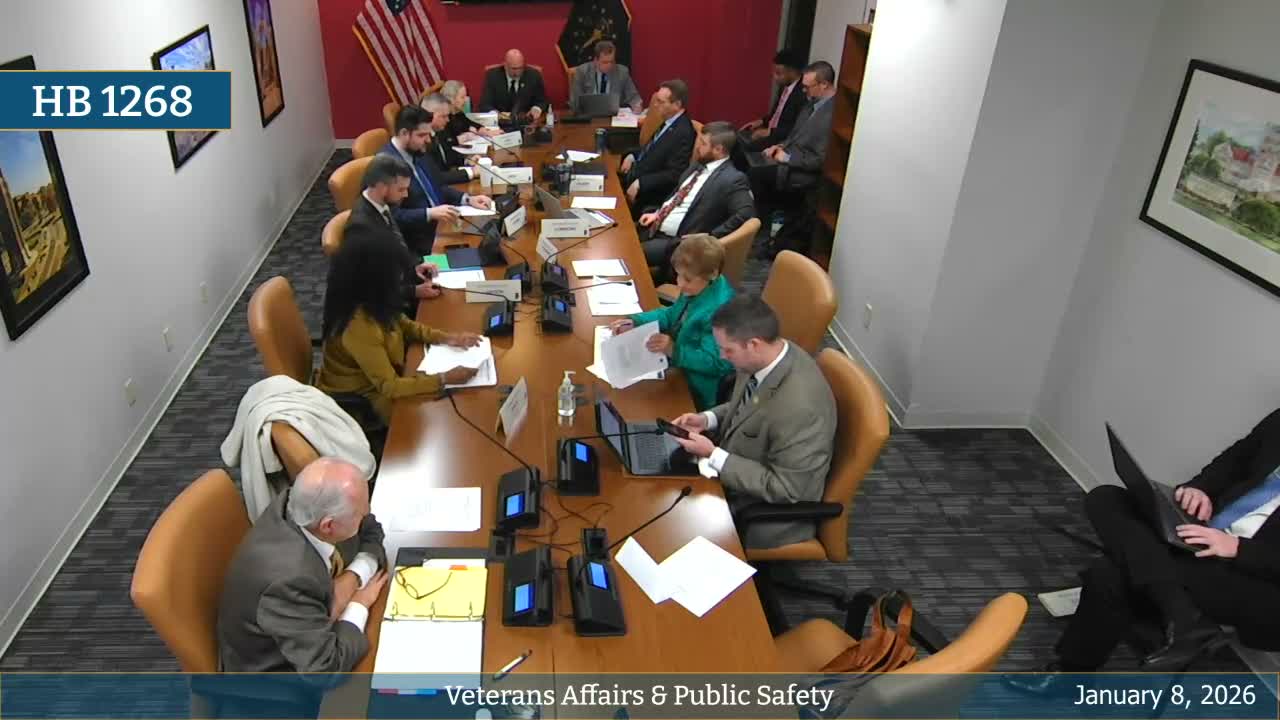
Panel advances broad Veterans Affairs and Public Safety bill after lengthy debate over Guard powers and veteran-benefit rules
Summary
House Bill 1343 would update Indiana National Guard code, create an Indiana Civilian Cyber Corps, grant limited law-enforcement authority to trained Guardsmen on state active duty, and revise the Military Family Relief Fund; testimony praised cyber and readiness steps while some veterans groups warned proposed veteran-definition changes and income limits could exclude eligible veterans.
Representative Steve Bartels presented House Bill 1343, a multipart bill that updates Indiana National Guard code, establishes the Indiana Civilian Cyber Corps, clarifies law-enforcement authority for trained military police when on state active duty, modernizes several military-benefit provisions and updates natural-resources language to align with U.S. Coast Guard requirements.
Major General Larry Munich, Indiana’s adjutant general, told the committee the bill focuses on three National Guard priorities: expediting authorities for a small subset of Guardsmen who are trained as military police so they can support civilian law enforcement when ordered to state active duty; creating the Indiana Civilian Cyber Corps to harness volunteer cyber talent to protect critical infrastructure; and updating outdated portions of the Guard code around appointments and property management.
"This bill expedites situational authorities to military police to carry a firearm, exercise police powers, or make an arrest," Munich said, adding the authority would apply only to troops with specific military-police training and only when ordered to state active duty by the governor.
Supporters called the cyber-corps and Guard updates timely. Several public-safety organizations, the Veteran's organizations umbrella (Big 4), and the Indiana Sheriffs Association expressed support for elements of the bill, including expanded capacity to respond to large incidents and the added training language.
At the same time, speakers raised substantive concerns about other parts of the bill. Jim Byerly, representing the Military Veterans Coalition of Indiana, said the bill's statutory definition of "veteran" differs from the federal definition in 38 U.S. Code and could exclude veterans who received certain discharges after court-martial proceedings; he urged the committee to rework that language and suggested lengthening the appeal window for Military Family Relief Fund denials from 30 days to 60 days.
"This definition in the bill differs from the federal definition... we are excluding men and women who've served in our military who may have actually been court-martialed and found innocent," Byerly told the committee.
Lisa Wilkin, an Air Force veteran and longtime advocate, warned against codifying a 200% of poverty income limit for the Military Family Relief Fund in statute because doing so would make future adjustments harder and could bar working veterans who experience sudden hardship. She described cases in which bank-account activity was used to deny applicants and urged a cautious approach.
Director Jake Adams of the Indiana Department of Veterans Affairs said the bill aligns definitions across agencies, will require more frequent reporting on the Military Family Relief Fund, and preserves a commission authority to waive income requirements for deserving applicants. He described the commission process and said quarterly reporting would improve transparency and stewardship.
On the law-enforcement authority for National Guard military police, members questioned command structure, the scope of training and whether additional statutory guardrails were needed. Munich and supporters said the authorities would be limited to trained MPs, used when the governor orders state active duty, and accompanied by training verified by the adjutant general and reviewed by the superintendent of state police.
After extended questioning and debate, the committee voted and the bill was recorded as passed (9–3). The committee also discussed next steps to refine training requirements and implementation details.